

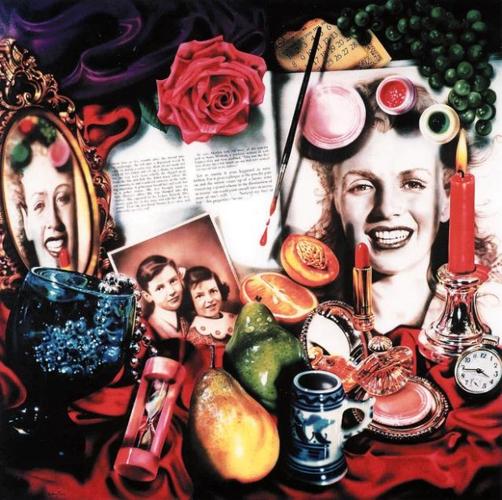
The work: "Marilyn" by Audrey Flack, 1977, oil over acrylic on canvas
The basics: Flack was part of the photorealism movement, predated by the minimalism and abstract-expressionism movements that had been getting away from realism. The pendulum swung back again with photorealism. Much of the work remained neutral, capturing what the gas station across the street looked like, for example, but Flack embraced sentiment and emotion in her work.
1. Space distortions. This piece alludes to traditional still lifes. But look closer. The paintbrush is hovering. The lipstick is floating. Makeup pots somehow manage to not slide off the book. Lisa Hastreiter-Lamb, UA Museum of Art curator of education, said the distortions might be symbolic of how the media can distort reality.
2. Symbols. The passage of time is a big one here, with a candle burning down, an hourglass, a rose in full bloom, a peach starting to rot, a still-green pear juxtaposed against one that's fully ripe. Taken together, they explore the fleeting quality of youth and beauty.
People are also reading…
3. Color. The canvas is super-saturated with rich hues. "She's using the glitz to enhance the sumptuousness of the scene and make it extra appealing, the way television does when it covers the lives of the rich and famous," Hastreiter-Lamb said.
4. Light. "I tend to have a more intellectual engagement with this painting than with the other one," freelance curator Joanne Stuhr said. "It's a technically complicated work of art." It isn't so easy to paint that mirror, with its distorted reflection, or place so many objects on different planes. And she has successfully captured light - look at how the shadows fall to imagine where the light sources are coming from.
5. Movement. There's a steady rhythm in the placement of objects, and they successfully lead you through the painting.
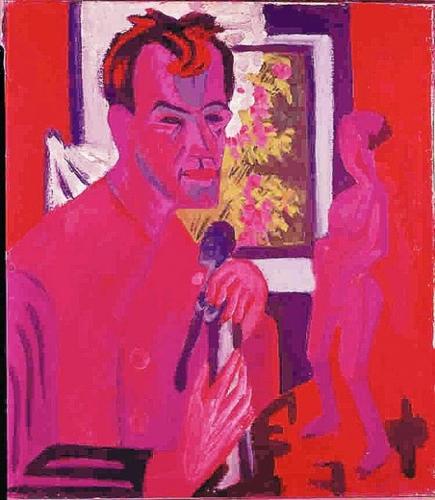
The work: "Portrait of the Sculptor, Scherer" by German expressionist painter Ernest Ludwig Kirchner, 1923, oil on canvas
The basics: Germany, recovering from World War I, was facing poverty and class struggles. And note that expressionists were less focused on re-creating the world as they saw it, and more interested in capturing emotional states.
1. Color. The canvas is awash in acidic red and purple. "The artist is lashing out with color. Imagine how different this piece would be in pale pink and pastel yellow," Lisa Hastreiter-Lamb, curator of education for the UA Museum of Art, said. In other words, he's trying to get to you. Did it work?
2. Space. It's flattened. There's confusion, as if the artist is responding to chaos in the world. It's hard to discern if that's a window with a drawn curtain in the background or a drape falling away from a painting in his studio. Because of distortions, you don't know if that's a model or another sculpture in the background.
3. Lines. They're not curving and flowing, which would smooth it out. Instead, they're sharp and angular - note the slope of the shoulders, the angles of the nose - which gives a harsh feeling to the work.
4. Texture. The brush strokes stand out. He captures the slashing action of putting the paint on the canvas. And there's an honesty to it - almost an acknowledgment that this is paint on a surface and not an attempt to truly represent a scene.
5. Movement. "This is not a static work," freelance curator Joanne Stuhr said. The artist leads the eye through the entire painting. The red stripes on either side lead the eye vertically through the painting, as does the upward angle of the arm and the figure in the background.
6. Emotion. "My initial response is that it's startling and jarring and it makes me a little agitated," Stuhr said. "But then you look at his expression and it's fairly peaceful, almost beatific, and the way he's holding the piece of sculpture is almost like a caress."
There's a tenderness to it that Stuhr doesn't see at first glance.
"That's what's exciting to me- that there's room for interpretation. There's a personal experience, even a relationship, that develops and that's different than how anyone else will respond to it."


