

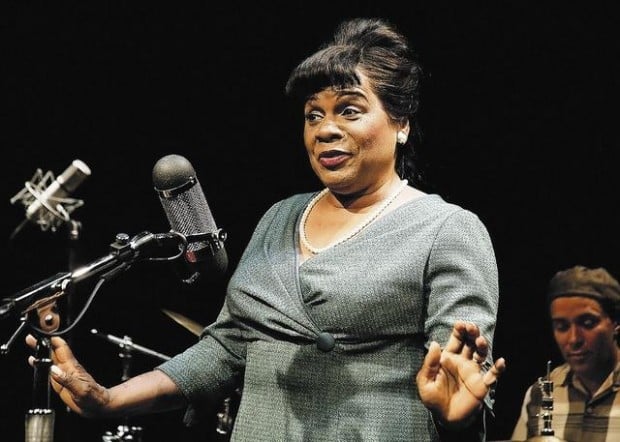
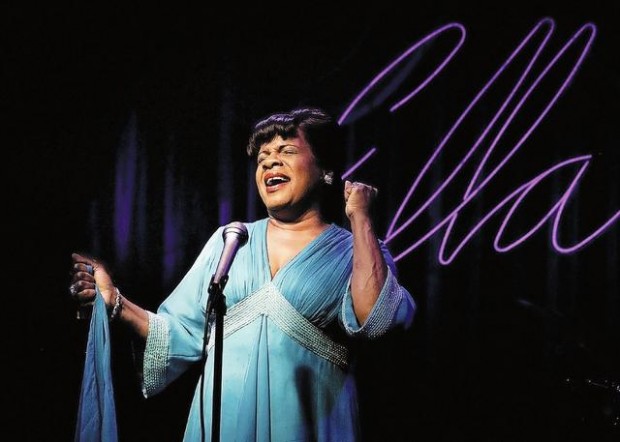
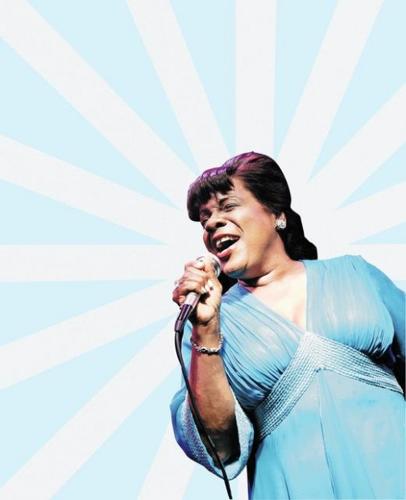
Tina Fabrique is living a dream.
She's acting, singing and resurrecting the spirit of a performer she has looked up to and loved much of her life: Ella Fitzgerald.
Fabrique stars in Arizona Theatre Company's "Ella," a bio-play about the legendary singer with stories from her life mixed in with a CD's worth of songs Fitzgerald gave distinction to. It opens in previews on Saturday.
For many, Fitzgerald defined jazz singing in the last century. Ira Gershwin, who defined "jazz-era songwriter" with his brother, George, once said, "I never knew how good our songs were until Ella sang them."
In her 50-plus years of recording, she won 13 Grammy awards and was presented the National Medal of Arts by President Ronald Reagan and the Presidential Medal of Freedom by President George H.W. Bush. Fitzgerald was 79 years old when she died in 1996, leaving behind a body of work that Tony Bennett declared "would live forever."
People are also reading…
And she could scat like nobody's business.
Fabrique, who has been travelling with "Ella" since last year, talks about stepping into the shoes of a legend, her favorite Fitzgerald songs and scatting a tune or two of her own.
When did you first hear an Ella Fitzgerald song?
My mother, a classically trained pianist, played a lot of Ella around the house. And she took me to see her when I was about 12. When I saw her, I thought, "How long did she rehearse to get that scat?" I didn't know it was improvised.
Have you a favorite Fitzgerald tune?
I have a couple of favorites. One of her songs I had done, "Something to Live For," wasn't real well known. I was in the car with director Rob Ruggiero talking about the project one day, and I told him about it, and sang it for him a capella, and he loved it, too, and it went in the show. The song is so wonderful and unfolds in such an emotional, wonderful way. That's always been a favorite, but knowing I came up with it and it's in the show. . . .
And I really love "Flying Home." Ella took it and recorded it as a scat solo. To me, that's the epitome of wonderfulness.
Speaking of scat . . . did you learn it for this show?
I've been scatting all my career. I was recommended for this job because of my scat. I can scat off the top of my head.
Your career parallels Fitzgerald's in that you, too, won a contest at Harlem's Apollo when you were 16. . . .
At the Apollo, there's a room with a wall that was signed by the stars who performed there. When I sang on amateur night, I saw Ella's signature on the wall. I was a big fan of the Apollo, and to know she really made her start there was amazing to me.
You are filling some huge vocal chops. Are you ever intimidated?
I feel honored to do this role, but I don't think anything happens totally by chance. I have a great faith base. I believe God has guided my entire career. I've had moments where I could have been intimidated, but I think God gave me a gift, so I just go for it.
What's the most surprising detail this play has revealed to you about Fitzgerald?
I think the abuse from her stepfather. I had absolutely no idea. I knew some facts about her, about her shyness. But I never knew about the abuse; how she had been damaged as a young woman and why she was living on the streets. It was because she was avoiding her stepfather.
You've been traveling with this show for a while now. How do you keep the material fresh?
It's no problem with this piece. With 26 songs and at least 10 monologues of varying lengths, there are new discoveries every day.
With jazz singers, improvisation is our way of life, so it's never the same.
Doing a project like this takes more than loving it; it's being able to express all these emotions. It's a journey every time.
What do you think Fitzgerald would think of this show?
I think Ella would be proud. The text gives you a real chunk of her, of her substance. I think she would have loved that.
In this day of instant fame and 14- and 15-year-olds winning multimillion-dollar contracts from shows like "American Idol," do you think Fitzgerald's style of singing, and her songs, are still relevant?
There are performers like Sting who have been around forever, who are now doing standards. They are doing the same songs she recorded. The music never goes out of style.
1917 — Born April 25, in Newport News, Va.
1932 — Her mother, Temperance, dies from injuries suffered in a car accident. Fitzgerald lives with her stepfather for a short time before she moves in with her aunt. After her stepfather dies, Ella's half-sister, Frances, joins her. Fitzgerald skips school, gets in trouble with the police and is sent to a reformatory, from which she escapes, and takes off on her own.
1934 — Fitzgerald wins the chance to compete in amateur night at the Apollo. She plans to dance, but once she sees the Edwards Sisters dance, she decides to sing. She sings Hoagy Carmichael's "Judy," one of her mother's favorites, and the audience demands an encore.
Saxophonist and arranger Benny Carter is in the audience that night, and he helps her launch her career.
1935 — While performing at the Harlem Opera House, she meets drummer and bandleader Chick Webb, who hires her.
1936 — Fitzgerald makes her first recording, "Love and Kisses," which meets with mild success.
1937 — Down Beat magazine names her Top Female Vocalist.
1938 — Fitzgerald records "A-Tisket, A-Tasket," and it soars to No. 1, making the singer famous.
1939 — Chick Webb dies, and the band is renamed "Ella Fitzgerald and her Famous Band." That same year, she marries dockworker Benny Kornegay, but the marriage is annulled within a year, after it's discovered he has a criminal record.
1942 — Fitzgerald leaves the band and starts a solo career.
1946 — Fitzgerald marries bassist Ray Brown while on tour with the Dizzy Gillespie band.
1952 — She and Brown divorce.
1955 — She leaves the Decca label and signs with Verve, and her golden era begins as she records the music of Cole Porter, Jerome Kern, Johnny Mercer and others.
1957 — Fitzgerald becomes the first black singer to sing at New York's famed Copacabana club.
1958 — She wins the first two of her 13 Grammys.
1961 — Fitzgerald sings at President John F. Kennedy's inaugural gala.
1966 — Fitzgerald's beloved sister Frances dies. The play "Ella" takes place in this year, shortly after the funeral, at a concert in France.
1985 — Fitzgerald performs in Tucson, winning four standing ovations.
1986 — She has open-heart surgery but continues to perform.
1990 — She receives the last of her Grammys, this for Best Female Jazz Vocal Performance.
1991 — She gives her final Carnegie Hall performance — the 26th time she performed there.
1993 — Diabetes leads to her having both legs amputated.
1996 — Fitzgerald dies on June 15 in Beverly Hills, Calif.
Sources: Associated Press, Arizona Daily Star archives, www.ellafitzgerald.com.
● When Ella Fitzgerald grabbed hold of a song, her rendition became the standard by which so many others were judged. Among those songs are these that will be in ATC's production of "Ella":
l "How High the Moon" (written by Nancy Hamilton and Morgan Lewis).
l "It Don't Mean a Thing (If It Ain't Got That Swing)" (Duke Ellington and Irving Mills).
l "Love and Kisses" (Sonny Curtis).
l "Judy" (Hoagy Carmichael and Samuel Lerner).
l "Cow Cow Boogie" (Benny Carter, Gene De Paul and Don Raye).
l "I'll Never Be the Same (Frank Signorelli, Gus Kahn and Matt Malneck).
l "You'll Have to Swing It (Mr. Paganini)" (Sam Coslow).
l "The Nearness of You" (Hoagy Carmichael and Ned Washington).
l "They Can't Take That Away From Me" (George Gershwin and Ira Gershwin).
l "Our Love Is Here to Stay" (George Gershwin and Ira Gershwin).
l "A-Tisket, A-Tasket" (Ella Fitzgerald and Van Alexander).
l "Flying Home" (Benny Goodman and Lionel Hampton)
l "Night and Day" (Cole Porter).
l "That Old Black Magic" (Johnny Mercer and Harold Arlen).
l "Lullaby of Birdland" (George Shearing and George David Weiss).
l 'S Wonderful (George Gershwin and Ira Gershwin).
l "Cheek to Cheek" (Irving Berlin).
l "Let's Call the Whole Thing Off" (George Gershwin and Ira Gershwin).
l "My Buddy" (Gus Kahn and Walter Donaldson).
l "Tenderly" (Jack Lawrence and Walter Gross).
l "The Man I Love" (George Gershwin and Ira Gershwin).
l "Something to Live For" (Duke Ellington and Billy Strayhorn).
l "Blue Skies" (Irving Berlin).
l "Oh, Lady Be Good" (George Gershwin and Ira Gershwin).
l The Apollo theme: "I May Be Wrong (But I Think You're Wonderful)" (Harry Ruskin and Henry Sullivan).


