

How's this for a goal — explore the history and processes of photographic art to examine the very nature of creativity.
It's no small task, yet the Center for Creative Photography achieved that ambitious aim in its current exhibition, "Making a Photograph: Iconic Images and Their Origins."
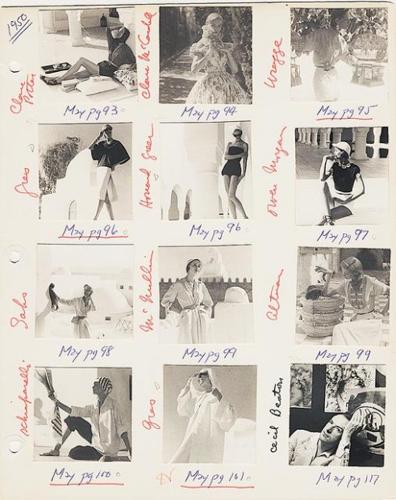
The informative display digs deep into the center's archives to pair famous images with their corresponding contact sheets and prints, tools, field notes and letters to show that each photograph was the end result of a process involving experimentation, determination and maybe a little luck.
Though the Center has more than 80,000 images in its archive, it was easy choosing the prints for the show, said Britt Salvesen, the Center's curator and interim director.
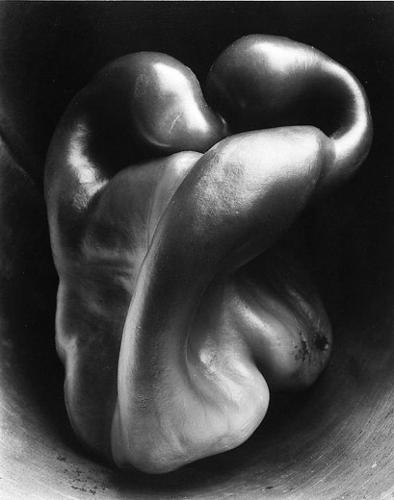
"We knew we would feature the Ansel Adams 'Moonrise' and the Edward Weston 'Pepper' because those have become really famous photographs as individual images," she explained. "But we wanted to show that they didn't just emerge fully formed from the head of the artist, that they required all this experimentation and work to achieve. It was our way of adding all these great footnotes to the history of photography as we know it."
People are also reading…
The show's title comes from Adams, who used it in a 1935 book outlining his belief that a photograph is crafted by an artist rather than recorded by a machine. Seeing several versions of his now iconic "Moonrise, Hernandez, New Mexico" confirms his conviction. Adams spent nearly 30 years turning the original negative, which a contact print shows to have wispy clouds in a gray sky, into a photograph that reflected his vision of a dark, cloudless sky with a piercing moon.
"It was not until the 1970s that I achieved a print equal to the original visualization that I still vividly recall," he wrote in his autobiography.
Adams' images are part of the In the Darkroom section, one of seven sections that constitute the exhibit.
"The sections came to my mind as a way of focusing on the bigger theme of creativity, which is so intangible," Salvesen said. "But I sensed that for photographers, that creativity could take place in a number of different ways, both physically and conceptually."
The other sections are In the Studio, In the Field, On the Wall, On the Page, In Dialogue and In the Archive. The viewers are, in a way, an unmarked eighth section of the exhibit.
"There's a process that happens after the object is created as well as one that leads up to it," the curator explained. "That's happening in our minds and our eyes and in textbooks and classrooms and so on. Those interpretations and projections really do contribute to how that object is seen and what role it has in history."
Though Weston intended his iconic "Pepper No. 30" to be purely about form — "abstract, in that it's completely outside subject matter. It has no psychological attributes, no human emotions are aroused," he wrote in a letter — society has long attributed a sexual quality to it.
The show — practically a who's who of photographic history — also includes iconic images and revealing source material by Richard Avedon, Wynn Bullock, Harry Callahan, Louise Dahl-Wolfe, Aaron Siskind, W. Eugene Smith and Garry Winogrand. The exhibit truly showcases the Center's extensive archives.
"The exhibition really includes a range of artists that in some ways represent our history," said Salvesen, who added that it ranges from the Center's founding archives — Adams, Callahan, Siskind and Bullock — to the newest acquisition — the Rosalind Solomon archive. "I was happy to be able to represent the growth of the collection over the years, which has been steady and diverse."
Preview
Making a Photograph: Iconic Images and Their Origins
• Where: Center for Creative Photography on the University of Arizona campus, 1030 N. Olive Road.
• Hours: 9 a.m.-5 p.m. Mondays–Fridays, noon-5 p.m. Saturdays and Sundays through Jan. 26. Closed Thanksgiving.
• Cost: Free and open to the public.
• Reception and artists' talk: Working Through Space and Time Equations: Collaborative Projects by Mark Klett and Byron Wolfe. 5:30–7:30 p.m. today.
• Information: www.creativephotography.org or 621-7968.


