

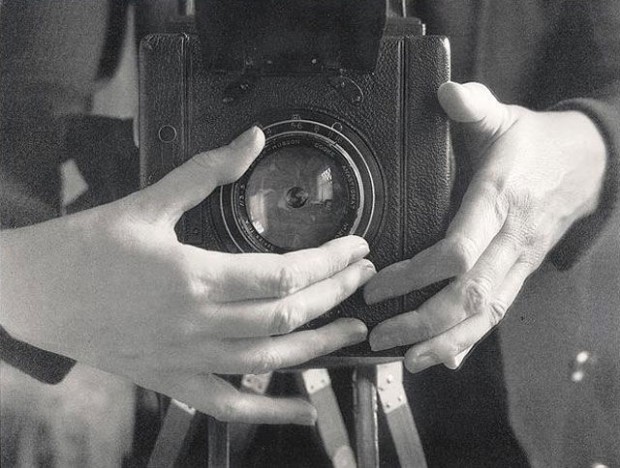
It is absolutely appropriate that the image chosen for the Center for Creative Photography's publicity for its current exhibition, "Debating Modern Photography: The Triumph of Group f/64," is Alma Lavenson's "Self Portrait (Hands.)"
It is a photograph of her camera anchored on its tripod, her hands placed around it in readiness to take a shot.
It is an unsentimental embrace of the camera.
This embrace is, essentially, the triumph referred to in the exhibition's name.
What photography was and what it might be characterizes the debate.
The exhibit was put together by Becky Senf, the CCP's assistant curator. She was interested in inviting us into the process of the evolution of artistic thinking. She also wanted to utilize the CCP's amazing resources.
People are also reading…
"I really wanted to draw people in to this exciting time, to allow them to become part of the debate, to understand the arguments of both sides, but on more neutral ground," she said.
"They then have the freedom to develop consciously their own opinions, to realize that viewers are part of the process. Something so rich and relevant needs the participation of the public. And, of course, these kinds of debates continue. They are part of art's evolution."
Today, the work of Group f/64 members hardly seems revolutionary. It's the work of the Pictorialists that is unfamiliar.
Pictorialists, in their effort to hide a straightforward photographic image, favored a narrow range of tones, with no deep blacks or bright highlights. Their photos have a soft, dreamlike quality. The focus is fuzzy. Portraits tend toward sentimentality or even the dramatic. The subjects, who are often costumed, are posed in deliberately designed scenes. Detail, clarity and crispness of form and background seem irrelevant.
To our contemporary eyes, what we experience with works by Johan Hagemeyer, Karl Struss and William Mortensen seem hardly photographic at all. That does not mean, however, that we are not intrigued, drawn in, even moved by them.
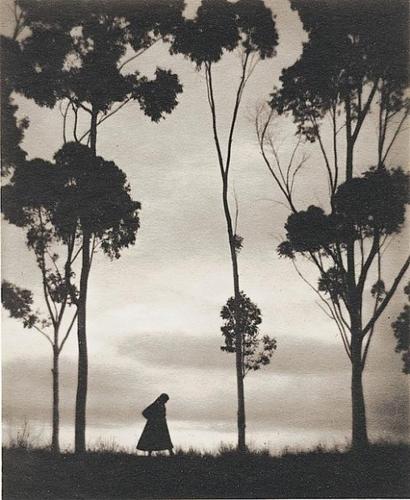
Struss' "Storm Clouds, La Mesa, California" (1921), is wonderfully evocative. Set against a background of a cloud-layered, unsettled sky, tall, thin-trunked trees tower over a small, dark figure cloaked in what appears to be a hooded garment. Making her way, head down, across the dark carpet of grass that anchors the image, she is small, solitary in her dark journey. The image is soft, hushed, tinged with mystery.
One of the joys of this exhibit is the opportunity to compare the earlier work of artists like Lavenson to their later modernist or purist work. Her "Starting Out" (1929) is a soft-focused view of a rowboat, crowded with four passengers, setting forth from a dock. The background has no clear demarcation of water or land. There is no horizon. These travelers are headed for somewhere undefined, ethereal, infinite.
Compare this to her "Turnips" in 1938. This subject is about as earthy as you can get and the image's detail is as crisp as a freshly harvested vegetable would be. The overall visual impact is so very different than in "Starting Out," but the evocative nature of the image is no less appealing.
Perhaps the most telling difference in the approaches of the Pictorialists and those who embraced the principles of Group f/64 is their portraiture work. Thanks to this exhibit, we not only get a chance to take in a variety of examples of portraits by both groups, we get to compare some "before-and-after" portraits by Edward Weston, who worked in both styles.
There is a series of three portraits of Margrethe Mather, Weston's muse and mentor, as well as his mistress. The characteristic Pictorialist style is evident in each portrait, soft focus, muted contrast, the eyes of Mather averted, not acknowledging the camera. In "Margrethe on Couch, Glendale Studio" (1922), most of the frame consists of a darkly textured, muted background. Mather is seen only in the lower left, in profile, her arm stretched and resting on the curve of the sofa's back. She wears a hat with a veil and her gaze extends beyond the frame.
Compare this to Weston's portrait of Sonya Noskowiak several years later. This shot is direct, informal, with little sense of being staged and no ostensible sense of drama. It appears Weston saw her curled on the couch, her arms propping her head on the sofa's arms, her wide-striped shirt offering contrast — as well as movement. She gazes directly at the lens. If there is a softness in her gaze, it appears to arise from Noskowiak herself, not prompted or manipulated by Weston.
The amazing array of Group f/64-influenced photos in this exhibit is a treasure. In contrast to the soft Pictorialists, these images pop with contrast, with detail, with form and graphic impact.
If the work of the Pictorialists results in a sense of something created, the work of Group f/64 suggests something being discovered.
These photographers unleashed the heart of the camera.
In a way, this heart seemed drawn to mundane matters: barn siding, architectural and industrial forms, coiled rope, milk bottles. Even the natural world seemed reinvented through the eyes of these artists and the camera's wide open lens.
The images are highly detailed but uncluttered. They have a compelling immediacy. And although the subjects are often found objects, within the frame we not only see them in new ways, we see through — or beyond — them as well.
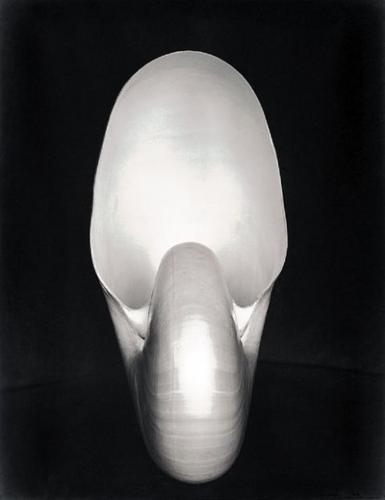
There are Ansel Adams' grand view of "The Golden Gate Before the Bridge" (1932) and the delicate but bold "Pine Branch, Snow, Yosemite" (1932). There are Edward Weston's intriguing "Pelican's Wing" (1932) and his seductive "Shell and Rock Formation" (1927).
Then there are the unique close-up observations of plants and flowers — cactus and aloe and succulents and buds and blossoms by Brett Weston, Noskowiak and others. These images of humble, simple objects, simultaneously detailed and sparse, slow us down, call us to a peaceful attentiveness.
It's tempting to speculate that the triumph of Group f/64 suggests the passage of a softer, more romantic sensibility in favor of the machine, of technology, of the industrial, of a more "straight on," unsentimental attitude that was both a product of and an influence on evolving social and cultural standards and practices.
What is certain is that in this CCP exhibit, we are witnesses to a moment when the photographic world was reckoning with what would become a seismic shift. We witness with intrigue the evidence propelling such a dynamic debate.
And we see the triumph of this experiment with what might happen when the camera's unique potential is fearlessly embraced by those who are willing to risk a new vision.
It is an embrace not only of a different way of thinking or working, it is an enfolding that has subsequently allowed us to embrace our world in new ways.
Early in the last century, the art world didn't quite know what to make of this image-making contraption, the camera.
That it could do amazing things and that it might be useful in the artistic process was clear enough. But there was a fundamental problem: The camera was a machine, and machines and art are a suspect combination.
American art photographers responded to this issue by creating works that, through various types of manipulations, were made to look like paintings or drawings. They were "Pictorialists."
Then, in the late 1920s and early '30s, there was a group of respected photographers, many of whom practiced the Pictorialist style, who began to think there might be another way of approaching photography, a way of utilizing the unique properties of the camera to create images that couldn't be produced in any other way.
They favored using the f/64 aperture lens setting, the one that provided the greatest depth of field, the most detail, the sharpest focus. They used large-format cameras and made contact prints on glossy gelatin silver paper.
This was revolutionary.
In late 1932, in San Francisco, a group of these photographers — Group f/64 — held its first exhibition at the de Young Memorial Museum. The show included work by group members Ansel Adams, Edward Weston, Willard Van Dyke, Sonya Noskowiak, and Imogen Cunningham, along with four other compatibly aligned photographers, including Alma Lavenson and Brett Weston.
The debate was on.
This new way of thinking about photography, and the works that resulted, were to become the aesthetic that informed photography for the rest of the century — and beyond.
— Sherilyn Forrester
Review
"Debating Modern Photography: The Triumph of Group f/64."
• Where: Center for Creative Photography, East Speedway and North Park Avenue in the University of Arizona Fine Arts Complex.
• When: 9 a.m.-5 p.m. Mondays through Fridays; noon-5 p.m. Saturdays and Sundays. Show continues through May 4.
• Cost: Free.
• Information: 621-7968.
• Et cetera: The show's curator, Becky Senf, will discuss the exhibition at 5:30 p.m. Thursday.


