

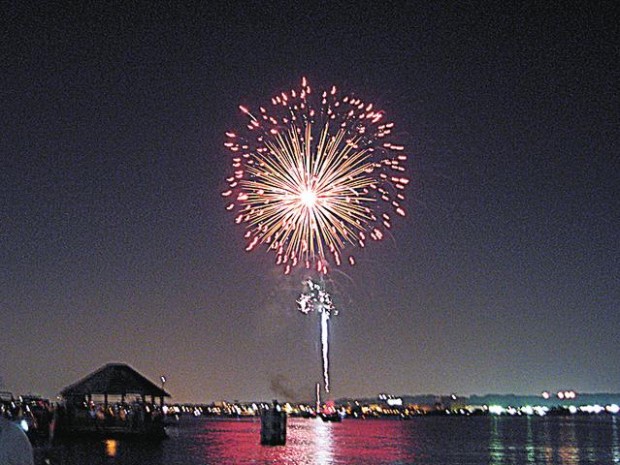
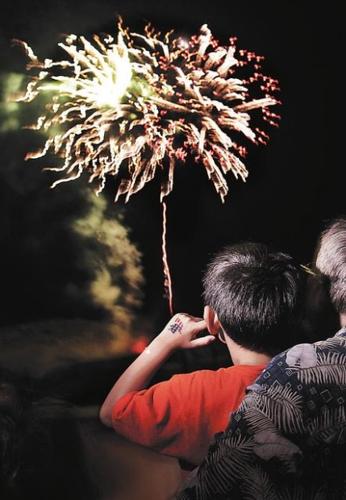
Fireworks shows are dazzling spectacles of stunning visuals and percussive sound. There's the pop of the launch, the boom of the explosion and the crowd's appreciative oohs and aahs. Often there's also the rapid-fire click-click-click of camera shutters trying to capture the brilliant yet fleeting light show.
While the actual fireworks last only a few moments, great pictures of the annual Independence Day pyrotechnics can last forever — if you can snap a quality picture, that is.
"Fireworks are very difficult to capture," said Jim Michael, vice president of the 786-member Green Valley Camera Club. "If you get a good shot, you're lucky."
It's exactly that challenge that drives Scott Weisman, the studio technician for the University of Arizona photography program and a self-described die-hard fireworks photographer.
People are also reading…
"Most people have high expectations, and when they look at the images later, it's a big letdown," he said. "It looks like paint running off the page."
To help prevent disappointment this Fourth of July, we asked local photographers for advice about how to capture great photos of fireworks. We learned some general tips that may help everyone, from committed shutterbugs with single lens reflex (SLR) cameras to scrapbookers just snapping point-and-shoots for fun.
We also learned that there's no surefire solution to getting a perfect shot. Cameras and situations can vary widely, so you may have to experiment. The best thing to do is to start tonight, said extreme-weather photojournalist Warren Faidley.
In preparation for Wednesday's fireworks, Faidley recommends that people familiarize themselves with their cameras by reading the manual and taking some night photographs.
But while the challenge may be part of the allure, photographing fireworks shouldn't take precedence over enjoying them.
"I've shot a lot of fireworks, and it's really difficult," admitted the storm chaser. "Sometimes it's better to sit and watch the fireworks rather than try to shoot them."
Weisman agreed that seeking the thrill of the catch shouldn't prevent a shooter from enjoying Fourth of July festivities.
"The wonderful thing about fireworks," he pointed out, "is the memories we associate with them."
* The accompanying photo tips were compiled from interviews with Arizona Daily Star Photo Editor Rick Wiley; extreme-weather photojournalist Warren Faidley; Scott Weisman, the studio technician for the UA photography program; Fred Hood, a Jones Photo sales associate and photo instructor; and Jim Michael, vice president of the Green Valley Camera Club.
Just point and shoot, right?
• Try using the "fireworks" setting, if you have it, or use the "landscape" mode — both will leave the shutter open longer and allow for better firework trails.
• Turn off the flash — you won't need it, and it wears down the battery.
• Allow the autofocus to lock onto a burst by pressing the shutter halfway down — but don't take the picture. Continue engaging the focus until the next burst, at which time you should be able to snap a focused picture without much lag time.
Location, location, location
• Think about where you can get a great shot — it's not necessarily closest to the fireworks launch point. For the most impact, find a location where the bursting fireworks will almost fill your frame.
Stillness required
• Your shots will require long exposures, so you'll need to use a tripod or prop your camera on a solid surface (not your vehicle — that can actually move quite a bit) and use a beanbag or other soft object to position it.
• If you must hold the camera, look through the viewfinder (rather than at the LCD screen) and use both hands while bracing the camera against your forehead.
• Snap pictures without touching the camera by using a cable release or electric remote control.
Techie SLR setup
• Set your camera to manual.
• There are two schools of thought when it comes to choosing an ISO speed. A fast ISO (and corresponding film speed if you're using film), such as 800, will result in shorter shutter speeds but more film grain or pixilated "noise" in digital files. A slow ISO, such as 100, will require longer exposures but may result in larger firework trails and richer colors.
• Open the aperture to f/5.6 or f/8.
• Focus on infinity or use the trick mentioned above in the point-and-shoot section to outsmart autofocus.
• For white balance, pick "automatic" or "daylight."
• Use the B (bulb) setting, if you have it, to open the shutter, and leave it open as long as you'd like (but no more than 10-15 seconds). If you want to layer multiple bursts on one frame, use the multiple-exposure mode or simply cover the lens between bursts.
• If your camera is overexposing, try setting your exposure compensation to -1 or -1.5, or set your camera to center-weighted metering.
Reminders for a successful shoot
• Bring additional batteries.
• Bring additional memory cards or film.
• The fireworks show builds to a grand finale, so save some film or room on your memory card to capture the best part of the show.
• Shooting fireworks is all about patience. Be ready for the unexpected.
Share your fireworks photographs by visiting go.azstarnet.com/fireworks and uploading your pictures into our reader-submitted photo gallery. Feel free to add information about how you captured your great shots.


