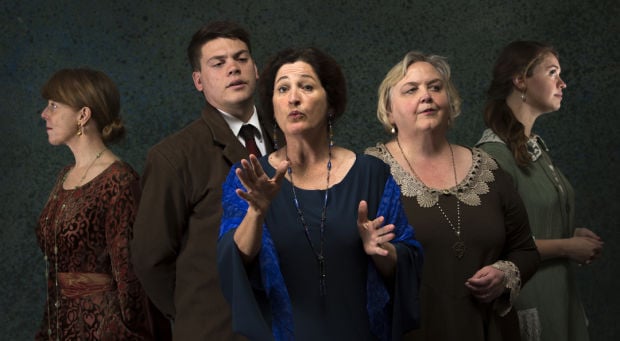
No, the Rogue Theatre is not afraid of Virginia Woolf.
The company opens “The Lady in the Looking Glass” this weekend. It is an adaptation of seven of Woolf’s short stories.
That is easier said than done: Woolf wrote of interior landscapes, often employed stream of consciousness, and the stories selected don’t always have dramatic arcs.
But Cynthia Meier, who adapted the stories for the stage, was able to see beyond all that.
“We are calling it a concert,” says Meier, co-founder of The Rogue and one of the performers in the suite of stories.
“It’s seven vignettes. They are monologues that other characters come into.”
The stories: This theatrical piece is made up of
People are also reading…
- “Monday or Tuesday,” published in 1921, is reflections on a day, which includes a search for meaning.
- “The Searchlight,” 1943, about an elderly woman and the strange story she tells about her great-great-great grandfather.
- “The Lady in the Looking Glass,” 1929, in which a woman looks into a mirror in a friend’s home and through the scene in the reflection tries to uncover the essence, the truth, of her friend.
- “Slater’s Pins Have No Point,” 1928, is about a young woman who muses about her older, unmarried piano teacher’s life.
- “The Mark on the Wall,” 1921, is a kaleidoscopic reflection on a life, launched by a fixed mark on the wall.
- “The New Dress,” 1927, is about a woman who is filled with doubt and self-consciousness as she shows up to a party in what she quickly realizes was not the right dress to wear.
- “The Duchess and the Jeweler,” 1938, centers on a once-poor man who has become London’s most successful jeweler and an in-debt duchess who wants him to buy some pearls, which he doubts are authentic.
Why these seven: The short stories all have self-reflection at the center, says Meier. “The metaphor that’s in all of them is the looking glass,” she says. “Each has moments of references to a looking glass, which is a looking inward. That is what Woolf does and why she was such a radical new writer. She wrote about interior landscapes. … It’s the life of the mind.”
About that stream of consciousness: The style of writing — where the thoughts flow together without interruption of punctuation in an effort to reflect how an interior dialogue would run together — can be tough to read. But not to hear, says Meier. “Stream of consciousness comes to life when you hear it,” says Meier. “That’s another reason it’s great to hear (these stories) out loud.”
Woman to women: Woolf became a go-to writer when the feminist movement took off in the 1970s. “She speaks of what’s going on inside a lot of women,” says Meier. “The things she’s writing about are very relevant to women’s concerns and issues. So I think men and women will find it interesting to hear her writing, and think about how it reflects on their life now. … I think it’s a really interesting perspective into this woman’s mind, which in many ways is many women’s mind; there’s an everywoman experience/perspective about it.”
Why you want to go: “To hear one of the greatest writers of the English language,” says Meier. “When it comes to lyrical prose, she’s the top.”