

In Agua Prieta, everyone knows what it means to live south of the carretera, or highway. The people there are poor, often without reliable electricity or running water.
But tucked between rows of rough adobe brick homes is a lush garden where local women cultivate organic produce with rainwater they collect in blue plastic cisterns. Thick stocks of corn sprout in ditches along the edge of the property and wildflowers push through spare cracks in the dirt.
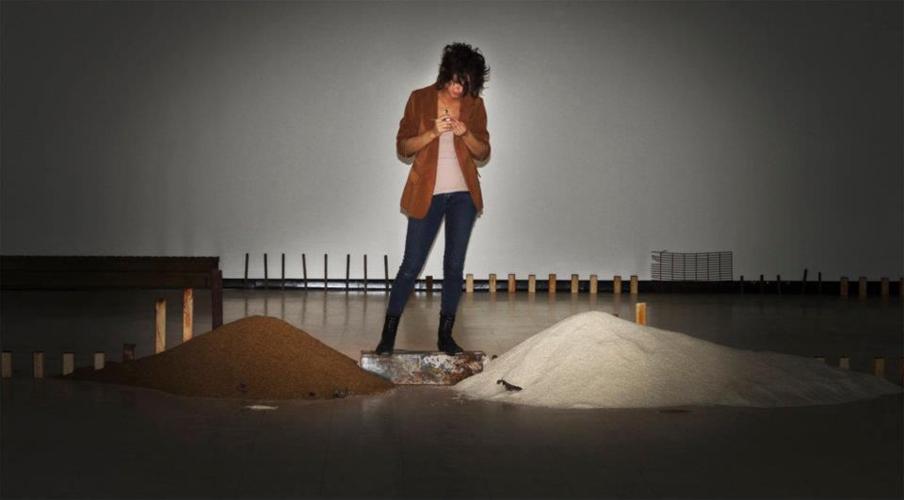
“My children call it the secret garden,” says Jenea Sánchez, an artist and educator who lives across the border in Douglas.
This place, and the women who tend it, are the subject of Sánchez’s most recent endeavor as an art activist: a photo series capturing the beauty and power of entrepreneurs.
Border Culture
People are also reading…
Sánchez grew up in the borderlands like her mother and father, and her grandparents before them. Born in Douglas, she and her brother spent half of their childhood in Agua Prieta, crossing the line each day going for school.
“We’re not from anywhere,” she says. “We’re just from this border region.”
That’s a common story in border towns, where culture, identity and community defy national boundaries. People here can “act” American or Mexican depending on what the situation calls for, she says. But living on the fringes of each country, they don’t fully fit into either one.
That duality engenders open-mindedness and empathy, she says. Migration, family separation, third-world poverty and crossing the border for work, shopping or school are often abstract concepts for people in the interior of the country. Here, they are daily experiences.
“When I was a kid I remember we would cross sometimes three times a day,” she says.
Where today stands a 20-foot steel fence, in some places bolstered by a second screen of metal mesh and coiled barbed wire, Sánchez remembers how she and her cousins would run to each other’s homes as children, across what they saw as nothing more than a backyard fence.
“Talking to other adults here in town, we all have similar stories of these ‘illegal crossings’ that we used to do as children,” she says.
When she moved to Phoenix to study art at Arizona State University in 2003, she realized that most people saw the borderlands in a different light. Conversations about the U.S.-Mexico border regularly focused on violence, militarization and smuggling of humans and drugs.
“It became more of my mission to represent the border as I know it,” she says.
She turned to her art to spread that message.
Art Activism
Expressing herself with words didn’t come naturally to Sánchez. From a young age she turned to drawing, painting, photography and video.
“I heard the term in contemporary art that it’s our job to be ‘cultural watchdogs,’ and that always stuck with me,” she says. “When you see something or you feel something or you witness something, it’s our responsibility to express it creatively.”
She started to create art based on cultural symbols from the borderlands such as La Llorona, the mythical Weeping Woman, and Lucha Libre, Mexican professional wrestling. She collaborated with fellow artist Gabriela Muñoz to create an image of la Virgin de Guadalupe on the border fence on paper they made from plants that grow in the shadow of the wall.
In a piece called Border Tapestry, she wove together fabrics representing herself, her mother and her grandmother through the bars of the border fence — a metaphor for the enduring connection between these women whose lives have transcended the barrier.
“The goal is to talk about truth. To expose bits and pieces of truth. To create a pathway to truth,” she says.
For her, that means exposing the diversity, nuance and beauty of the borderlands.
Women’s stories
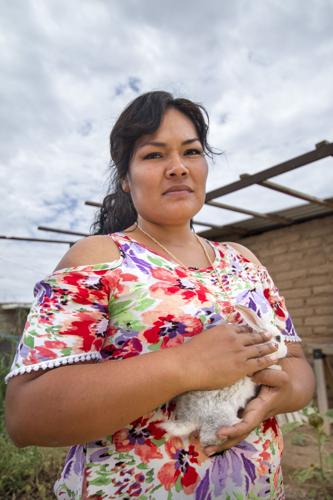
The women of the DouglaPrieta are strong, powerful and ingenuitive, and that is how Sánchez portrays them in her photographs.
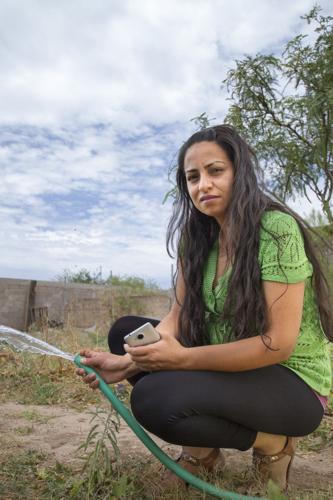
In one, a woman named Maty is crouched in the garden, a garden hose in one hand, a cell phone in the other, one eyebrow slightly lifted and half a smile on her lips, as though she’s sizing you up.
In an area where electric power lines were brought in less than a year ago and the only running water is rainwater harvested in their cooperative, this group of 12 has created a small paradise in one of the poorest neighborhoods in Agua Prieta.
Shucking conventional ideas about what they should do and how they should live, they use sustainable practices to grow organic produce, raise chickens and rabbits, and sell hand-sewn clothing, bags and embroidery.
When Sánchez was asked to paint a mural at DouglaPrieta, she was in awe of the women’s strength, resourcefulness, generosity and spirit.
“That’s something I wanted to shine a really bright light on,” she says.
She is working with the women on a how-to book, “The Mexican Woman’s Post Apocalyptic Survival Guide in the Southwest: Food, Clothing, Shelter y La Migra,” which shares strategies that have helped them turn this dusty, impoverished area into a verdant and producing garden.
Women of color are rarely represented as experts and innovators, Sánchez says. Through her art, she is working to complicate the narrative of womanhood and femininity in the borderlands.
Binational and beyond
In Douglas, wide, rusty-brown steel bars rise 20 feet above the ground.
On the other side, in Agua Prieta, the community has taken it upon itself to improve the view, painting large swaths of the metal barrier with images of unity and freedom.
“We’ve put up geese, monarch butterflies, clasped hands that look like they’re reaching across the wall, as though they weren’t divided,” says Laura Rios, the director of civic and cultural development in Agua Prieta.
The murals can only be painted on the south side of the fence, where the city of Agua Prieta is actively beautifying the area adjacent to the wall. North of the border, the fence is patrolled by federal agents and marked with signs telling passersby not to trespass.
Artists and community organizers in Douglas-Agua Prieta are partnering to create binational events and art projects, jointly working on murals, concerts, performances and vigils on both sides of the border.
Sánchez and her husband Robert Uribe, elected mayor of Douglas earlier this year, spearhead a group called the Border Arts Corridor, hosting visiting artists and public conversations and creating a binational art walk.
These intercity collaborations are picking up creative momentum, using art to strengthen the connection between the two cities in spite of the fence, Sánchez says.
Whatever form that takes, she’ll be part of it.
“Whether those forms of expression will be art or writing or video making, I’m not sure yet,” she says. “But I know I’ll continue doing what I’m doing.”


