

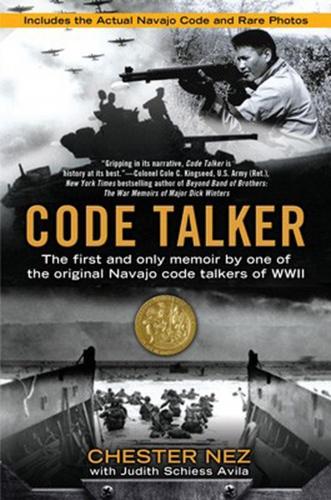

"Code Talker: The First and Only Memoir by One of the Original Navajo Code Talkers of WWII"
By Chester Nez with Judith Schiess Avila
You don't need to be a fan of World War II literature to appreciate this memoir by Chester Nez and his co-author, Judith Schiess Avila, a code-talker scholar.
"Code Talker" is a fascinating melange of combat in the Pacific theater, the history of the Navajo people and the development of a uniquely American code that remained unbroken by the Japanese throughout the war and classified until 1968.
Nez tells the story of his childhood in the "checkerboard" area of the American Southwest and his education in the late 1920s at a boarding school in Arizona where he and other American Indian children were assigned new names and were taught to speak, read and write English. It was torturous at the time but, much later, Nez realizes the experience helped make him one of the indispensable original 29 code talkers.
People are also reading…
Nez switches seamlessly between stories about his traditional upbringing - without electricity or indoor plumbing - and his service in the U.S. Marine Corps. He effortlessly peppers his tales with insights into Navajo culture. The only flaw of "Code Talker" is the jarring overuse of footnotes. In what seems like an attempt to validate even the most mundane facts, including the years that Pabst Blue Ribbon and Budweiser were introduced, they provide an unnecessary distraction.
"Yankee Doodle Dixie"
By Lisa Patton
Leelee Satterfield moves back to Memphis in this second novel by Lisa Patton about her redheaded heroine.
After a trek to Vermont turned frigid in "Whistlin' Dixie in a Nor'easter," Leelee looks to her hometown for support - and, hey, maybe a good man to replace her long-gone, loser husband, who stayed in the snows of New England.
Patton turns to a stock Southern figure, the warm, wise black woman who raised Leelee, to provide a soft landing for Leelee's return. With two young daughters in tow, the plucky but uncertain Leelee also needs and gets support from her three chatty, chipper girlfriends, including her roommate from Ole Miss days.
This is light, easy reading, slowed at times by meandering dialogue that doesn't advance plot or character. But Patton nails the scene at a Memphis radio station where Leelee gets a job working for a bossy, devious program director. She also hits all the right notes in her portrait of a self-absorbed rock star who sweeps Leelee into a weekend of challenged morals.
Leelee's beguiling inner struggle - and her humorous, likable personality - will keep many readers.
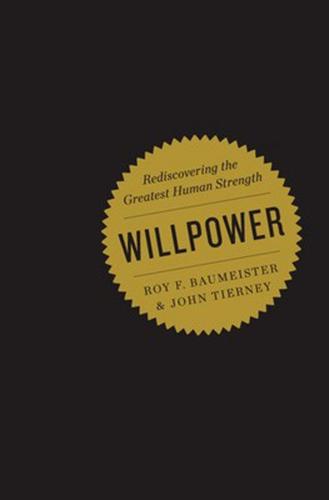
"Willpower: Rediscovering the Greatest Human Strength"
By Roy F. Baumeister and John Tierney
Self-control, as it turns out, is like a muscle: It can be exhausted from overuse, but it can also be strengthened through exercise.
The latter quality is good news since most problems - drug abuse, violence, overspending, underachievement, unhealthy habits - can be traced back to a lack of self-control.
That's according to "Willpower: Rediscovering the Greatest Human Strength," a new book by Florida State University psychologist Roy F. Baumeister and New York Times science writer John Tierney. The authors cite fascinating lab experiments that reveal how the human mind and body work.
In one experiment, college students who had been fasting were put in a room suffused with the smell of freshly baked chocolate-chip cookies. Some were allowed to eat cookies; others were offered chocolate, and a third group could only snack on radishes. Researchers left the room to increase the temptation of the radish group. Afterward, the students were given unsolvable puzzles to work on. The first two groups of students attempted them for about 20 minutes, as did a control group of students who hadn't been offered any food. The radish group, however, gave up after eight minutes. Their effort resisting the sweets earlier had left them with less energy to tackle the puzzles.
"Willpower" contains dozens of thought-provoking nuggets, including an entire section on the psychology of dieting. These bright spots are unfortunately diluted, however, by a rambling chapter on an African explorer and other instances of unfocused, belabored writing.
Kim Curtis / For The Associated Press Kendal Weaver / For The Associated Press Rasha Madkour / The Associated Press


