

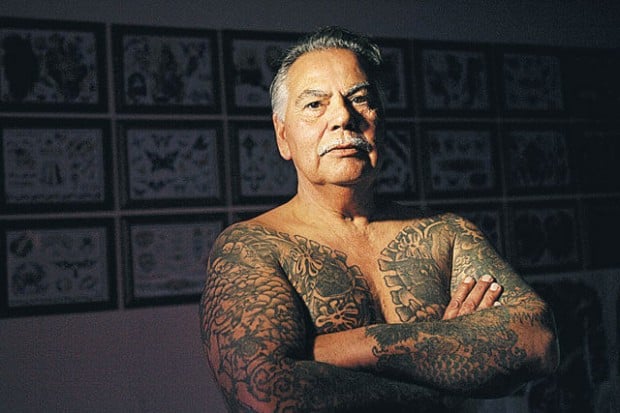
When Bert Rodriguez began his career as a tattoo artist in 1961, John F. Kennedy was president, a gallon of gas cost 31 cents and getting tattooed in the United States was still considered a distasteful practice.
"The artwork and the whole nature of it was crude," said Rodriguez, 65, a Tucsonan who started out giving tats to his army buddies on paydays. "They were more for sailors and tough guys."
Times have certainly changed.
Over the last 46 years, the art of tattooing has blossomed from society's ugly duckling into a multimillion-dollar industry.
According to a 2007 survey by the Pew Research Center, 36 percent of people ages 18-25 and 40 percent of those ages 26-40 reported having at least one tattoo.
Three of the most popular shows on The Learning Channel center on tattoo shops: "Miami Ink," "London Ink" and "L.A. Ink," and tattoo artists such as Chris Garver and Kat Von D have become national celebrities.
People are also reading…
Some of the biggest stars in Tucson reveal prominent body art regularly at McKale Center, where tattoos have become almost de rigueur on the UA men's basketball team.
And it's not hard to find a place to get inked. The Dex phone book lists more than 30 tattoo shops in town, from the South Side to the Catalina Foothills.
Rodriguez, owner of Bert's Classic Tattoo, Downtown, says the local popularity of tattooing made it possible for him to put together this weekend's "Tucson Tattoos and Blues" show.
The elder artist tattooed professionals from lawyers to councilmen when he owned a shop in the San Francisco Bay Area.
The show, which Rodriguez held for 15 years in California, will feature more than 80 artists, including established names like Henry Goldfield and members of the Washington-based tattoo collective The Hive. Rodriguez said calls have been pouring in from Colorado, Utah, Nevada and states throughout the country from tattoo enthusiasts looking to attend.
"There is the availability of much finer art now," Rodriguez said. "A lot more knowledge of the trade, too. Realism is starting to come out — tattoos that are comparable to photographs."
The "Tattoos and Blues" show is big enough to bring out Bob Baxter, editor in chief for Skin & Ink magazine, who will have a production crew with him filming a documentary on tattoos for the History Channel.
Baxter, who has three tattoo-artist sons, including the popular Hollywood ink slinger Riley Baxter, has headed Skin & Ink magazine for the last 11 years. The monthly publication covers different aspects of body art — the history, culture and talent — and boasts a readership of 250,000 monthly.
Baxter said events like Rodriguez's were few and far between when he took over at Skin & Ink.
"There were far fewer shops and artists back then," Baxter said. "There were maybe four shows across the country of any sort of repute. Tattoos have definitely become more mainstream. And not just in Tucson. It is in L.A., New York, Auckland, New Zealand. It is in Samoa. Little villages with no electricity are bringing back their tattoo culture."
As the tattoo world continues to expand, Tucson is benefiting with a slew of high-quality artists moving to town.
Jay Cavna and his wife Kimberly, opened Sanctity Tattoo five months ago at 970 E. University Blvd.
The shop, with its floor-to-ceiling window facade and wood panel flooring, sits next to the upscale Vila Thai restaurant and upstairs from a trendy espresso bar, just a block away from the UA campus.
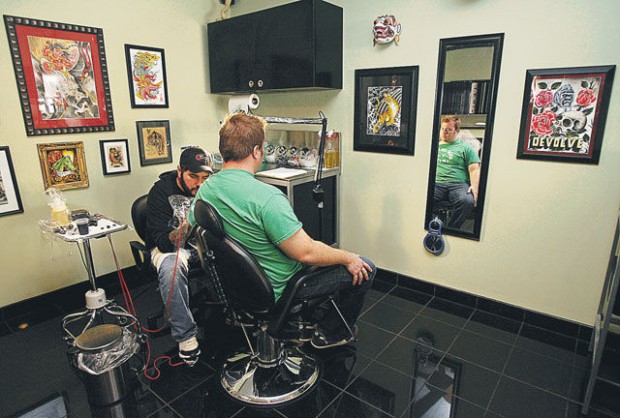
Cavna, a New York City native and graduate of the High School for the Performing Arts, works at the studio six days a week along with another full-time artist and an apprentice. When Cavna started tattooing 11 years ago, he had to move from Manhattan to Long Island because tattooing in the city was still illegal.
Cavna said the popularity has increased substantially since he started, and shows like "Miami Ink" have helped.
"What's good about those shows is that people are getting more educated about it and making better choices," he said.
"Ten years ago, tattoos weren't as good because the clients didn't know how to go about it. Now they have a more solid idea of what they want because they are watching these shows. Some of the programs overcharge, which is a bad thing. But people like Chris Garver on 'Miami Ink,' God bless that guy. He approaches it the way an artist should approach it. When someone comes in and expects that kind of treatment, that's perfect."
Philip J. Felix, 45, didn't even wait around for his Bisbee high school graduation ceremony before heading off to work as an illustrator for the Hallmark company in Missouri. Later, in the animation industry, he lent his artistic talents to films like "Shrek" and "Men in Black."
In his mid-30s, recognizing that his job was keeping him from his family, Felix opted to take on tattooing, an art form that wouldn't leave him at the mercy of the television and film industry.
He learned the trade working for Riley Baxter.
"I was the world's oldest apprentice," Felix said with a laugh. "But my previous experience really benefited me. I was a serious, focused artist at the time. When you go from working on Academy Award-winning movies to tattooing, it is a big jump. I was very lucky that my family was very supportive and didn't freak out."
He eventually moved to Tucson and opened Red Sky Studio on the corner of East Sixth Street and North Fourth Avenue.
Felix's shop attracts more high-end customers and doesn't accept walk-ins. The artist has a steady flow of customers coming in, often booking months in advance.
"We are close to the college, but I think I've only worked on two or three college students in the last three years," Felix said. "My clientele is the urban professional, the policeman, doctor or lawyer who wants a sleeve or a back piece. A lot of people fly in from out of town.
"People tend to look at body modifications as a way to reclaim their bodies or mark a point in time," he added. "We get everything from the nervous 18-year-old to the really, really nervous 70-year-old. It is a clear indication of the societal shift of tattoos to a non-threatening art form."
Jeffrey Larish
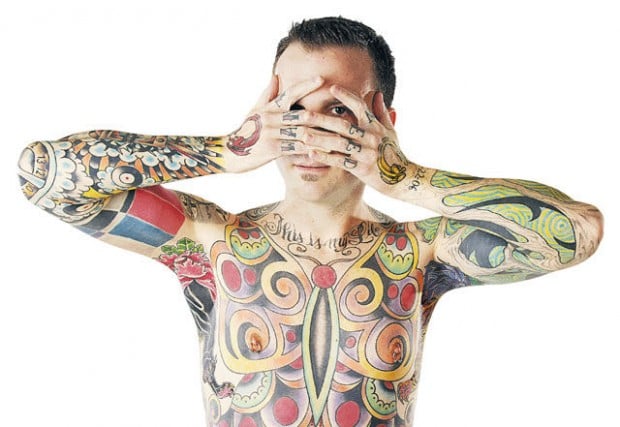
Larish, 37, is a stay-at-home dad and a recent transplant from the Washington, D.C., area. He lives in Tucson with his wife, Tione Torrens, and 14-month-old daughter.
Does your wife have as many tattoos as you? “Not quite as many, but she is working on it. Both of her arms are sleeved out and below her knees on her legs. She is in the process of getting her back piece finished.”
Do you run tattoo design ideas past each other? “To a certain extent. But ultimately it comes down to doing that with the artist, too. A lot of times you end up getting something because an artist does something really well or has a particular style.”
When did you get your first tattoo? “It was in early ’93. It was a cattle skull on my left shoulder with some green swirls behind it. I ended up with my left arm sleeved out with the same theme. It seemed big at the time, but it was rather small in hindsight. That was initially going to be my only tattoo. You see how that worked out for me.”
Why the giant butterfly on your chest? “I thought that would fit on the body really nice there. It had to do more with placement. I also thought it was kind of fun. People normally think of butterflies as a very feminine tattoo. . . . But you get one really large on your chest and it is not very feminine anymore.”
Danielle Oxman
Oxman, 23, is a former Arizona Daily Star apprentice who is currently finishing up her degree in journalism at the University of Arizona.
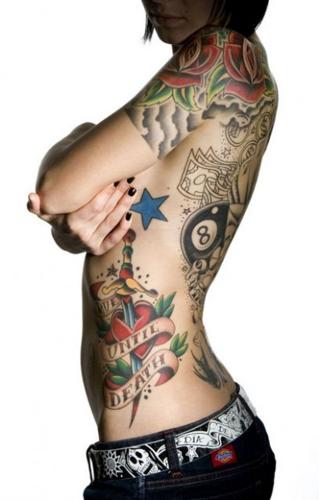
Number of tattoos: 12.
Preferred artists: Jim Quinn of Black Rose Tattooers 3, 425 N. Fourth Ave..
First piece: A nautical star on the small of her back, now part of a more elaborate back tattoo.
Do all of your tattoos have meaning? “Some of them do and some of them don’t. I actually just recently got a portrait of my grandmother on my forearm. She died on Christmas Eve and was born on New Year’s Eve. So I started the tattoo on Christmas Eve and had it finished on New Year’s Eve. That is the one that means the most, even though she would probably roll over in her grave if she knew I had done it.”
Do you worry about what certain people, professors or potential employers, might think of your tattoos? “Oh, yeah. I don’t wear short sleeves anywhere. Walking around campus in 110-degree heat with long sleeves isn’t fun. But my tattoos are personal. I don’t have them for the shock value like a lot of people do. I have to be very comfortable with where I am going and who I am with.”
Krystina Lee
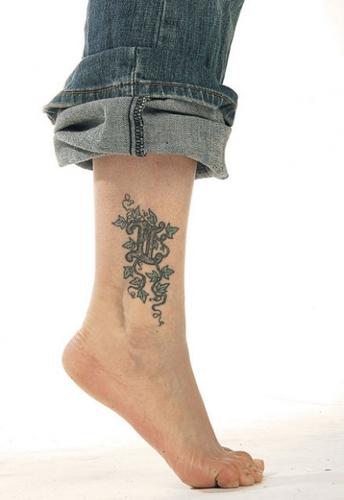
Lee, 21, is a veterinary technician for the Pima Pet Clinic.
Number of tattoos: One. A Gemini zodiac sign with ivy that Lee received in a New York tattoo parlor. She plans to get many more.
Why that tattoo? “It is my sign. A lot of people get zodiac tattoos. I thought it showed off my personality at the time and still does. I’ve always been obsessed with ivy for some reason.”
Next project: “I want to do an entire calf piece, get my calf covered from where my original tattoo is located. I have ideas of what I want, but I keep tossing them out. You don’t want to get something you are not going to like.”
Have you ever worried about the stigma attached to tattoos in your line of work? “I used to think that it would be a problem, but as I started working more in the industry, I’ve noticed that some of the vets have some pretty big pieces. I do consider it, though. I probably wouldn’t get anything visible.”
Lydia Scott
Scott, 23, is a Fry’s clerk and avid fan
of the online role-playing game
“World of Warcraft.”
Number of tattoos: Eight, including two works-in-progress, a full-sleeve and a back piece.
Preferred artist: Philip Felix of the Red Sky Studio.
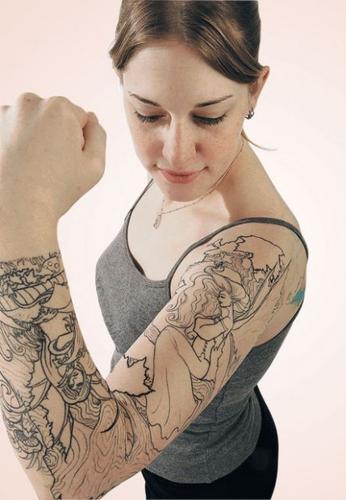
Most common themes: “I love fairies and fantasy. I have always loved dragons. I have a full enchanted forest sleeve that goes along the curve of my elbow. I also have a Japanese theme on my back.”
Why the Japanese back piece? “I read a story where a koi climbs a mountain and goes through all of these life journeys and obstacles and then turns into a beautiful dragon and flies away. I feel it symbolizes my life’s journey to become a better person.”
Favorite tattoo? “The dragon on my forearm. It is an amazing dragon. Philip worked on it and basically free-handed the thing. He based it on what he thought would look good. It is just beautiful. And I get to see it every day. My back piece is beautiful too, but I can’t see it unless I’m really trying.
Marty ‘Haviik’ Mendoza
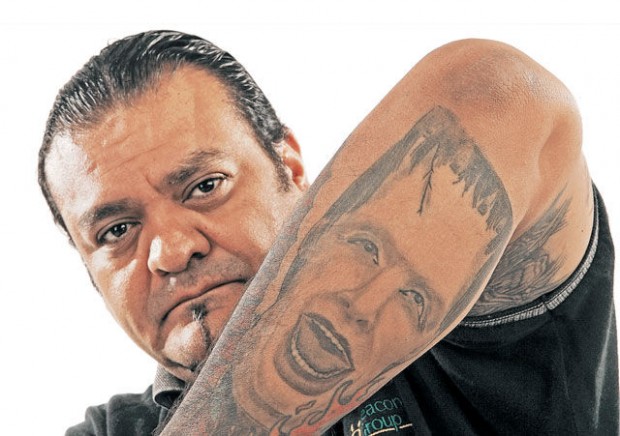
Mendoza, 44, is a case manager for the Beacon Group, which offers a wide variety of employment services for people with disabilities. He also plays bass guitar for The Tragedy Club.
Number of tattoos: 25.
First tattoo: A purple rose with blood dripping from the leaves. “I was influenced by music in the ’80s. That was the thing back then, roses and blood. I wanted to be like those musicians I saw on television. Now it is more like each piece of art is a moment in my life.”
Favorites: Herman Munster and a Virgin of Guadalupe/Charlie Chaplin hybrid tattoo dubbed “the Virgin Charlie Chaplin” on his left forearm.
“I got Herman because I’ve always loved the TV show. As far as the Virgin Charlie Chaplin goes, I grew up in a religious family, but my religion was entertainment. One of my favorite actors was Charlie Chaplin growing up. I made him the forefront of my religion.”
Why the body art? “Before, it was more like, ‘Wow, look at me!’ But now, it allows me to share my life, my story, with different people. The 60-and-above crowd is always really interested to learn about my ink.”
The Tucson Tattoos and Blues show
• What: A celebration of tattoo culture with live music, seminars and more than 80 tattoo artists from across the country.
• When: 11 a.m.-11 p.m. Saturday and Sunday.
• Where: Hotel Arizona, 181 W. Broadway.
• Cost: $15 for one day; $25 for both days. 884-5893.
• Blues artists slated to perform: Michael P. Nordberg, Red Mouth, Blues Cubed and others. The music begins at 1 p.m. and continues until close on both days.
• Et cetera: In addition to tattoos and music, the show will feature the following seminars on both days:
Noon — "Custom Banner Making for Tattooing."
1 p.m. — "The History of Tattooing."


