

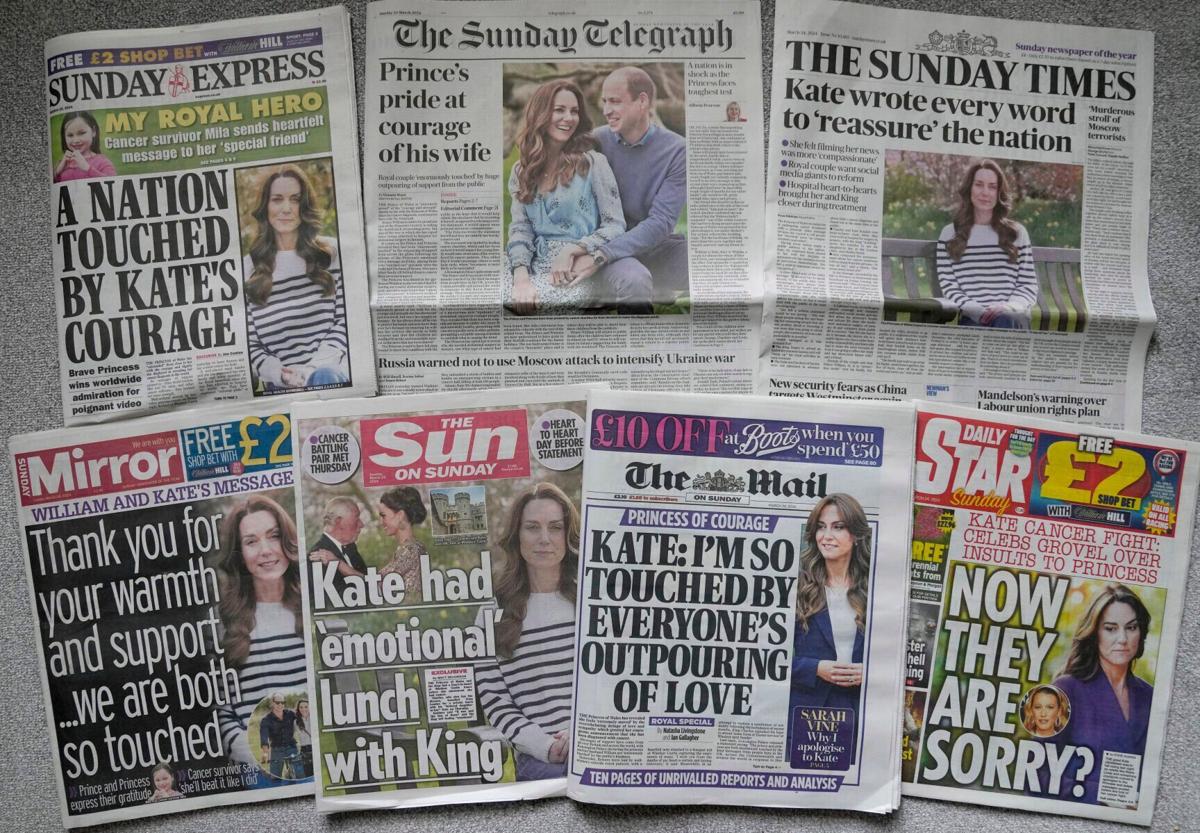
NEW YORK — A media frenzy was born on Feb. 27, when the hashtag #WhereIsKate exploded online with speculation about the whereabouts of Britain's Princess of Wales. It opened a rabbit hole of amateur detective work, memes, bizarre theories and jokes — mixed with genuine concern about Kate's health — into which thousands of people descended until her announcement last week that she was recovering from cancer.
The episode offered the royal family — and everyone else — a lesson in the modern world of online media: If your silence leaves an information vacuum, others will rush to fill it. And the results may be messy.
“The royal family's mantra is never complain, never explain,” said Ellie Hall, a journalist who specializes in covering Britain's king and his court. “That really doesn't work in a digital age. It doesn't take much to get the crazy things going.”
People are also reading…
It was, in part, entertainment for some people with too much time on their hands. Except it involved real people with real lives — and, it turns out, real medical challenges.
ANATOMY OF AN INFORMATION VACUUM
On Jan. 17, Kensington Palace announced that Kate was in the hospital recovering from a planned abdominal surgery and would not be doing any public events until after Easter. There was relatively little online chatter, or official updates, until it was announced on Feb. 27 that her husband, Prince William, would not be attending his godfather's memorial service due to a “personal matter.”
That's when the theorizing really began, noted Ryan Broderick, who writes the Garbage Day newsletter about the online environment.
Where was Kate? Was she seriously ill — in a coma, perhaps? Did she travel abroad to undergo plastic surgery? Had she been replaced by a body double? Was there trouble in her marriage? Did she leave William? Had she been abused? Unsubstantiated rumors made it all the way to American talk show host Stephen Colbert. Memes appeared that included putting Kate's picture on the face of an actress in “Gone Girl,” a 2014 film about a missing wife.
After two decades in which people have uploaded their lives to a system of platforms run by algorithms that make money off our worst impulses, “we have wondered what the world might look like when we crossed the threshold into a fully online world,” Broderick wrote on Garbage Day. “Well, we did. We crossed it.”
“Conspiracy is the Internet's favorite sport,” Sarah Frier, author of “No Filter: The Inside Story of Instagram,” posted on X, formerly Twitter. “It starts here and becomes mainstream. At one point last week, MOST of the content on my (X) feed was about her. None of it was right. This is just what people do for fun and followers now.”
Then came the grand, unforced error — the palace releasing a photo on March 10 of Kate and her children that it later admitted had been digitally manipulated, without leaving clear exactly what was done.
Even before that, a ham-fisted public relations strategy by the royal family's handlers had lost control of the narrative, said Peter Mancusi, a journalism professor at Northeastern University and a lawyer with his own business in crisis counseling.
Providing some proof of life, some morsels of information — even a staged shot of Kate waving from a balcony — would have filled the vacuum, he said. Mancusi contrasted the strategy with that surrounding King Charles, where it was quickly announced around the same time that he was fighting cancer. It has never been made clear exactly what kind of cancer the king has, but people are inclined to grant some degree of privacy with that diagnosis, Mancusi said.
Mancusi frequently deals with clients who resist releasing damaging or uncomfortable information that usually winds up getting out anyway. Best to be pro-active or, as Hall said, “feed the beast.”
“It's just human nature, and it's the nature of a lot of companies when bad news hits, to go into a defensive crouch,” Mancusi said. “But hope isn't a strategy anymore.”
CLEAR AND VERIFIABLE INFORMATION CAN HELP MATTERS
Despite the temptation to ignore rumors and conspiracy theories, it's best to respond quickly with clear and verifiable information, said Daniel Allington, a social scientist at King's College in London who studies disinformation. “Once people start speculating that you are lying to them," Allington said, “it's very hard to get them back on board.”
In an article published on vulture.com 12 days before Kate announced she had cancer, author Kathryn VanArendonk seemed to anticipate that truth in a discussion about how the monarchy is not built for the modern information era.
“Catherine may be going through some private experiences she does not want to share widely," she wrote, “and the internet has broken everyone's ability to assess what's a supervillain-level coverup and what's more likely to be something sad and mundane.”
Cancer is something too many people can relate to. They understand how hard it is to speak those words to loved ones, much less the entire world. Kate's video was a candid, emotional and effective way of sharing very personal information, said Matthew Hitzik, a veteran in crisis communications from New York.
It didn't end wild online speculation, though. Almost immediately, suggestions popped up that the speech was generated by artificial intelligence or, in an unholy alliance of conspiracy theories, that her cancer was caused by the COVID-19 vaccine.
But that was nonsense, and felt churlish. A corner had been turned. The Sun in London now runs daily stories with “Brave Kate” in the headline. Trolls “should hang their heads in shame,” the newspaper editorialized. The Atlantic magazine headlined: “I Hope You All Feel Terrible Now.”
What shouldn't be lost, however, is how preventable it all was.
“You cannot blame British newspapers for the miseries heaped on the Prince and Princess of Wales,” columnist Hugo Rifkind wrote in The Times of London. "Certainly we didn't help, if only because a princess releasing doctored photographs to the public, for reasons at that point unclear, is an objectively grabby and fascinating story. But the conspiracy theories? The juggernauts of dirty speculation? You could argue, I suppose, that papers should have simply pretended none of this was happening.
“But it was, and it wasn't driven by us,” he wrote. “It was driven by you.”
#WhereIsKate? Now we know.
Associated Press correspondents Sylvia Hui and Jill Lawless in London contributed to this report. David Bauder writes about media for The Associated Press. Follow him at http://twitter.com/dbauder
Here is the order of succession to the British throne
1. Prince William

As King Charles III receives treatment for cancer, he remains Britain's monarch and head of state. The crown does not pass from reigning monarchs to their spouses, so Queen Camilla is not in the line of succession.
Prince William, the older son of Charles and the late Princess Diana, is next in line. He is known as the Prince of Wales and is married to Kate, Princess of Wales.
2. Prince George

Prince George, older son of William and Kate, born in July 2013.
3. Princess Charlotte

Princess Charlotte, daughter of William and Kate, born in May 2015.
4. Prince Louis

Prince Louis, younger son of William and Kate, born in April 2018.
5. Prince Harry

Prince Harry, the younger son of Charles and Diana, who has relinquished his royal duties but retains his place in line.
6. Prince Archie

Prince Archie, born to Harry and Meghan, Duchess of Sussex, in May 2019.
7. Princess Lilibet

Princess Lilibet, born to Harry and Meghan in June 2021.
8. Prince Andrew

Prince Andrew, Queen Elizabeth II and Prince Philip’s second-oldest son.
9. Princess Beatrice

Princess Beatrice, older daughter of Andrew and his former wife, Sarah Ferguson.
10. Sienna Mapelli Mozzi

Sienna Mapelli Mozzi, daughter of Beatrice and Edoardo Mapelli Mozzi, both pictured, born in September 2021.
11. Princess Eugenie

Princess Eugenie, Andrew and Ferguson’s younger daughter.
12. August Brooksbank

August Brooksbank, born to Eugenie and James Brooksbank in Feb. 2021.
13. Ernest Brooksbank

Ernest Brooksbank, born to Eugenie (pictured) and James Brooksbank in May 2023.
14. Prince Edward

Prince Edward, the queen and Philip’s youngest child.
15. James, Earl of Wessex

James, Earl of Wessex (right), son of Edward and his wife, Sophie, Duchess of Edinburgh.
16. Lady Louise Mountbatten-Windsor

Lady Louise Mountbatten-Windsor (left), daughter of Edward and Sophie.
17. Princess Anne

Princess Anne, second child and only daughter of Queen Elizabeth II and Prince Philip. She’s older than brothers Andrew and Edward, but lower down due to rules that for centuries favored sons over daughters. The rules were changed in 2015 – too late for Louise Mountbatten-Windsor, who remains behind her younger brother James.
18. Peter Phillips

Peter Phillips, son of Anne and her ex-husband, Mark Phillips.
19. Savannah Phillips

Savannah Phillips (right), older daughter of Peter Phillips and his ex-wife, Autumn Kelly.
20. Isla Phillips

Isla Phillips (center), younger daughter of Peter Phillips and Autumn Kelly.
21. Zara Tindall

Zara Tindall, daughter of Princess Anne and Mark Phillips.
22. Mia Tindall

Mia Tindall, older daughter of Zara and her husband, Mike Tindall.
23. Lena Tindall

Lena Tindall, younger daughter of Zara and Mike Tindall.
24. Lucas Tindall

Lucas Tindall, son of Zara and Mike Tindall.
Copyright 2024 The Associated Press. All rights reserved. This material may not be published, broadcast, rewritten or redistributed without permission.


