David Levy was 8 when he saw his first shooting star, an unknown meteor scratching the nighttime sky above a summer camp in Vermont.
“A group of us kids were hiking up a hill shortly after dark, and I just happened to look up,” he recalled. “It wasn’t very bright. It only lasted a few seconds, but it’s a funny thing. I still remember it like it happened yesterday.”
Well he should, because those few brief seconds — in July of 1956 — gave young David Levy a star to wish upon for the rest of his life.
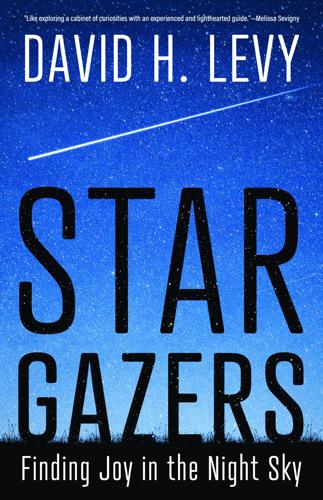
They also seeded a lifelong passion for astronomy that comes pouring out in “Star Gazers,” a new book releasing March 4 from the University of Arizona Press.
Wednesday night, a capacity crowd gathered for a launch party at the Western National Parks Association bookstore in Oro Valley. Most of those in the room were, like Levy, amateur sky-watchers.
People are also reading…
All were surprised to hear Levy say he isn’t really an astronomer anymore.
“There is a difference between the science of astronomy, with all the math and all the computers, and a simple passion for the night sky,” Levy said with a twinkle in his eye. “That’s what my book is about: my passion for the night sky. When I walk outside now and look up at the stars, it’s like I’m taking this enormous tranquilizer pill with no side effects. I would prescribe that for anybody.”

David Levy has discovered 23 comets and written 40 books.
Be that as it may, Levy remains one of the best-known amateur astronomers in the United States today.
Since arriving in Tucson in 1979, he has discovered 23 comets, including one of the most famous comets in history: Shoemaker-Levy 9, which crashed into Jupiter in 1994.
“Star Gazers” is his 40th book, and Levy has written hundreds of articles for publications such as Astronomy Magazine, Sky and Telescope Magazine, Sky News, Parade … and his hometown monthly, The Vail Voice.
At age 76, Levy says he is slowing down some, but those telescopes in his backyard aren’t about to get dusty anytime soon.
Levy grew up in Montreal, which on many levels is light-years from the American Southwest.
But young David was severely asthmatic and, as luck would have it, he had an aunt and uncle living in Tucson.
“In the Spring of 1963, my parents and I came to Tucson to visit them,” he recalled. “I was pretty into astronomy by then, so my mom took me out to Kitt Peak. We were in a tour group, and at one point I remember raising my hand. I asked the tour what an astronomer had to do to get observing time on a big telescope like this?
“He said the telescopes at Kitt Peak are available to all ‘qualified’ astronomers. He kind of underlined the ‘qualified.’ It kinda sounded like a challenge to me.”

"Star Gazers" discusses David Levy's passion for the night sky.
Levy would earn a master's degree in English Literature from Queen’s University in Canada. He then taught for a time, but the dry air and clear nighttime sky eventually beckoned him back to Arizona.
In 1979, now determined to become a serious astronomer, he purchased a home in Corona de Tucson and began staying up late.
“There were some lean years at first,” he confessed. “I worked as a floor manager at the Flandrau Observatory. I took a job at Kitt Peak. I wrote a little bit.”
Things began looking up, quite literally, when Levy discovered his first comet in 1984. It would be known as Comet Levy-Rudenko, honoring Levy and Michael Rudenko, then an amateur astronomer living in Marlboro, Mass.
As Levy discovered more and more comets, his name became more and more familiar to those in the trade, and in 1988, he teamed up with two other well-known comet hunters: Carolyn and Gene Shoemaker.
Together, Levy and the Shoemakers began spending one week a month at the Mount Palomar Observatory north of San Diego. Together, they would discover 12 comets, one of which would make history.
On March 23, 1993, Levy piloted an eight-minute scan of the late-night sky near Jupiter. Two days later, while examining the developed slide under a stereomicroscope, Carolyn Shoemaker suddenly said, “I don’t know what I’m looking at, but it looks like a squashed comet!”
And so it was.
The sighting was confirmed the following night by Jim Scotti at Kitt Peak, and further study revealed this “squashed comet” was actually an enormous mass that had shattered … with 21 huge fragments now strung together like pearls on a string. What is more, they were streaking toward Jupiter at 137,000 miles an hour.
In July 1994, those fragments began to hit, each causing a spectacular explosion captured by the Hubble Space Telescope and the Galileo spacecraft then headed that way.
Astronomers around the world were spellbound by what they were seeing. Consider this: If Shoemaker-Levy 9 had hit Earth instead of Jupiter, NASA scientists said the resulting dust and debris cloud would have enveloped the globe in darkness and probably ended all life as we know it.
“Gene, Carolyn and I were in Washington that month, with one of us doing a briefing every day,” Levy recalled. “One day when I was on stage, Gene hustled in to say we had to go. We’d been invited to the White House. We shook hands with President Clinton, and actually sat down to talk with Vice President Gore. He loved astronomy, too. It was a pretty exciting time, for sure.”
Life isn’t quite so exciting now, but Levy has already started another book. There are stories to write, lectures to give, and maybe even one “great white whale” there for the chasing.
“There is a star called T Coronae Borealis that is about to explode,” Levy said. “We all thought it would blow last summer. It still hasn’t, so it could happen any time now … and I want to see it when it does.”
FOOTNOTES
- Levy will be signing copies of his book at 1:30 p.m. on Sunday, March 16, in the UA Press Tent at the Tucson Festival of Books. He will then be featured at 4 p.m. that day in a session called “The Starry Sky” on the Science City Stage.
- More than 300 authors will appear in more than 300 sessions at this year’s book festival March 15-16 at the University of Arizona. To see the full schedule of programs, visit tucsonfestivalofbooks.org.
- “Seeds of Discovery,” a new entry in Lori Alexander’s series of STEM biographies for young readers, was released Jan. 28. This time, the Oro Valley author features Barbara McClintock, a key figure in modern genetics who later won a Nobel Prize.
Browse previous Bookmarks columns and keep up with news from the Tucson book community by following Bookmarks Arizona (@BookArizona) on X, formerly known as Twitter.