Last week, several restaurants in Buffalo closed down to protest the country's approach to immigration enforcement. A dozen more pledged to donate a portion of their sales to nonprofits supporting immigrants.
These restaurants were standing up for their immigrant neighbors, including foreign-born workers in the restaurant industry who are nervous to be detained at the Buffalo Federal Detention Center in Batavia or deported, even in cases when they are legally allowed to work here.
"I feel like somebody could come and try to take me because they see I'm Hispanic. They don't know that I'm a citizen," said a Puerto Rican restaurant worker who declined to be named for this story. Immigrants "come here and they're just looking for a better life, so they actually want to work. They're the ones that want to put in the hours."
People are also reading…

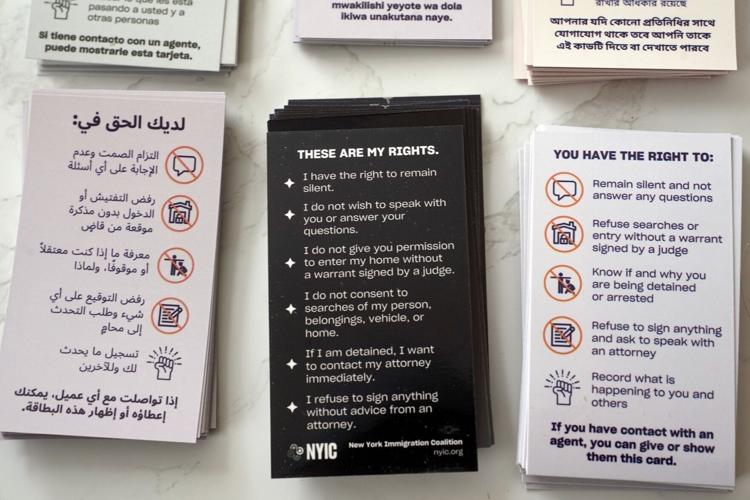
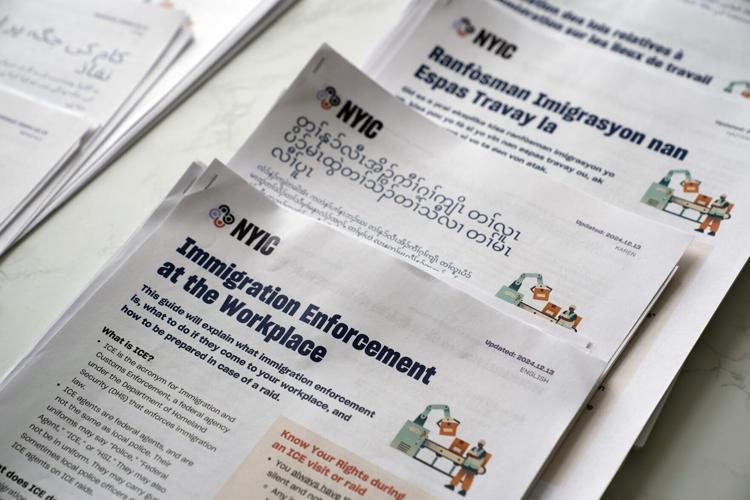
Literature in multiple languages helping restaurants know their rights about ICE at the New York Immigration Coalition Buffalo.
The Trump administration's intensified Immigrations and Customs Enforcement raids have spread fear throughout the food system, including in the immigrant restaurant community. About half of the Latinos living in the United States fear they or someone they are close to will be deported, despite the fact that 82% of Latinos have full legal status. About one in five Latinos said they have changed their daily routines because they worry they will be stopped and asked to prove their legal status.
Most restaurant workers approached by The Buffalo News declined to be interviewed for this story, even on the condition that their names and workplaces wouldn't be published. One Mexican restaurant owner who initially agreed to an interview canceled the meeting because he didn't "feel safe anymore to talk." Another restaurant owner who had previously publicly denounced ICE declined another interview because he believes he lost customers after speaking out.
At a local Mexican restaurant, a manager told The News that she thinks her restaurant is losing business because its mostly Latino customer base is scared to go out in public.
"I'm certainly fearful," one Buffalo restaurant owner said. "I've told everyone, 'Look, have copies of all your IDs, whether you are a citizen of not, have copies of your I-9s, have all that stuff, make copies so I have a copy of it. Keep it on you, at all times. Put it on your phone, as well, a picture of everything."
'It's hitting restaurants from all sides'
At least a couple of Mexican restaurants in the Buffalo area closed temporarily following rumored immigration raids over the last couple of months. A Colombian restaurant owner was deported, according to the Investigative Post. Asia Food Market, a large Asian grocery store with a food court on Niagara Falls Boulevard, was also the subject of an ICE raid.
"A lot of restaurants have been targeted," said Alejandro Gutiérrez, a Buffalo immigration attorney whose clients include Asia Food Market.
Before the Trump administration took office again last year, Gutiérrez said there were more opportunities for immigrants to live and work legally in the United States while their asylum paperwork was pending. As long as asylum-seekers showed up for their scheduled court dates and a judge decided they weren't either a flight risk or danger to the community, then they would be released on bond, he said.
Now, Gutiérrez said, even people with pending asylum cases are at risk for detainment or deportation.

Literature in multiple languages helping restaurants know their rights about ICE at the New York Immigration Coalition Buffalo.
Some people who had immigration status and were able to live and work in the United States have lost that status because of recent immigration law changes, said Colleen Putzel-Kavanaugh, associate policy analyst with Migration Policy Institute's U.S. Immigration Policy Program. Now, there is a "new pool of people" who are vulnerable to deportation.
"There's a lot of pressure on DHS (Department of Homeland Security) and its components, mainly ICE right now, to be arresting people and deporting them," Putzel-Kavanaugh said. "The large-scale enforcement operations that we've seen are part and parcel of that mission, trying to go out and arrest people in ways that can yield the most arrests possible. From our vantage point, it really does seem to be about those numbers and about reaching those goals."
The restaurant industry, along with construction and agriculture, have more workers without proper work authorization, Putzel-Kavanaugh said.
However, those industries are also reliant on immigrant labor. Most restaurant owners have struggled in recent years to find enough labor. Immigrants help. Nearly three-quarters of growth in the "prime-age" American workforce – workers between ages 25 to 54 – has been from foreign-born workers, according to a study by Migration Policy. Immigrants also start businesses at higher rates than American-born citizens, according to the study.
Workplace raids have long been an immigration enforcement tool, Putzel-Kavanaugh said, but their frequency has ebbed and flowed. Previous administrations have focused more on charging employers who hire unauthorized workers, rather than the workers themselves, she said.
"It has had a huge impact on immigrant restaurant workers," said Jessie Hahn, senior counsel of labor & employment policy at National Immigration Law Center. "This kind of worksite immigration enforcement is harmful for workers, for their families and for the economy."
ICE raids are "hitting restaurants from all sides," Hahn said, because workers are afraid to go to work, and customers are afraid to be in public.
For the benefit of their employees, some restaurateurs have hung signs to mark private areas. ICE agents are allowed in restaurant dining rooms, because they are public spaces, but ICE needs a judicial warrant to enter private areas, such as the kitchen. In the "vast majority" of cases, ICE does not have a judicial warrant.
"One of the most important ways that people can protect themselves is to understand what their rights are, and then know how they're going to assert them, in the event that they need to," Hahn said.
Buffalo restaurants bite back
It takes a lot for a restaurant to take a public political stand. It comes with financial risk. Plenty of people think restaurants should stay out of politics altogether.
Kenmore's Mojo Market, for example, had never closed down as part of a political movement before last Friday. But it joined several other local restaurants in shutting its doors as part of a nationwide strike against ICE.

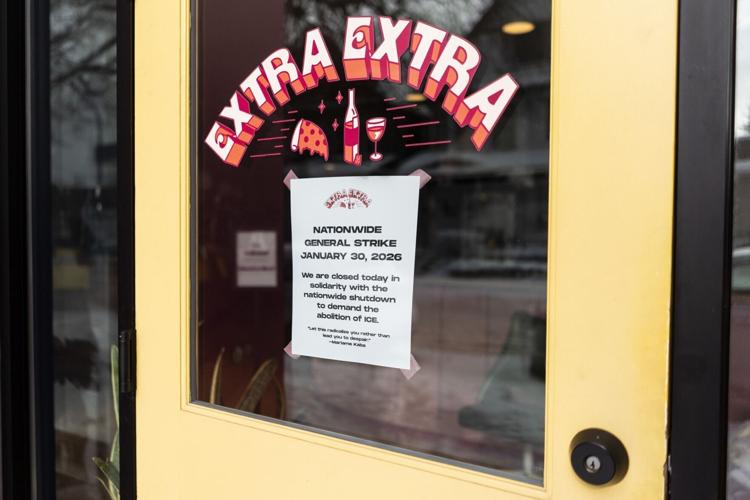
Extra Extra Pizza on Utica Street is closed for a nationwide general strike against ICE in Buffalo on Jan. 30, 2026.
"We knew there was going to be some backlash, but it's been more surpassed by the overwhelming support we had," said Bridget Murphy, worker/owner at Extra Extra Pizza, a West Side pizzeria that also closed for the strike. "As a small business, we can vote with our dollars."
Joseph Orlando, owner of Mojo Market, had some reservations, but then he thought of one of his immigrant workers, who had received his citizenship. Orlando looked at what has happened in other parts of the country, especially recently in Minneapolis, and worried about his worker potentially being racially profiled in an ICE raid.
"I'm not an activist. I'm just a regular person who's watching things unfold and trying to run my business," Orlando said. "I know that there's some people that have reached out on our socials and said that they won't support us. I don't know if those people ever have. If they have, and this decision makes them not want to support us, I think that's sad. ... Overall, the response has been very positive, and I think people are happy to see that we took a stance. And if there's another day, we will probably do it again."