Once the applause died down and the audience had settled on a recent Thursday night at the University of Arizona Poetry Center, Tucson poet Richard Siken adjusted his glasses, took a deep breath and began.
“I had a stroke, and I fell down, and I forgot everything,” he said, simply. “I don’t know how to tell you about it, so I’m going to show you.”
And with that, he began reading from his latest book, “I Do Know Some Things,” a uniquely powerful collection of prose poems Siken wrote to chart his recovery from a stroke he suffered in 2019.
The stroke was significant, paralyzing Siken’s right side, erasing his short-term memory, and blocking his ability to form complete thoughts.
People are also reading…
His collection is significant, too.
Siken and “I Do Know Some Things” are among five finalists for this year’s National Book Award in Poetry.
Winners will be announced Nov. 19 in New York City, and just by being there, Siken will have authored a fitting postscript to a story six years in the making.
It began on March 15, 2019, when he suddenly became disoriented and fell to the floor of his midtown home. Rushed to the nearby hospital by a friend, he tried telling them he was having a stroke.
“They said, ‘No, you’re having a panic attack,’ and sent me home. I kept thinking, ‘Something is terribly wrong. I do know some things.’”
Unfortunately, Siken was right. He went to a second hospital the following day and was admitted immediately. Once stabilized, he did what writers do. He asked for a pencil and pad.
“I started taking notes even before I left the hospital,” he said. “I was trying to define things. Remember things. Keep things straight. Eventually, the book became an attempt to reconstruct myself.”
Early selections are often a patchwork of random thoughts, incomplete sentences and ill-fitting logic that reflected Siken’s early struggles, mentally.
“The goal, especially at first, was to say a complete thought,” he recalls. “A solid, complete sentence. Connecting one word after another was excruciating.”
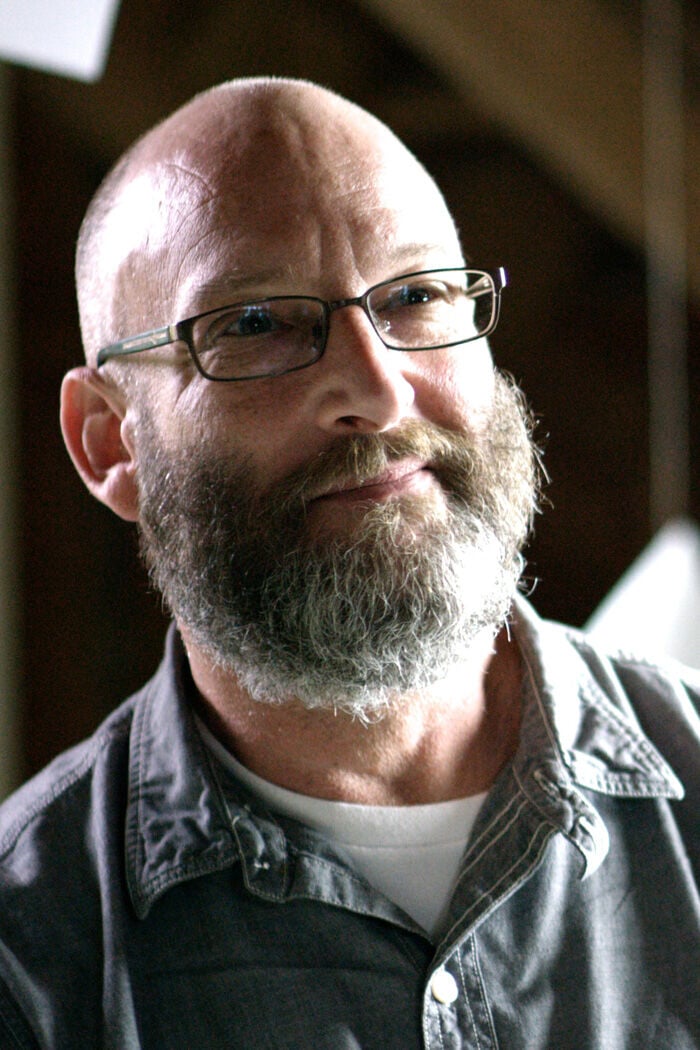
Richard Siken
By Page 92, in a poem called Zeno, he has begun to find a new voice:
“I knew I was getting better when dogs at the coffee shop started leaving me alone,” he wrote. “Dogs I didn’t know had been coming over and sitting at my feet, as if they knew I was dying. It was unnerving. I was having success with my transitions and people could track what I was saying. I was charming with my limp and my cane. I was getting to the ends of sentences. I still got everyone’s name wrong.”
Siken still gets lost in sentences now and then, still struggles occasionally to find the right word, but readers will gladly forgive him that.
A graduate of Catalina High School who received a bachelor’s degree in psychology and an M.F.A. in creative writing from the UA, Siken has been in the upper echelon of American poets since 2005, when his first collection — “Crush” — was selected by Louise Gluck for the Yale Series of Younger Poets Prize.
Interestingly, the original version of “Crush” had been his thesis in graduate school 10 years earlier.
“It wasn’t the book that would eventually be published,” Siken said. “It was more of an outline then. It grazed the edges of what I really wanted to do. I needed more time with it, so I worked nights and stayed up late, while everyone was asleep, writing poems.
“Every year I would send the newest version to contests. Nothing came of it until 2004, when Louise saw something in it and took a chance on me.”
Siken would spend a weekend with her in Cambridge, editing every line at her kitchen table.
The final version was published the following year, and an overnight success it was not.
“The box of my copies arrived in the mail. I waited for applause, but nothing happened. Reviews did not appear. Invitations to read did not arrive. Months passed. A year.”
Then, suddenly, “Crush” began to crush it, particularly among the young. A powerful exploration of love, lust and obsession, “Crush” spoke to readers with a passionate fierceness.
“It got very strong responses once people began to find it,” Siken said. “People were taking what I said very seriously. I got an email that said, ‘I’m not sure if I should be telling you this, but my girlfriend hanged herself last night and left one of your poems as a suicide note.’ After that, I stopped writing for awhile.”
Luckily for us, Siken is back in print, and back in the spotlight. It will be shining brightly next month in New York City.
“When I first got the news, I felt sick in a kind of excited way,” he confessed. “Maybe I was hyperventilating. I want to win, fiercely and completely. At the same time, there’s a part of me that doesn’t care. Now that I’m done with the book, I can’t play with it or change it."
Footnotes
- Time is running out for submissions to the annual writing contest sponsored by the Tucson Festival of Books. Cash prizes of $1,000, $500 and $250 will go to the top three entries in Fiction, Nonfiction and Poetry. The submission window will close Oct. 31 at midnight. To learn more, visit tucsonfestivalofbooks.org.
- Stacks Book Club in Oro Valley will celebrate Día de Muertos week by presenting author-illustrator John Picacio this coming Wednesday, Oct. 29. Picacio will discuss his recently released picture book, “The Invisible Parade,” which explores the traditions and continued importance surrounding Day of the Dead. For ticket information, visit stacksbookclub.com/events.
- Tucson poets Susan Briante and Farid Matuk will read and compare notes this coming Thursday, Oct. 30, at the University of Arizona Poetry Center. To learn more, visit poetry.arizona.edu.
- The Pima County Public Library will host an online chat with author Silvia Moreno Garcia Saturday, Nov. 8, at 1 p.m. For more information, visit library.pima.gov/events.