

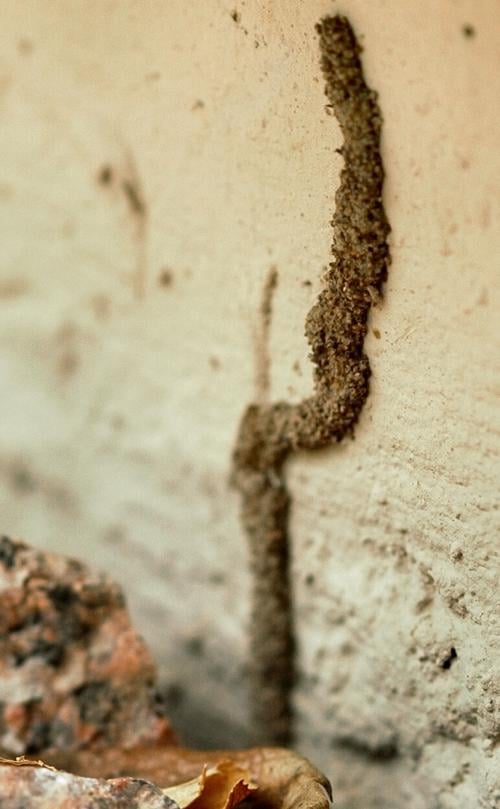
Q: I think I have termites at my house. How can I know for sure?
A: Here are some signs you can look for:
- Loose drywall, sagging paint or tiny pinholes on the surface
- Wood that is soft, spongy or sounds hollow when tapped
- Tiles that become dislodged
- Sawdust-like piles in or around walls and floors
- “Tubes” that seem to pop out of nowhere especially dropping out of the ceiling or up from the floor
Termites can do a lot of damage if left unchecked. A termite inspection every couple of years is a wise investment in your home. As Rosie says, there are two kinds of homes in Arizona: those that have termites and those that will.
Q: How are termites eradicated?
A: Termite treatments have changed over the years. Here are a few that have been widely used with varied success.
People are also reading…
- Liquid repellent: Before the mid-1990s, liquid repellents were the primary product used to treat termite colonies. While helpful, liquid repellents have limitations. The products repelled termites, limiting their interaction with the termiticide, which reduced their effectiveness. Even when pest control professionals followed the treatment instructions precisely, the treatments often failed to eliminate the termites. This led to call-back frustration for homeowners and pest management professionals.
- Baiting: Around the mid-’90s, manufacturers came out with a termite baiting system that consisted of a plastic, 3-inch diameter spike-like container driven into the ground about every 10 feet. The spike contained a cellulose dowel, which is similar to a treated wooden dowel. Randomly foraging termites came into contact with the cellulose dowel and started eating. The manufacturer was required to have the pest management companies inspect the dowels monthly. Once an activity was identified, the wooden dowel was replaced with a dowel impregnated with a product that prevented molting. The workers would die from not being able to molt, and the colony couldn’t be fed, leading to colony elimination. While the product worked well in other parts of the country, original baiting systems failed in Arizona. Arizona subterranean termites don’t like disturbance and the system was not successful here.
- Liquid non-repellent: This product was developed in the late 1990s and works differently from the liquid repellents mentioned earlier. As its name implies, termites come into contact with the product and “they don’t even know they are in it,” says Nate Wolf of Blue Sky Pest Control. The termites can’t smell it, sense it or taste it. The liquid non-repellents are much more effective than the liquid repellents and the early baiting systems. These treatments involve digging a trench around the home, applying the liquid non-repellent, and drilling into the concrete to ensure thorough application. While effective, it requires a lot of labor, which increases cost. In addition, over time, the liquid non-repellant will break down in the dirt, making it necessary for regular inspections and a new treatment.
Q: What is the best way to treat them currently?
A: The newest technology in bait systems make bait a good option.
Baiting systems have significantly improved, according to Wolf. In 2010, a fifth iteration of termite baiting systems was introduced. Some of the main differences in the old and new systems are:
- The system is deployed similarly to the earlier bait systems. It also uses a wooden or cellulose bait placed in the ground, but the bait is treated with a termiticide from the start. As termites randomly forage, they run into a dowel, start eating, and are impacted immediately by the product.
- The sleeves they are placed in differ slightly from the earlier sleeves and are placed in a similar pattern around the perimeter of your home. Wolf prefers they be placed within 3 feet of the home’s stem wall to be most effective.
- Unlike the earlier bait systems that needed to be monitored and replaced every month, this new product only needs to be monitored once a year.
- The chemicals in the bait prevent the termites from molting. If termites cannot molt, they die. If the workers die, there is no one to feed the colony, and the colony is eliminated.
Q: What are the pros and cons of the new bait systems?
A: The pros would be that the speed with which the improved baiting system works helps to eliminate a colony very quickly. The faster they go away, the less damage done to your home.
And the chemicals do not leech into the ground making them better for the environment.
The con with the new baiting systems is that the exterminator may still need to drill holes in the concrete, like the systems of the past, because the bait needs to be within 3 feet of the home. If there are impervious surfaces like concrete walkways, driveways and patios, the exterminator will need to drill small holes to place the bait in every 18 inches.
As we said earlier, termites in Arizona are a force to be reckoned with. Usually, you don’t know you have them until they have done some damage. The best way to protect your home is to have your home inspected periodically, at least once every couple of years, by a licensed and bonded contractor with an eye for detail and customer service.
Rosie offers advice on how to choose a contractor at tucne.ws/1qf8. Request a hard copy by emailing info@rosieonthehouse.com or call 1-888-767-4348.
Tucson Water: How to Read Your Water Meter
An Arizona home building and remodeling industry expert since 1988, Rosie Romero is the host of the syndicated Saturday morning Rosie on the House radio broadcast, heard locally from 10-11 a.m. on KNST-AM (790) in Tucson. Podcasts are available at rosieonthehouse.com or on your favorite podcast app.


