
The sun beat down on the plastic chairs set up on Ochoa Street for Saturday's second annual KXCI Baila el Pueblo — A Desert Music Festival and you couldn't help but wonder how hot it was going to be to actually sit in them.
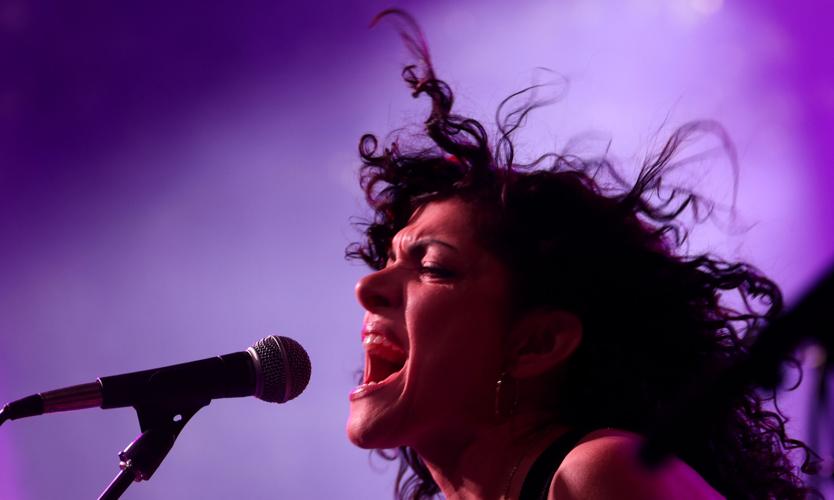
Not that you needed a seat when Hermosillo singer-songwriter Dámaris Bójor and her band started performing what she describes as “Folkpirano” — a hybrid of campirano, the regional music of Sierra de Sonora Sinaloa, and American folk/country.
There were flashes of acoustic twang intertwined with Mexican accents wrapped in energetic rhythms that got your toes to tappin' and your heart to pounding.
Music fans braved the record heat and turned out to the Cathedral Square for KXCI’s 2nd Annual Baila el Pueblo–A Desert Music Festival, March 21, 2026, Tucson, Ariz.
Little kids and old women made their way to the stage front, a piece of real estate at the main stage of KXCI's festival that celebrated the music and culture of the borderlands.
People are also reading…
Baila el Pueblo translated means "dance pueblo," and every act KXCI put on the two stages at South Stone Avenue's Cathedral Square got the audience numbering just under 800 to do just that.
Saturday's blistering heatwave — the high when the festival started at 4 p.m. was south of the century mark — was likely to blame for a drop in attendance over the inaugural event last spring. But it didn't dampen anyone's spirit.

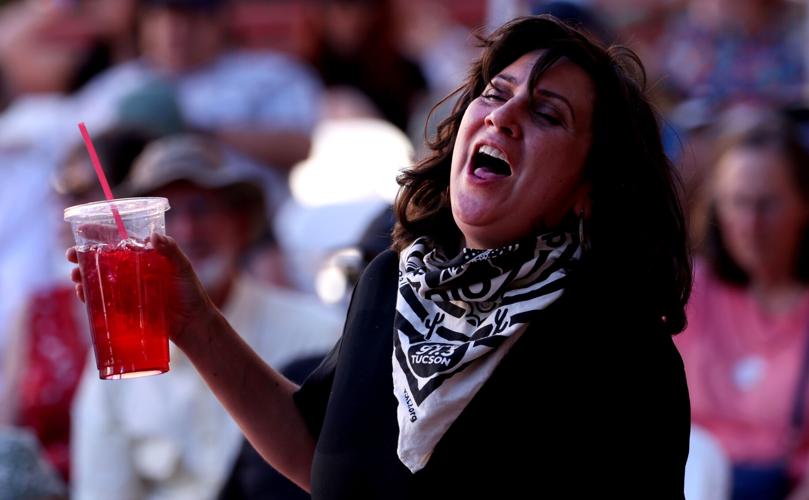
Bridgitte Thum gets into the mood as she sings along with Sage Lacapa, one of the acts at KXCI’s 2nd Annual Baila el Pueblo–A Desert Music Festival, Tucson, Ariz., March 21, 2026.
"I'm used to this," said Nancy Rodriguez, who's originally from Yuma and now lives in Phoenix, "It's a lot hotter where I come from and where I live now. It's a few degrees cooler here."
The sun was starting to go down and a nearby tree was casting a bit of a shadow where Rodriguez was dancing to Las Azaleas' cover of a song by the late Tejano/pop superstar Selena.
Record heat hurt overall attendance, but it didn't dampen spirits at daylong festival celebrating regional music and Tejano superstar Ruben "El Gato Negro" Ramos.
Several bands had warmed the stage for Tucson's spectacular all-female mariachi including opening act D Faktion Nyne.
The Tohono O'odham family band plays waila, the traditional native music that borrows influences from European polkas and Polish folk dances, Mexican norteño, American country and, as far as lead singer Damon Enriquez is concerned, "The Andy Griffith Show." That's where Enriquez first heard the bluegrass song "There Is a Time," which D Faction Nyne performed as a cumbia with accordion and acoustic guitar.
The husband-and-wife native folk duo of Sage and Kirin Lacapa from the White Mountain Apache tribe brought the unique sound of a singing saw, which Kirin played by drawing a bow over the teeth to create an eerie but interesting whine underscoring Sage's folk-leaning songwriting.
Mexico City's Mexican Institute of Sound (electronica DJ/producer Camilo Lara) was the headliner, but the real excitement at Saturday's festival was seeing Tejano superstar Ruben "El Gato Negro" Ramos.
Saturday's festival was a tribute to Ramos, the 86-year-old Texas musician whose latest album was produced by Tucson musician and producer Sergio Mendoza and Texas tejano singer-songwriter Carrie Rodriguez.
Mendoza and Rodriguez accompanied Ramos along with a who's who of Tucson musicians that Mendoza had assembled including members of Calexico, Orkesta Mendoza and Brian Lopez of XIXA; and a member of Ramos's Austin, Texas, band.

Ruben Ramos sings one of his songs as he performs with Sergio Mendoza & Friends, a band made of many of the area’s prominent Latino musicians, at KXCI’s 2nd Annual Baila el Pueblo–A Desert Music Festival, Tucson, Ariz., March 21, 2026.
"I feel very honored to be here in Tucson with this beautiful group of musicians," Ramos told the audience, which had abandoned the majority of the plastic chairs and packed up close to the stage.
A lot of the audience was singing along to some of Ramos' big hits, which he sang mostly in Spanish in a voice that defied his age. Even those who couldn't understand what he was singing were dancing along to the infectious groove, turning the normally staid Ochoa Street into a giant street party.
Somewhere among those hundreds of revelers, Nancy Rodriguez was taking it all in.
"It's fun," she said earlier. "It's great to share with the community and forget what's going on in the world. It's a great cultural interruption."
Contact reporter Cathalena E. Burch at cburch@tucson.com. On Bluesky @Starburch

Cathalena E. Burch
Reporter