MARQUETTE, Mich. — Spend enough time along the shores of Lake Superior and it won’t be long before there’s some reminder of what happened “when the gales of November came early.”
This year marks the 50th anniversary of the wreck of the Edmund Fitzgerald, the largest and most famous of the estimated 6,500 ships that have gone down in the Great Lakes. But the Fitzgerald is remembered while the others are forgotten, thanks in large part to Gordon Lightfoot’s haunting 1976 folk ballad that became a surprise hit.
The Fitzgerald, a 730-foot long freighter named after a Milwaukee insurance company executive, went down in Lake Superior on Nov. 10, 1975. All 29 men on board died.
The Fitz, as it's still affectionately called, was the largest ship on the Great Lakes when it launched in 1958 and kept that title until 1971.
People are also reading…
On its final voyage, the Fitzgerald departed Superior, Wisconsin, on Nov. 9, 1975, carrying 26,000 tons of iron ore along a familiar route to Zug Island in Detroit.
Oliver “Buck” Champeau, 41, was making his first trip on “The Mighty Fitz."

Debbie Gomez-Felder holds up a picture of her father, who died aboard the Edmund Fitzgerald, on Oct. 20 in her home in Nashotah, Wis.
The U.S. Marine veteran and experienced seaman was drawn by the higher pay that time of year due to increased risk, recalled daughter Debbie Gomez-Felder, who was 17 at the time.
“It was an honor to be on the Fitzgerald,” Gomez-Felder said, speaking in her home outside of Milwaukee adorned with images of her dad and paintings of the famous ship.
Most of the crew members were born and lived in states that border the Great Lakes — Wisconsin, Michigan, Ohio and Minnesota.
The captain, 63-year-old Ernest M. McSorley, intended to retire after the 1975 season. He was known for his ability to navigate storms on the Great Lakes, but the one that hit on Nov. 10 was unlike any he had encountered.
McSorley chose a northerly route across Lake Superior to be protected by highlands along the Canadian shore. Gale warnings were issued the night of Nov. 9. Those worsened to storm warnings in the early morning of Nov. 10.
The crew of the nearby Arthur Anderson, which was trailing the Fitz, reported waves as high as 25 feet. The first mate radioed McSorley, who reported that the Fitz had been damaged by the storm.
“We are holding our own," McSorley said. That was the last message received from anyone aboard.
Gomez-Felder said she was called out of class the following day and told to go home immediately. Her mom told her that the Fitzgerald was missing.
“I was banging on the church doors at St. Michael’s Church, our home church where I grew up, wanting answers from one of the priests as to how could this happen,” Gomez-Felder said. “I didn’t understand it.”
There are many theories as to what caused the Fitzgerald to sink so rapidly without a distress call, but the exact reason remains unknown.
Even without an answer, the wreck spurred many “incredible” safety improvements, said Frederick Stonehouse, whose 1977 book “The Wreck of the Edmund Fitzgerald” was the first of dozens written about the tragedy.

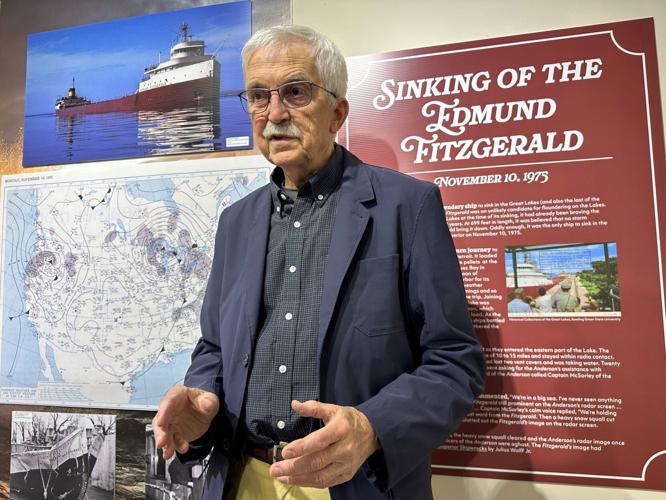
Frederick Stonehouse, whose 1977 book "The Wreck of the Edmund Fitzgerald" was the first written on the famous ship, discusses the impact of the disaster 50 years later on Oct. 25 in Marquette, Mich.
Whereas a similar-sized ship would be lost on the lakes every six or seven years before the Fitzgerald, none has gone down since then, he said.
“Every sailor on the Great Lakes that’s sailing today owes a great deal of debt of gratitude to the Fitzgerald,” said Stonehouse, who taught Great Lakes maritime history at Northern Michigan University, located on the shores of Lake Superior.
The Fitzgerald still sits at the bottom of Lake Superior, submerged in 535 feet of water, about 17 miles north-northwest of Whitefish Point, Michigan. No bodies have been recovered.
The wreck is protected as a grave site under Canadian law, a status that family members including Gomez-Felder lobbied for. Unauthorized dives or artifact retrieval are barred.
Gomez-Felder said she wants the wreck — and the bodies entombed within — to remain undisturbed.
Events around the Great Lakes each year remember the men killed and reunite their family members, and organizers say the 50th anniversary has driven public interest to a new peak.
The Great Lakes Historical Museum in Whitefish Point plans a public event on Nov. 10. A separate ceremony only for the crew’s families will be livestreamed. The Edmund Fitzgerald’s bell, retrieved in 1995 at the request of crew family members, is housed there as a permanent memorial.

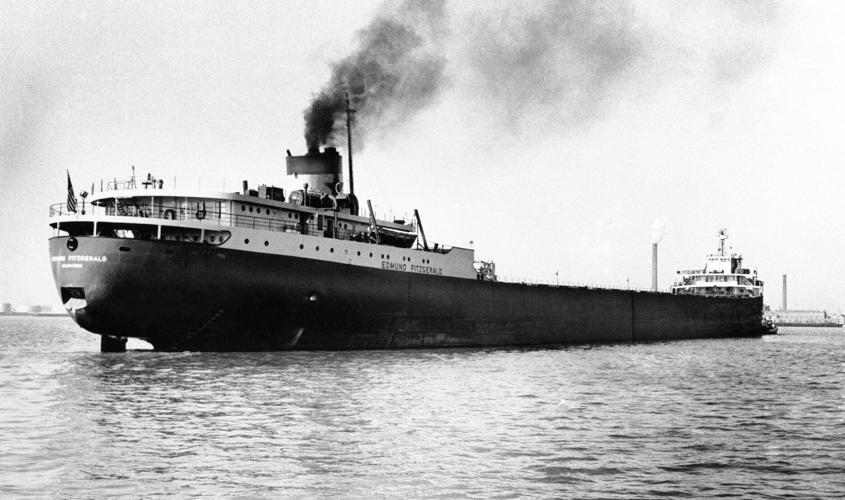
The Fitzgerald is pictured in 1959, carrying a crew of 28 to 30 men and a load of 26,216 tons of taconite pellets.
Bruce Lynn, executive director of the Great Lake Shipwreck Historical Society, said the museum is on track to see its busiest year ever on the 50th anniversary.
“When we remember the Fitzgerald, I like to think that at the same time we’re remembering all those other shipwrecks,” he said.
The wreck is also remembered in Detroit at the Mariners’ Church, where Rector Richard Ingalls rang its bell 29 times in honor of the crew after receiving word in the predawn hours of Nov. 11, 1975, that the Fitzgerald had sunk.
The tolling bell helped spread the word of what had happened and was memorialized by Lightfoot when he sang “the church bell chimed til it rang twenty-nine times."
In 2023, after Lightfoot died, they rang the bell a 30th time. The bell will also be rung 30 times this year on the anniversary, with the final toll representing all sailors lost on the Great Lakes.
On this 50th anniversary, Gomez-Felder said she wants people to remember the Fitzgerald crew’s loved ones.
“It took me a little while to recognize he’s not coming back,” Gomez-Felder said of her father. “He’s not going to be here for my wedding, he is not going to see me graduate, he isn’t going to walk me down the aisle. He has gone.”
She has been comforted by traveling to Whitefish Point each year to be with other families and, for the past 30 years, ringing the Fitzgerald’s bell in memory of her father and the others who died.
“That was the closest thing to my dad,” she said. “That’s the soul of the ship.”
Photos: Wreck of the Edmund Fitzgerald still resonates 50 years later

In a Nov. 24, 1975 file photo Coast Guard officers on a Board of Inquiry inspected life rings that were recovered from the ore carrier Edmund Fitzgerald, which sank in stormy weather in Lake Superior on Nov. 10, 1975. All 29 crewmen aboard perished and did not get a chance to use any of the lifesaving equipment. The Great Lakes have claimed some 6,000 ships since European explorers began navigating the waters in the 1600s, but few have captured the public’s imagination as has the Edmund Fitzgerald. (AP Photo/GE, File)

In a Nov. 11, 1975 file photo, one of several merchant ships, that aided in the search for the missing freighter Edmund Fitzgerald cruises the area believe to be the last known location of the freighter, which sunk on Nov. 10, 1975, in Lake Superior. The Great Lakes have claimed some 6,000 ships since European explorers began navigating the waters in the 1600s, but few have captured the public’s imagination as has the Edmund Fitzgerald. (AP Photo/JCH)
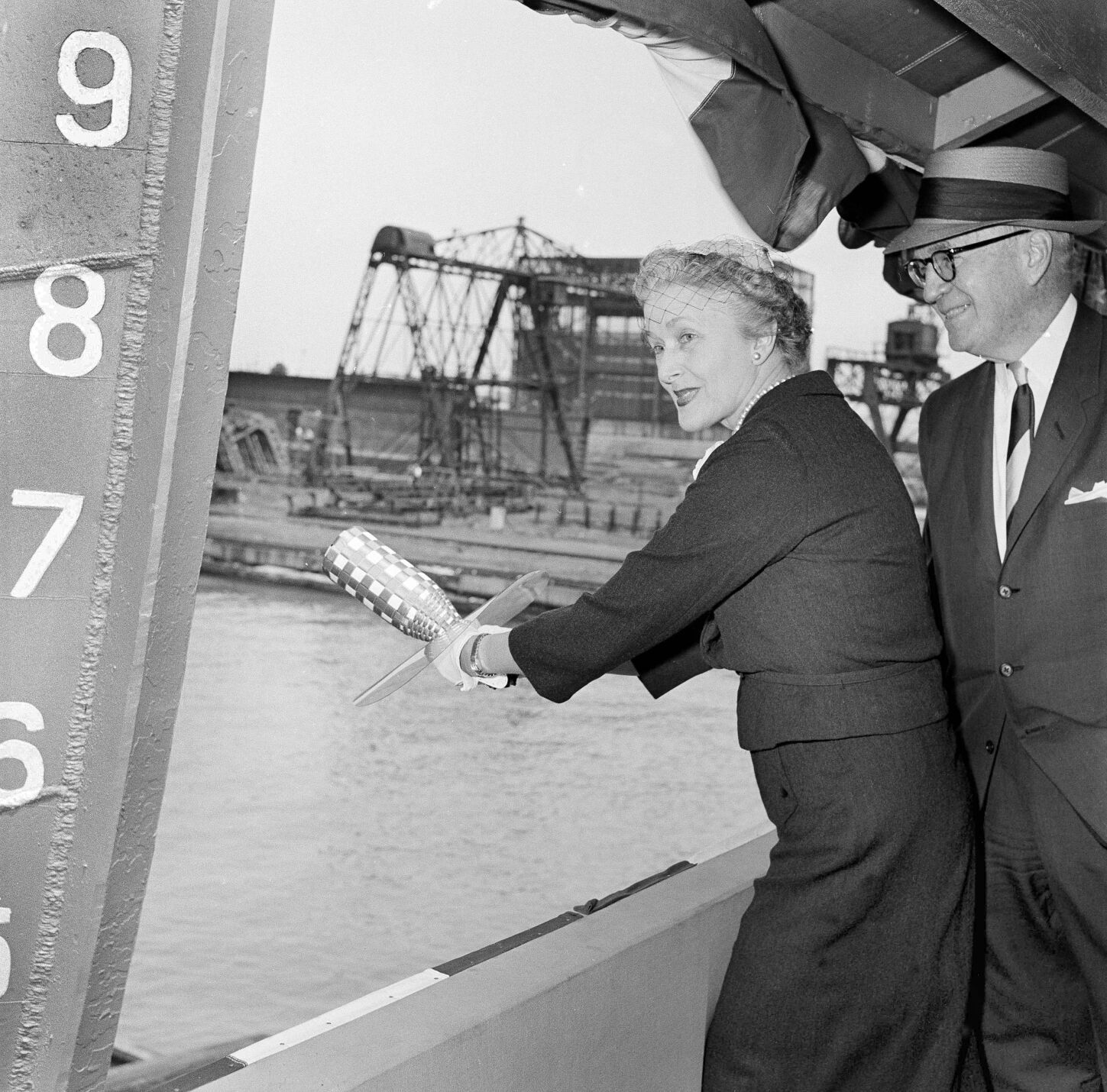
Elizabeth Fitzgerald, wife of the chairman of the board of Northwest Mutual Life Insurance Co., holds a bottle of champagne with which she launched the ore carrier Edmund Fitzgerald in Detroit, June 7, 1958. With her is her husband, for whom the vessel was named. The Edmund Fitzgerald was built at a cost of $8 million and is the largest and longest ship ever constructed in the Great Lakes. (AP Photo/Alvan Quinn)

FILE - The largest and longest vessel ever built on the Great Lakes, the 729-foot ore carrier SS Edmund Fitzgerald, slides into the launching basin, on June 7, 1958, in Detroit, Michigan. Sailors who lost their lives in shipwrecks on the Great Lakes and Michigan waterways will be remembered at a historic church in downtown Detroit on Sunday, Nov. 13, 2022. The S.S. Edmund Fitzgerald sank on Nov. 10, 1975, in Lake Superior during a storm. (AP Photo, File)

The bell at the Mariner's Church in Detroit is displayed, Tuesday, Oct. 21, 2025. (AP Photo/Ryan Sun)

One of several merchant ships, that aided in the search for the missing Str. Edmund Fitzgerald that apparently sank in Whitefish Bay just off of Coppermine Point, Ontario on Monday, in severe weather, cruises the area believe to be the last known location of the Str. Fitzgerald on Tuesday, Nov. 11, 1975. (AP Photo/JCH)

A helicopter, aiding in the search for the missing Str. Edmund Fitzgerald lost in severe night in Whitefish Bay on Lake Superior just north of Sault Ste. Marie, Michigan, is fueled at a landing pad at Whitefish Point on Tuesday on Nov. 12, 1975. The Fitzgerald went down with a crowd of 29 while carrying about 26,000 tons of taconite pellets. (AP Photo/JCH)

Coast Guard officers on a Board of Inquiry inspected life rings that were recovered from the ore carrier Edmund Fitzgerald which sank in stormy weather in Lake Superior on November 10. All 29 crewmen aboard perished and did not get a chance to use any of the lifesaving equipment. Inspection took place at Cleveland Harbor on Sunday, Nov. 24, 1975 and officers donned white coveralls because equipment was covered with oil. (AP Photo/GE)

** ADVANCE FOR SATURDAY- SUNDAY, NOV .5-6 ** A life ring and life vest hang in an exhibit along with a painting of the Edmund Fitzgerald in rough Lake Superior waters in a display at the Lake Superior Maritime Museum Tuesday, Oct. 25, 2005, in Duluth, Minn. The Fitzgerald, an ore carrier, sank with its crew of 29 Nov. 10, 1975. (AP Photo/Jim Mone)

Coast guard officials said Tuesday, Nov. 11, 1975, that lifejackets and floating debris have been found near the last reported position of the great lakes freighter Edmund Fitzgerald which disappeared in a storm on lake superior on Monday. The Fitzgerald in a 1959 file photo, with a crew of 28 to 30 men, was carrying a load of 26,216 tons of taconite pellets. (AP Photo)

FILE - In a Nov. 11, 1975 file photo, two U.S. Coast Guardsmen move a life raft from the freighter Edmund Fitzgerald across the dock in Sault Ste. Marie, Mich., after the raft was plucked from Whitefish Bay by the freighter Roger Blough, a ship assisting in the search for the missing Edmund Fitzgerald, which sunk on Nov. 10, 1975, in Lake Superior. The Great Lakes have claimed some 6,000 ships since European explorers began navigating the waters in the 1600s, but few have captured the public’s imagination as has the Edmund Fitzgerald. (AP photo/JCH)