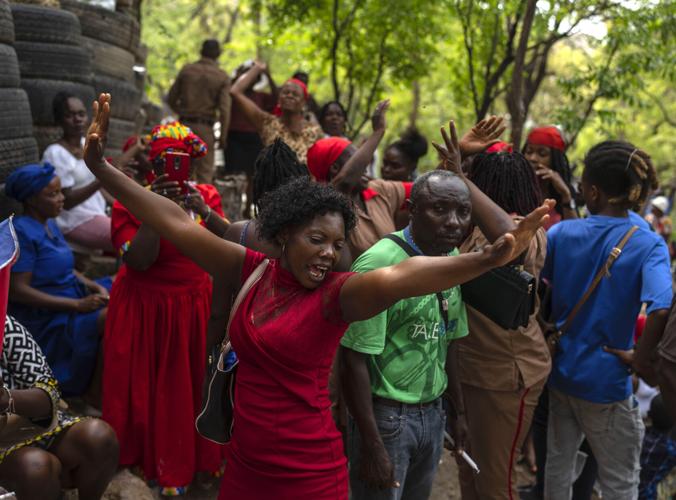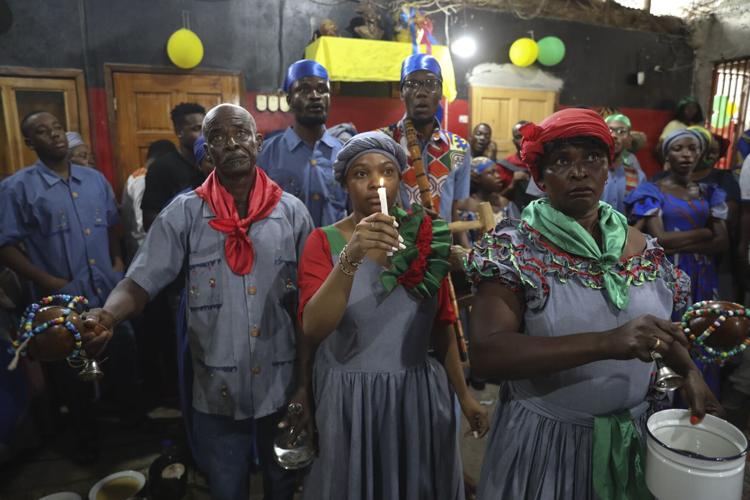
PORT-AU-PRINCE, Haiti — The Vodou faithful sing, their voices rising above the gunfire erupting miles away as frantic drumbeats drown out their troubles.
They pause to swig rum out of small brown bottles, twirling in unison as they sing in Haitian Creole: “We don’t care if they hate us, because they can’t bury us.”
Shunned publicly by politicians and intellectuals for centuries, Vodou is transforming into a more powerful and accepted religion across Haiti, where its believers were once persecuted. Increasingly, they seek solace and protection from violent gangs that have killed, raped and kidnapped thousands in recent years.

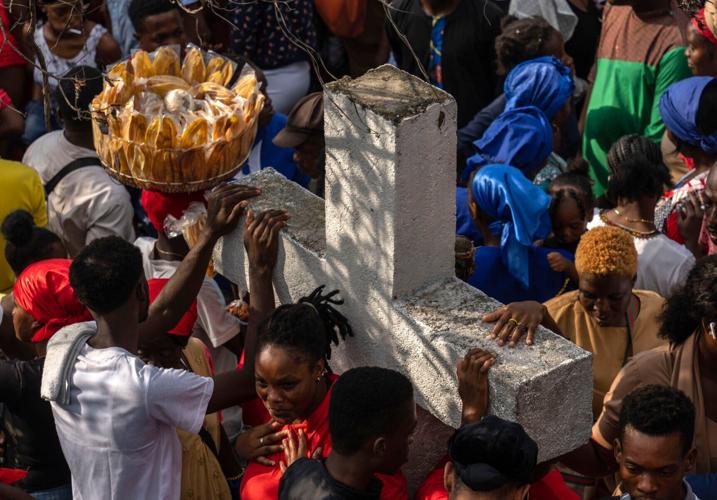
Believers dance during the St. George vodou celebration April 24 in Port-au-Prince, Haiti. While spirits infuse believers with energy and hope, Vodou priests warn they don’t perform miracles.
The violence has left more than 360,000 people homeless, largely shut down Haiti’s biggest seaport and closed the main international airport two months ago. Basic goods including food and life-saving medication are dwindling; nearly 2 million Haitians are on the verge of famine.
People are also reading…
Amid the spiraling chaos, numerous Haitians are praying more or visiting Vodou priests known as “oungans” for urgent requests ranging from locating loved ones who were kidnapped to finding critical medication needed to keep someone alive.
“The spirits help you. They’re always around,” said Sherly Norzéus, who is initiated to become a “mambo,” or Vodou priestess.
In February, she invoked Papa Ogou, god of war and iron, when 20 armed men surrounded her car as she tried to flee the community of Bon Repos.
“I prayed to Papa Ogou. He helped me get out of the situation,” Norzéus said.

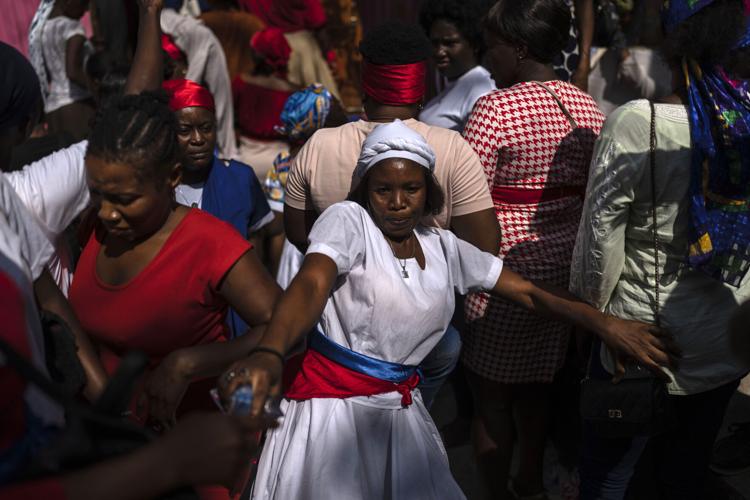
A Vodouist clad in white invokes a gede spirit during the Saint George celebration April 24 in Port-au-Prince, Haiti, where Vodou is transforming into a more powerful and accepted religion.
Vodou was at the root of the revolution that led Haiti to become the world’s first free Black republic in 1804, a religion born in West Africa and brought across the Atlantic by enslaved people.
The syncretic religion that melds Catholicism with animist beliefs has no official leader or creeds. It has a single God known as “Bondye,” Creole for “Good God,” and more than 1,000 spirits known as the lwa — some that aren’t always benevolent.
During Vodou ceremonies, lwa are offered treats ranging from papayas and coffee to popcorn, lollipops and cheese puffs. A ceremony is considered successful if a Vodouist is possessed by an lwa.
Some experts consider it a religion of the exploited.
“Vodou is the system that Haitians have developed to deal with the suffering of this life, a system whose object is to minimize pain, avoid disaster, soften losses, and strengthen the survivors as much as the survival instinct,” Haitian sociologist Laënnec Hurbon wrote in a recent essay.

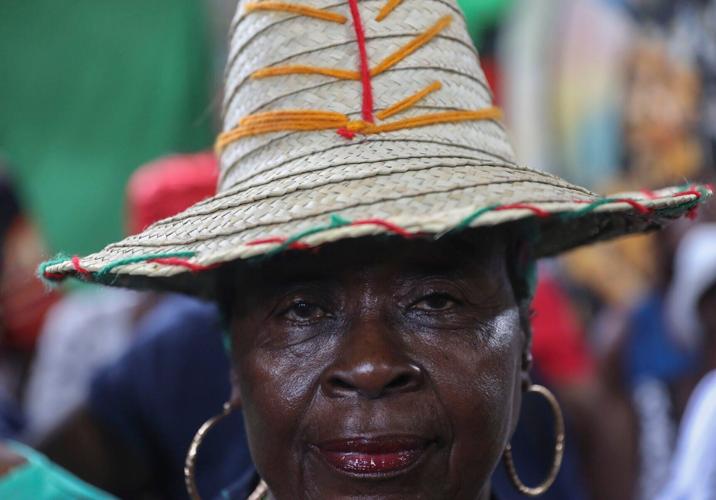
Vodou pilgrims attend a Mass marking the feast day of agriculture and work May 1 in Port-au-Prince, Haiti. A growing number of Haitians are praying more or visiting Vodou priests for urgent requests as gang violence and famine grip the nation.

A Vodou pilgrim attends a Mass marking the feast day of agriculture and work May 1 in Port-au-Prince, Haiti. The syncretic religion that melds Catholicism with animist beliefs has no official leader or creeds.
Vodou began to take shape in the French colony of Saint-Domingue during funeral rituals for enslaved people and dances called “calendas” that they organized on Sunday evenings. It also was practiced by slaves known as Maroons who escaped to remote mountains and were led by François Mackandal, a Vodou priest.
In August 1791, some 200 slaves gathered at night in Bois-Caiman in northern Haiti for a Vodou ceremony organized by Dutty Boukman, a renowned enslaved leader and Vodou priest, swearing to keep secret an imminent revolt against slavery.
After a 13-year revolution, Haiti became independent, but Vodou remained oppressed.
The country’s new leaders condemned Vodou worship, as did the Catholic Church.
Catholic leaders demanded parishioners take an oath renouncing Vodou in 1941.
Thousands of Vodou followers were lynched and hundreds of symbolic spaces destroyed in what became the most violent attack in Haiti’s history against the religion, according to journalist Herbert Nerette.

Vodou pilgrims gather round a cross April 24 during the Saint George celebration in Port-au-Prince, Haiti.
But Vodou persisted. When François Duvalier became president in 1957, he politicized the religion during his dictatorship, appointing certain oungans as its representatives.
By 2003, Jean-Bertrand Aristide, a Salesian priest who became Haiti’s first democratically elected president, recognized Vodou as one of Haiti’s official religions.
Despite the formal recognition, Vodou remains shunned by some Haitians.
“When you say you are a Vodouist, they stigmatize you,” said Kadel Bazile, a 42-year-old civil engineer who until recently, was a practicing Catholic.
Vodou is attracting more believers given the surge in gang violence and government inaction, said Cecil Elien Isac, a 4th-generation oungan.
“Whenever the community has a big problem, they come here, because there is no justice in Haiti. You find it in the ancestral spirits,” he said.
When Isac opened his temple years ago in Port-au-Prince, about eight families in the area became members. Now he counts more than 4,000, in Haiti and abroad.
Vodou has since become a key ingredient in Haiti’s rich cultural scene, inspiring music, art, writing and dance.

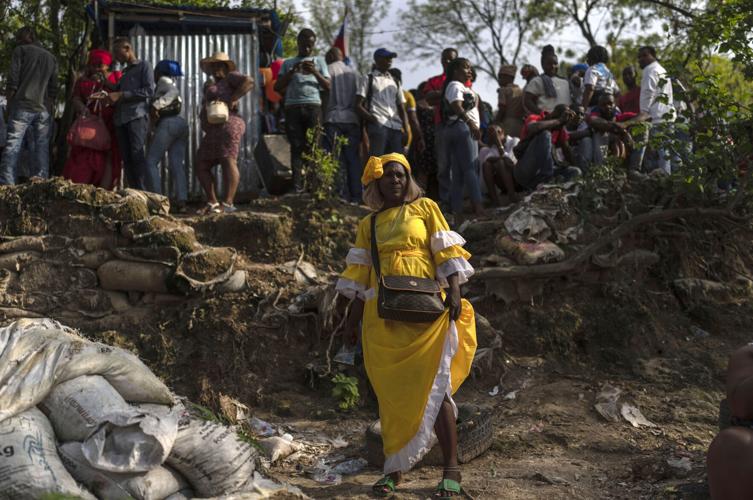
A Voudist clad in yellow, a color associated with the power of light, poses for a photo April 24 during the Saint George celebration in Port-au-Prince, Haiti. It’s unknown how many people currently practice Vodou in Haiti, but there’s a popular saying: “Haiti is 70% Catholic, 30% Protestant and 100% Vodou.”
It’s unknown how many people currently practice Vodou in Haiti, but there’s a popular saying: “Haiti is 70% Catholic, 30% Protestant and 100% Vodou.”
Vodou also has countless lwas, although Ogou Je Wouj — the god of red eyes — has grown more significant to Haitians given the lack of security in the country, said Erol Josué, a singer, oungan and director of Haiti’s National Bureau of Ethnology.
While spirits infuse believers with energy and hope, Vodou priests warn they don’t perform miracles.
“We’re praying, but we’re also taking precautions,” Isac said. “There are a lot of lwas to protect you from kidnapping, but if you walk through certain areas, no lwa is going to protect you.”
Josué, the singer and oungan, noted that some young people becoming Vodouists are trying to change traditional prayers or certain practices, but he said oungans and mambos are not embracing the push.
“We make them understand that those spirits are a symbol of resistance of the Haitian nation,” he said. “There’s a lot of substance in Vodou that can lead to a renaissance of Haiti.”
Hope amid chaos: Haiti students find refuge in music

Woodberson Seide, standing right, plays Sept. 23 with his little brother Jean Roods Seide as their cousin Belle Fleur Sanshaly sits by at the church where they live in the Delmas 32 neighborhood of Port-au-Prince, Haiti. Woodberson Seide's family sleeps on the floor of a church, something they've done since losing their home to gangs.

Siltane Alexandre, right, gives a keyboard lesson Sept. 21 at the Plezi Mizik Composition Futures School in Port-au-Prince, Haiti. The after-school music program founded in 2014 by U.S. nonprofit Music Heals International started with 60 children and has grown into a group of 400 enrolled in the $160,000-a-year program offered at eight schools.

Woodberson Seide plays the drums during service Sept. 24 at a Protestant church in Port-au-Prince, Haiti. Woodberson Seide's family sleeps on the floor of a church, something they've done since losing their home to gangs.

A student practices guitar Sept. 21 at the Plezi Mizik Composition Futures School in Port-au-Prince, Haiti. Students meet twice a week to play for two hours.

Music students hangs guitars back up after practice Sept. 21 at the Plezi Mizik Composition Futures School in Port-au-Prince, Haiti. Across the capital, hundreds of children are playing percussion, piano and bass guitar to drown out the violence and hunger around them.

Music students practice Sept. 23 at the Plezi Mizik Composition Futures School in Port-au-Prince, Haiti. Students in the program are allowed to choose any instrument. Available are guitars, keyboards, bass guitars, maracas, ukeleles, tambourines and cowbells.

Woodberson Seide laughs as he plays Sept. 23 with his step-sister Nayanka at the church where they live after drumming practice in the Delmas 32 neighborhood of Port-au-Prince, Haiti. Woodberson Seide's family sleeps on the floor of a church, something they've done since losing their home to gangs.

Woodberson Seide sits at a drum set Sept. 23 as he studies with his music teacher, Bijou Marc-Williamson, at the Plezi Mizik Composition Futures School in Port-au-Prince, Haiti. “When I play drums, I feel proud,” Woodberson said.

Nayanka Seide accompanies her step-brother Woodberson Seide to his music school Sept. 23 in the Delmas 32 neighborhood of Port-au-Prince, Haiti. They avoided cars, motorcycles, and territory controlled by the gangs whose predation prompted a U.N. Security Council vote for the deployment of a multinational armed force.

Woodberson Seide puts his drums away after a practice session Sept. 21 at the Plezi Mizik Composition Futures School in Port-au-Prince, Haiti. He took his first lesson two years ago as part of the after-school music program founded in 2014 by U.S. nonprofit Music Heals International.

Students take a guitar lesson Sept. 21 with Hebert Michel at Plezi Mizik Composition Futures School in Port-au-Prince, Haiti. The program's teachers and students decide together what music they’ll play, spanning genres that include compas, reggae, rock, Latino music and African music.