When Russell Crowe complimented Rami Malek during the filming of “Nuremberg,” Malek wasn’t sure if it was an actor’s ploy or actual praise.
“I couldn’t tell if he was trying to charm me as Hermann Goring or if it was just Russell,” Malek said. “But there was a respect for what we had on our hands. The story is intimate. It’s epic. It’s about a handful of voices that change the way the world thinks about justice.”

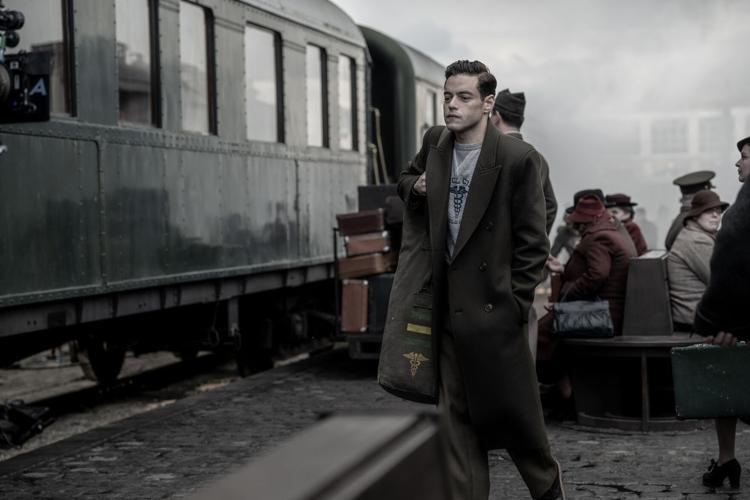
Rami Malek is shown in a scene from WWII drama "Nuremberg."
Based on the book, “The Nazi and the Psychiatrist,” “Nuremberg” shows the conversations between Goring and psychiatrist Douglas Kelley (Malek’s character). The goal is to see if Goring is fit to stand trial for his crimes during World War II. The film includes the actual words from the trial and films from concentration camps. The one-on-one conversations between the two men, however, are something most weren’t aware of.
People are also reading…
Shot in a 10-by-13-foot cell, the scenes zero in on the two men.
“We knew we had a duty,” Malek said, “and if that meant we needed to go toe-to-toe and be absolutely vicious with one another, we could. If we needed to bring moments of humor and allow a certain tension to be released, we could do that.”
Malek, who, like Crowe, is an Oscar winner, said his co-star was ideal to play the enigmatic Nazi leader.
“To fall victim to that charm and then to try to weave my way out of it is what created such tension,” he added.

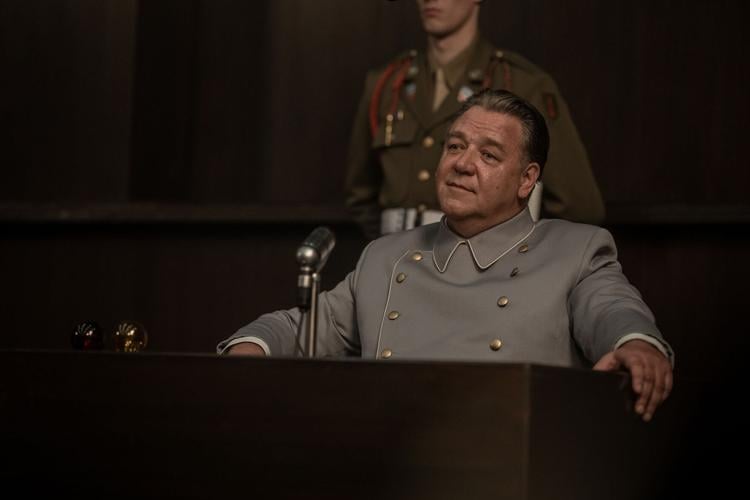
Russell Crowe is shown in a scene from "Nuremberg."
In the courtroom, there’s a different dynamic. Kelley isn’t near Goring, but he is able to digest what his sparring partner has to say. “I remember one specific moment where we were shown (camp footage) and there was only so much I could take in at that moment,” Malek said. “I think I watched about six or seven takes and my editing/director brain started working and saying, ‘What’s next? What’s after this?’” He realized it was a scene in Goring’s cell.
There, Malek confronts Crowe. He noticed a bead of sweat falling down Crowe’s face. “I thought, ‘Is this happening because of performance? Is it happening because of the proximity of that cell?’ I could see a chin quiver; I could feel my heart racing. I couldn’t believe all the nuances that were happening between the two of us. After every take, we could just look at each other without smiling, without blinking but knowing what we were bringing to that moment. It wasn’t who is going to deliver a better performance, it was who is going to allow us to tell this story about moral courage and resilience and speaking truth to power in all its iterations.”
After “Bohemian Rhapsody,” the film that won him the Best Actor Oscar, Malek realized he wanted to do more films that had meaning.
“I’ve always been drawn to roles that raise questions rather than give easy answers. It’s my way of engaging with complex ideas of silence or complicity. Storytelling, for me has always been a way of keeping conversations alive and asking audiences to look at themselves a little differently.
“'Nuremberg' is an endeavor and an achievement, from a filmmaking perspective, that I hold as one of my highest achievements.”