It’s showtime in central Nebraska.

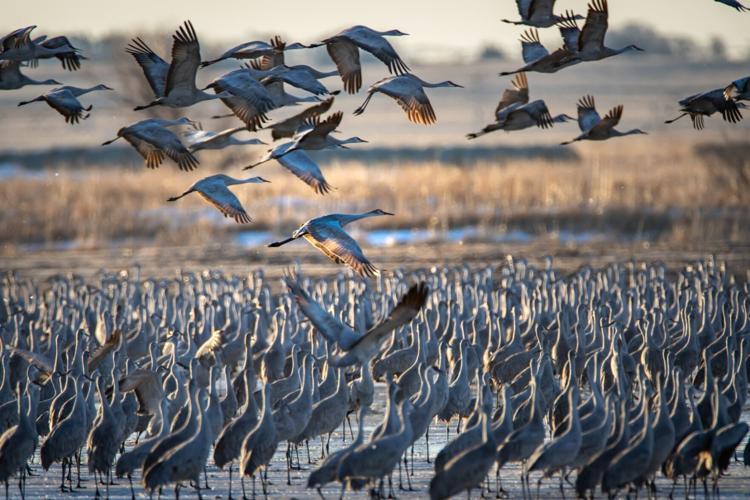
As many as 50,000 cranes have already arrived on the Platte River in central Nebraska on their way north to their breeding grounds.
Fifty thousand of the nearly 1 million cranes that will stop on an 80-mile stretch of the Platte River before heading north to their breeding grounds have already arrived. They’ll be followed by thousands of visitors, eager to view a spectacle like no other.
“It’s an experience that lifts your spirits and engages your soul,” said Brice Krohn, Crane Trust president and CEO. “As the sandhill cranes begin to arrive at the Platte River, we are eager to welcome guests from across the world to witness one of the last great wildlife migrations.”
Eighty percent of the world’s sandhill cranes pass through the central Platte River valley each year, the largest gathering of the species at any place in the world. Visitors follow, coming from every county in Nebraska, every state and numerous countries.
People are also reading…
Both birds and guests will find a big welcome. Their visits mean a $14.3 million boon to the economy each spring, according to a 2017 report. A new study being done this year likely will show a much larger impact.
Roger Jasnoch, retiring director of the Kearney Visitors Bureau, calls it Kearney’s version of March Madness, a popular moniker for the NCAA basketball tournament.

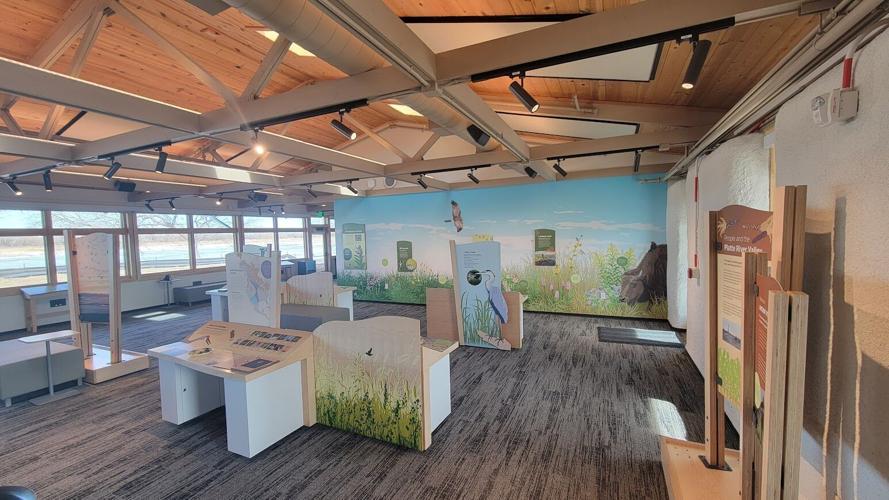
Visitors can learn about cranes, the Platte River and the people of the area in the Discovery Room at the Iain Nicolson Audubon Center at Rowe Sanctuary.
“We have so much stuff going on. Wrestling tournaments, visitors for conferences and that sort of thing,” he said.
“Then we throw the chicken people,” which is what he calls the crane-related visitors, “in on top of that. You’ve got to make your reservation early because we may be full.”
Visitors long ago watched from the hood of their cars. But that has changed.
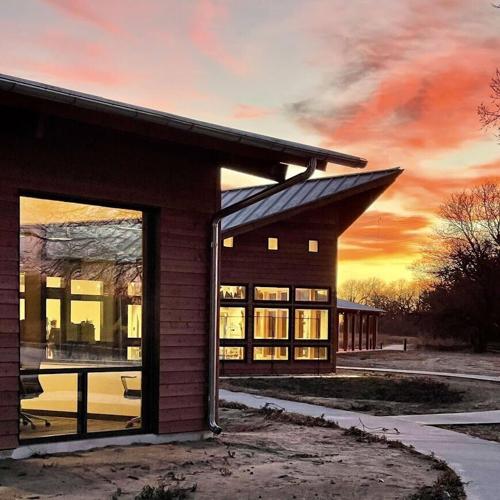
This year, the Iain Nicolson Audubon Center at Rowe Sanctuary near Gibbon marked its 50th anniversary with a $12 million makeover. It and the Crane Trust near Wood River are two of the primary destination spots for crane watchers.
The original structure at Rowe, built to accommodate 5,000 visitors, was renovated with a revamped gift shop and new exhibit hall called the Discovery Room. The Lauritzen Great Hall, the first area visitors see, has new windows to offer better views of the river.
Two new wings house a conference room and community space and the Anne M. Hubbard Education Center.
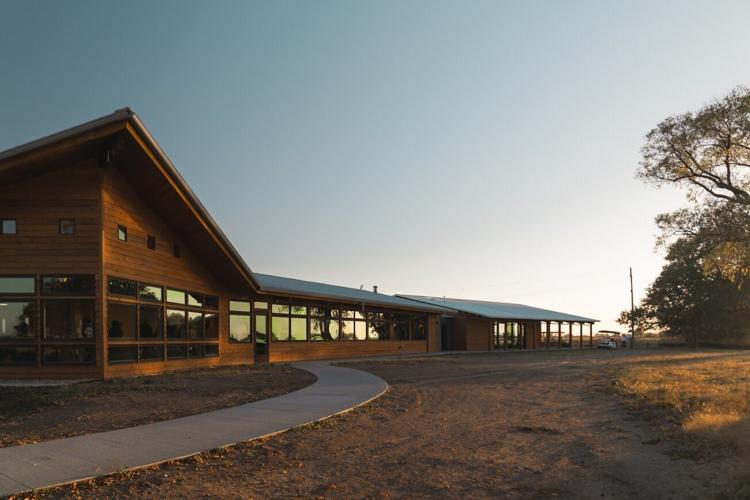
Improvements were done to the exterior, a completely concrete parking lot was added along with a fully accessible trail and a wetland deck. A river viewing platform allows views five miles up and down the river.
Now Rowe, with the 12,000-square-foot building, can better accommodate the 30,000 visitors that typically make their way through its doors.

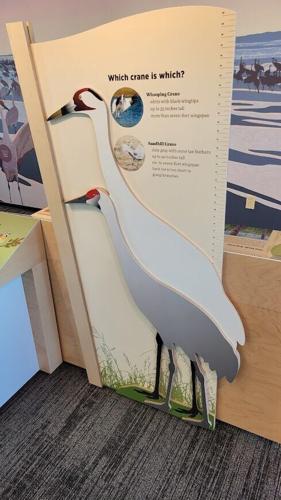
An exhibit shows how to tell the difference between a sandhill crane and a whooping crane.
“We were due an upgrade,” center director Marcos Stoltzfus said. “There’s a lot of space to spread out and welcome visitors. We just about doubled our square footage.”
In the Discovery Room, exhibits tell the story of the Platte River, the migration of cranes and the people of the area. Together, they provide insight into the center and the big migration.
That the migration continues as it has for millions of years is due to a collaborative effort by Rowe, the Crane Trust, the Nature Conservancy, Nebraska Game and Parks, the U.S. Fish and Wildlife Service, the Platte River Recovery Implementation Program and others, Stoltzfus said.
Changes in the way the Platte River has been managed in the past 100 to 150 years could have adversely affected the route through Nebraska. The elimination of spring flooding on the Platte due to developments in irrigation and dams meant the creation of more tree and vegetation-filled islands in the river rather than the moving sandbars preferred by the birds.
To combat those changes, farming equipment is used to churn up those islands in the shallow water of the Platte to keep them empty.
“The simple way to think about it is, we keep the habitat the way that they like it,” Stoltzfus said. “One of the things they really like is to roost on the river each night. It keeps them safe from predators.”
Because the cranes also need foraging habitat, Rowe alone has protected about 3,000 acres of land along its five-mile stretch of the river. Two people work full time on combating native species and holding subscribed burns to manage grasslands, which have largely disappeared from that landscape.

Improvements were made to the outside of the Iain Nicolson Audubon Center at Rowe Sanctuary, part of a $12 million renovation.
Cattle at Rowe and the bison herd at the Crane Trust, which protects 8,000 acres of land, keep invasive species at bay and knock down vegetation.
That collaborative effort has helped the whooping crane population grow from about 20 in the 1940s to a migratory population of around 550 that visit the 80-mile stretch from Chapman to Overton.
They and the sandhill cranes will be around until early April, when they head to Canada, Alaska and as far north as the Arctic Circle.
The birds leave early in the morning to feed on the surrounding corn fields and then return at sunset to roost. That leaves a lot of time during the day to enjoy the attractions in the surrounding communities.
“I’m thankful for whoever taught the cranes that,” Jasnoch said.

A sunset photo of the Iain Nicolson Audubon Center at Rowe Sanctuary, which draws about 30,000 visitors for the spring crane migration.
The past few nights Stoltzfus has stood outside in the evening watching the birds arrive. The cranes are charismatic, he said, with their size, their calls and how they dance and interact with each other.
Watching the sheer number of birds is like nothing the director, who arrived last May, had ever seen before.
“It’s hard to put to words. It’s a full sensory experience, and it’s unforgettable,” he said. “It makes a unique and very indescribable experience that people from come all over to see.”