KIRKWOOD, MISSOURI — When David Purcell decided last spring to go on a three-year, round-the-world cruise, things at home were falling apart.
His wife of half a century, Beth, was dying of cancer. She had been on hospice for more than a year, wasting away in a hospital bed in their Kirkwood, Missouri, living room.
“She suffered a great deal more than she was supposed to suffer,” said Purcell, 78.
He didn’t want to admit it, but he was suffering, also — living in a fog, taking multiple naps a day.

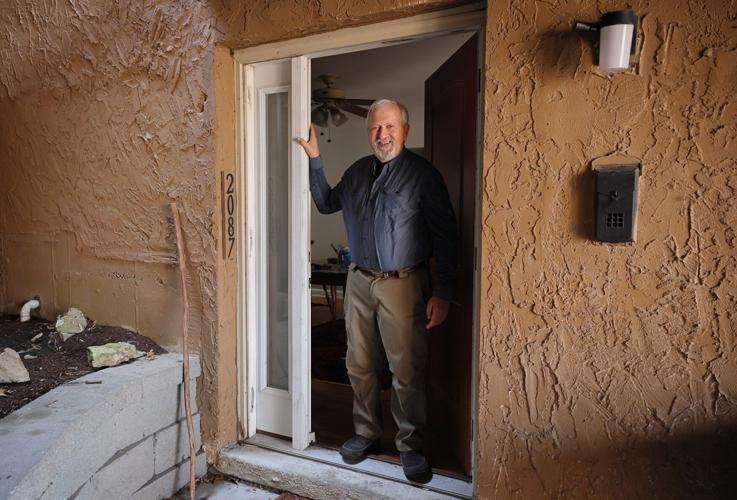
David Purcell stands at the entrance to his apartment in Kirkwood on Friday, Feb. 9, 2024. Purcell sold his house, car, many of his other belongings and put money down to hold his spot on a three-year round-the-world cruise. Then the company operating the cruise canceled the trip.
Then he saw a story about Life at Sea: 382 ports. 140 countries. 1,095 days. The expedition would leave in November.
“Maybe there’s a life left for me,” Purcell thought.
He put down a deposit weeks before Beth died in May. It somehow felt like he was carrying around a lottery ticket, one where he knew the numbers he’d picked were the numbers. All he had to do was get ready for the draw.
People are also reading…
Purcell, a retired lawyer, was not the only one lured by the fantasy of exotic surroundings and ocean adventures. Miray Cruises, based in Turkey, announced the ambitious itinerary for Life at Sea on March 1, and almost 300 cabins were reserved by the end of the month, according to a former executive. The priciest suites rang up for close to a million dollars, but the cheapest started at $90,000 — not pocket change, but less expensive than three years of housing costs in some big cities.
The announcement of the longest cruise ever, as Miray claimed it would be, made “Good Morning America” and CNN. A retired flight attendant nabbed the first ticket, writing in The Guardian that she was looking forward to being with others who were “grabbing life by the horns.”
So the week before Thanksgiving, when Life at Sea was scrapped, scores of aspiring globetrotters were deserted. They had sold homes, quit jobs and bid farewell to loved ones. Purcell had shelled out a $55,000 deposit. Some hopeful travelers had put down even more. A few were already waiting in Istanbul.
Purcell was in Honduras, testing out his scuba legs, when he heard the news.
“I’m homeless,” he thought. “Hundreds of us are homeless.”
Fresh worldview
Purcell had already taken a gamble once, decades ago, and hit the jackpot. While he was in the Navy, stationed on a destroyer along the coast of California, he attended a dance where a bubbly young nurse caught his eye. It took a week for him to track her down at the Naval hospital in San Diego — the largest military medical facility in the world.
Purcell had found a lid to his pot: He was the big-ideas guy; Beth tended to details. He was quick; Beth meandered.
Eventually, the couple headed to St. Louis so Purcell could attend law school at Washington University. They moved into a gray-shingled house in Kirkwood with a leafy backyard and raised three girls. They traveled a little — nothing extravagant, mostly station-wagon road trips.
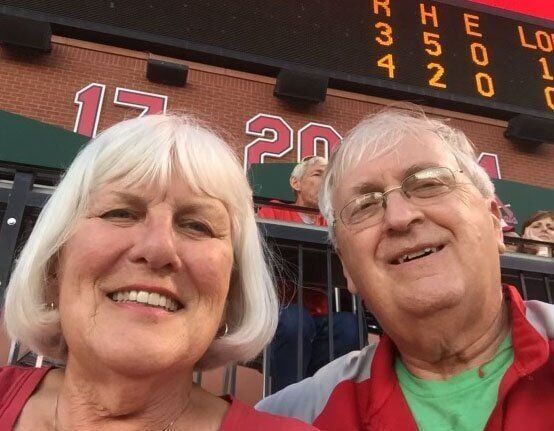
David and Beth Purcell enjoy a day at Busch Stadium in 2015. The two raised a family in Kirkwood and later enjoyed retirement together, before Beth, who spent most of her career as a cardiothoracic intensive care nurse, eventually succumbed to cancer in 2023.
After retirement, the couple stayed busy: gardening, visiting their grandkids in Colorado, getting more involved in church. Three years ago, Beth fell while in the yard, and then again on a trip to Mexico for their anniversary. By the summer of 2021, she was having trouble keeping food down. That July, she was diagnosed with pancreatic cancer.
Beth, who spent most of her career as a cardiothoracic intensive care nurse, knew it was a death sentence. She tried radiation and chemotherapy, but the side effects were too much.
At-home hospice began in early 2022. Their middle daughter, Jody, handled much of the caregiving. It wouldn’t be long, they all believed.
But Beth lingered. Dementia set in. The cancer wore the family down.
“It’s a grueling disease,” said Purcell. “It was grueling for everyone.”
The cruise seemed like a promise that something better was possible.
“My eyes glazed over when I saw the itinerary,” Purcell said.
He would crisscross the globe, stopping at Machu Picchu, the Taj Mahal, French Polynesia, the Amazon, New Zealand, Alaska.
“We were just going to go everywhere, see everything,” he said.
Purcell was back in childhood, when he dreamed of being a pirate. He was in the Navy again, in cramped quarters but with a brotherhood on board with him.
He saw his future as well, making new friends, attempting new hobbies. Maybe he would learn to tap dance or join a singing group. Maybe he would write a book.
Jody could see that just the prospect of the odyssey was lighting her father up. He had told her months prior that he’d never leave the house in Kirkwood. But he got Beth’s blessing before she died, and, in May, soon after her burial, he was itching to be rid of it all.
“I started thinking about not having any real estate, not having any cars,” Purcell said.
He moved out of the master bedroom and into what had been his daughters’ nursery. He wanted to mimic what it would be like to live in a 150-square-foot cabin.
Warning signs
By that time, Life at Sea had hit a few roadblocks. The project was a partnership between Mikael Petterson, a Florida-based entrepreneur, and Miray International. Petterson had formulated the concept. His team was responsible for sales and marketing; Miray would cover operations.
But the ship it originally planned to use was deemed incapable of making such an extensive journey. There were disagreements about where American passengers’ deposits should be held. Petterson said he had collected $20 million by late May, but he wasn’t getting answers about where the money was going.
“I was told to mind my own business,” Petterson said.
Instead, he quit. So did almost two dozen people from his team. Some passengers bailed, too.
Ethem Bayramoglu, Miray’s chief operating officer, contends that Petterson departed because of a personal dispute with Kendra Holmes, a Miray executive who later became CEO and has since left the company.
“We had to continue the project without him,” Bayramoglu said in an email. “We did not want to abandon all passengers who trusted in our name.”
Despite the turmoil, many people — including Purcell — hung on.
Miray told them it had located another, better ship, which it would be buying in the fall. The company held reassuring webinars, often hosted by Holmes. And passengers connected on an app, sharing advice and information.
The summer was a scramble for Purcell. He secured his visas, updated his scuba certification and dusted off his fishing tackle and skiing gear. He spent $3,000 on vaccinations, he said, for yellow fever, typhoid, Japanese encephalitis and “other things I’ve never heard of.”
A lifetime of possessions got boxed up and stored, sent to his kids, or sold. One night, he and his daughter hauled everything that was left onto the front yard with a sign that read, “Free stuff! Moving soon!” They took apart a piano so they could squeeze it into a hatchback.
“It was chaos,” said Jody. “The stress of how fast we had to do this, it was too much.”
Rebuilding
The house was sold in September. Purcell couch-crashed with friends from church.
That same month, Miray had pledged to purchase its new ship, which it would rename the Lara. But an announcement of the acquisition never came. The company had missed its deadline to send out containers for additional storage. Passengers’ emails were going unanswered.
Jody, who had moved to her mother’s hometown in Indiana, was feeling more and more unsettled. She wasn’t sure how much to let on.
“I didn’t want to be a killjoy,” she said.
She wanted the cruise to work out as much as her dad did, maybe more. Even so, the time and distance that would separate him from everyone he knew felt risky to her.
“Once he got on that boat, and he didn’t have my mom anymore, I was afraid he’d hit rock bottom,” Jody said.
The lack of details about the cruise ship didn’t keep Purcell from saying his goodbyes. In October, he flew to Colorado for a bon voyage with his youngest daughter, Erica, and his two grandchildren.
“It was really sad,” Erica said. “It was like the end of an era, of my roots in St. Louis.”
The contract with Miray stipulated that the launch could be postponed for up to a month. In the middle of October, the company announced the Nov. 1 departure would be pushed back 10 days. Then it was delayed again, until Nov. 30.
Purcell was antsy. He thought he’d be sailing by then. He decided to head to Honduras, a mini trip before the major trip. That’s where he learned what happened: Life at Sea was dead.
“There were some bad words,” he recalls. “I realized I had to go back to St. Louis and rebuild.”

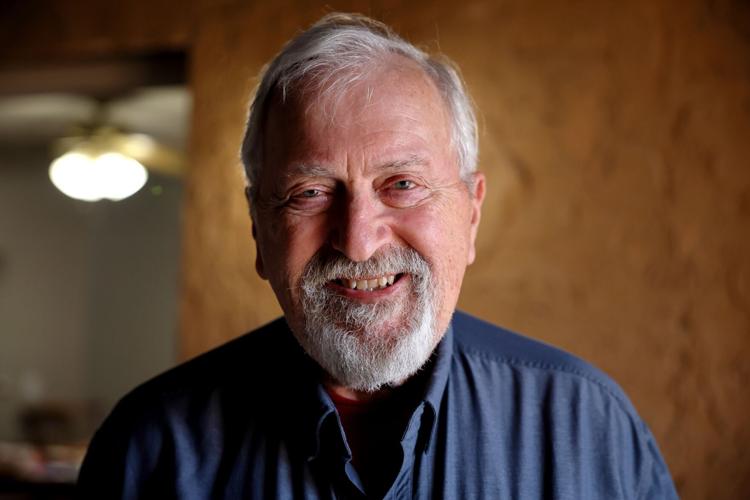
David Purcell, who sold his house and all his belongings to prepare for a three-year cruise, stands at the entrance to his apartment in Kirkwood on Friday, Feb. 9, 2024.
Purcell rented an apartment not far from his old home. He started doing research and compiling documents. Last month, he and 77 other would-be passengers filed a criminal complaint against Miray with the U.S. attorney’s office in Florida. It estimates their losses at $16 million. Bayramoglu, Miray’s COO, would not confirm the amount but said it was “much less” than that.
He said Miray had 110 cabins booked at the time of the cancellation. In a text message, CEO Vedat Ugurlu said “at least 30 to 40” of 150 people had received reimbursements, though he did not specify if they were partial or full. The company has pledged to finalize all refunds by Feb. 22.
Purcell doesn’t believe it. He wants his money back, but recognizes it won’t be a balm for his heartache. Beth is gone.
“That was my big-time loss,” he said. “She was a neat lady.”
He is attending grief therapy and reconnecting with friends. His daughters are helping him sort through what was hastily packed away.
Among the rescued belongings, he found a map. It has sparked ideas, though he’s in no rush.
“Right now, I’m just trying to make a nest. I do need to have a nest,” Purcell said. “Then I’ll branch out.”