
A moment Atlantic City has long feared is drawing nearer: Gambling companies have submitted eight bids for the three licenses expected to be awarded in or near New York City by the end of this year.
But lost in the general anxiety over what three new casinos on New Jersey’s doorstep might do to Atlantic City’s casino industry is this fact: Four of the eight proposals for New York come from companies that already operate casinos in Atlantic City.
In effect, they are bidding to compete against themselves.
So The Press of Atlantic City asked: If you get a license for a New York casino, will you commit to keeping your Atlantic City casino(s) open?
Two said they would: MGM Resorts International, which owns Borgata Hotel Casino & Spa, and Bally’s Corp., which owns Bally’s Atlantic City.
People are also reading…
Bally’s, however, is in a unique quandary: Earlier this month, New York City Council denied zoning changes the project needs to get built. That seemingly dooms the proposal — unless Mayor Eric Adams vetoes council’s decision, something he is considering.
Two others would not say: Caesars Entertainment, which operates three Atlantic City casinos — Tropicana, Caesars and Harrah’s Resort — and Hard Rock International, which owns Hard Rock Hotel & Casino Atlantic City.
The last time new nearby competition was a real possibility, in 2016 when a referendum on whether to allow two casinos in North Jersey was on the ballot, the industry was awash in predictions that anywhere from two to five of Atlantic City’s casinos could close as a result.
That did not come to pass, as the referendum was defeated by an 80% to 20% margin. (Two state lawmakers want to revive the idea, introducing a bill to ask voters again to approve gambling in the Meadowlands complex in East Rutherford, just outside New York City.)
So far, there have not been similar predictions of the imminent demise of one or more casinos.
But the concern is real as to what might happen next.

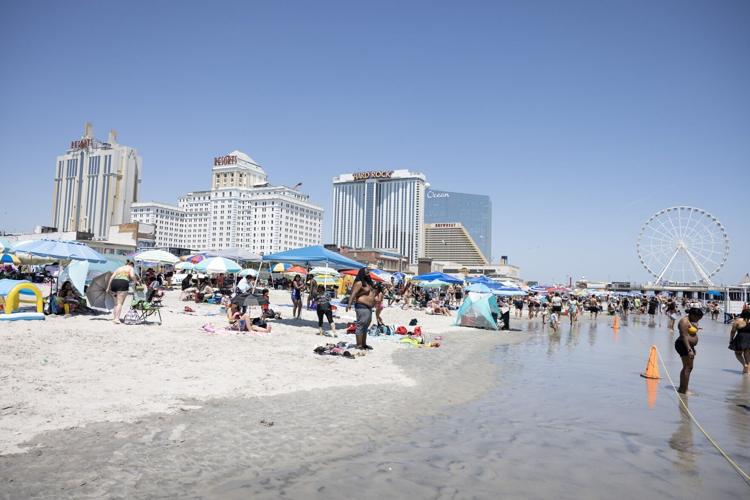
On July 4, 2025, views of the expanded beach in front of the north end casinos in Atlantic City.
“It’s hard to see how this could help Atlantic City,” said David Schwartz, a gambling historian at the University of Nevada, Las Vegas. “The market is still building itself back up and seems to have been dealing with existential crises for the past 20 years.”
Jane Bokunewicz, director of Stockton University’s Lloyd D. Levenson Institute of Gaming, Hospitality & Tourism, which studies the Atlantic City gambling market, said the next few years “will be interesting” for casino companies with existing properties in Atlantic City that also want one in New York.
“Downstate New York casinos, when they finally do open, will no doubt increase regional competition for casino patrons,” she said. “While the New York commercial market may increase its overall market share, neighboring jurisdictions, including existing New York casinos, will likely see declines, at least in the short term.”
She said businesses will be interested in seeing a return on their efforts in New York, and might leverage their databases from Atlantic City and other states to build up visitation to these new facilities.
“Coupled with the draw generated by the novelty of newness, this could have at least a short-term negative impact on Atlantic City operations,” she said.
But it could cut the other way, too.
“From a tax standpoint, these businesses might be inclined to try directing consumers to their Atlantic City operations to take advantage of New Jersey tax rates that, even with recently proposed increases, would be more favorable than those in New York,” Bokunewicz said.
Marc Jacobson, a spokesman for MGM Resorts International, said simply, “We’re committed to keeping Borgata open.”
It makes sense; Borgata is Atlantic City’s top-performing casino, with $1.36 billion in total gambling revenue last year.
At the lower end of the revenue scale, Bally’s will keep its Atlantic City property open “whether we win in the Bronx or not,” said spokeswoman Lauren Westerfield.
Bally’s did not respond to requests for comment after the New York City Council vote went against it.

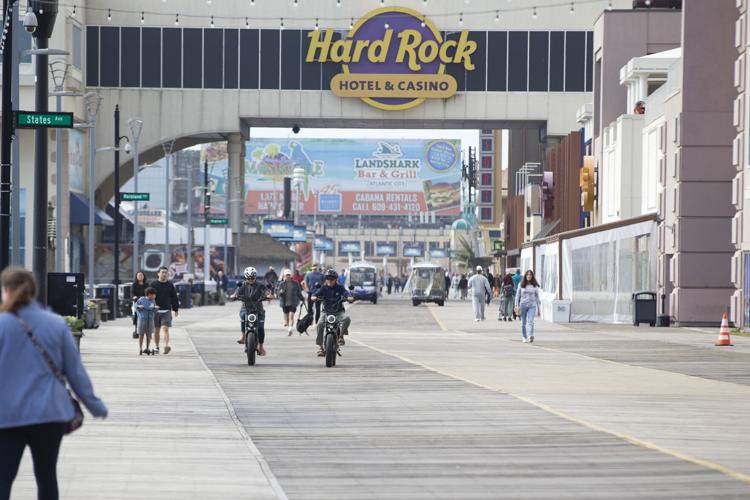
Views of boardwalk lead to the Hard Rock Hotel and Casino in Atlantic City, N.J.
While stressing the mayor has not yet decided whether to intervene and revive the Bally’s proposal, deputy press secretary Zachary Nosanchuk indicated Adams is concerned that council may have treated the Bronx unfairly in rejecting the zoning changes it needs.
“The City Council’s disapproval of this Bronx bid pits boroughs against one another and leaves the Bronx unable to even have a shot at benefiting from the potential of new jobs and new investment in their community,” he said. “By rejecting the land use application for one casino bid while approving two others, the City Council is putting its finger on the scale before the state ever has a chance to consider applications. We are reviewing our options in response to this vote.”
The mayor has 10 days to veto the move. But that clock starts running from the moment council transmits its decision to the mayor’s office, not when the vote took place. As of late Wednesday, the mayor’s office had not received anything from council regarding Bally’s, Nosanchuk said.
The other two companies with a foot in each state are Hard Rock, which declined to comment, and Caesars, which did not respond to messages seeking comment over a week.
The New York proposals include add-ons to existing racetrack casinos in Queens and Yonkers, as well as multibillion-dollar resort projects in Manhattan, Queens, Brooklyn and the Bronx.
Price tags range from $2.3 billion to over $11 billion.
Hard Rock is partnered with New York Mets owner Steve Cohen and others on an $8.1 billion casino resort next to CitiField, the Mets’ baseball stadium in Queens.
And Caesars is partnered with SL Green, Roc Nation and Live Nation for a $5.4 billion casino resort in the heart of Times Square.
As far back as 1997, when New York was considering legalizing commercial casinos (they were approved in 2013), one New Yorker predicted that would hurt Atlantic City.
“If gambling happens in New York, it will be very detrimental to my holdings,” Donald Trump said at the time, when he owned three Atlantic City casinos.
For now, Atlantic City is focusing on what it can control: the quality of its offerings and conditions in the city.
“We have known that downstate New York casinos have been on the horizon for years,” the Casino Association of New Jersey said in a statement. “While we recognize this expansion will have a substantial impact on the Atlantic City market, we must continue our ongoing efforts to transform Atlantic City into a leading year-round beachfront resort destination.”
In the last few weeks, Resorts Casino Hotel has unveiled a new tiki bar and outdoor stage, and a Boardwalk tapas bar, representing a combined investment of nearly $3 million.
Bokunewicz said that approach could succeed.
“Increased competition has often led to operators making considerable investments in amenities and the improvement and differentiation of their product,” she said. “To remain competitive at the national scale, all Atlantic City casino operators, even those with New York assets, will need to continue to invest in their properties to attract new customers and maintain existing customers from other markets.”
And Schwartz, the UNLV historian, is not betting against Atlantic City just yet.
“The city and its people are resilient, and what Atlantic City looks like on the other side of this might be quite different,” he said.