

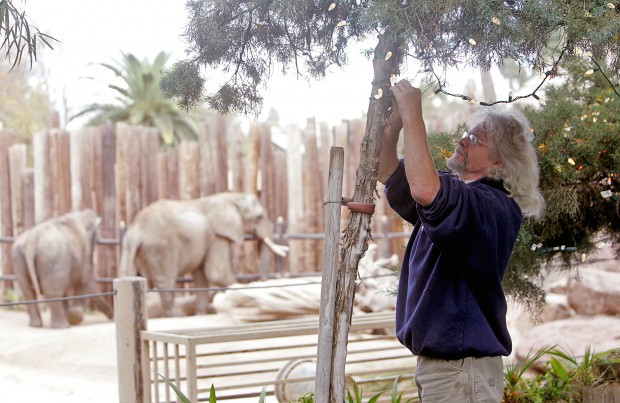
Should the trees be strung from the bottom up or top down? What lights should you go for? And should you even try stringing that saguaro? Decorating the outside of your home can become one big holiday headache. So we interrupted the efforts of two of Tucson's top light-hanging teams and asked them to share their tips.
About our experts
• The "team" behind Reid Park Zoo's holiday lights is largely just one person: semiretired zookeeper Mark de Denus, now living in Winnipeg, Canada.
When he worked here, the light hanging became part of his job. Because he's so familiar with it and the animals, de Denus is flown down here each year by the zoo just for this purpose.
He spends the month of October putting up Halloween decorations, then November decorating the park for Christmas, before returning home in early December. Then he returns in January for the three-week-long job of taking them all down again.
People are also reading…
Eight years into his light hanging gig - a full-time job that he spreads across day and night hours - de Denus has only minimal help from other staff and volunteers.
If visitors to the Zoo Lights look closely, they'll see some gaps in the decorations. De Denus avoids lighting the inside of trees around the perimeter of the giraffe area, as the giraffes tend to nibble on the lights. For the same reason, he won't light near the gibbons or elephants.
• Home-schooling mother of five Devra Raica, 41, is the brains behind Holiday Light Hanging, originally started nine years ago by her brother-in-law, Tim Raica, and his sister, Susan Derbak.
Devra and her husband, T.J. have since taken it over, although Tim is still involved. The brothers are the principal light hangers, using up vacation time from their day jobs and working weekends. Devra deals with the customers and fields prank calls and calls from competitors trying to find out their hanging techniques.
They recruit help from their family: siblings, in-laws and Devra's three eldest children.
"The lights that are put up are so much better than anything we could do ourselves," says client Donna Rogers, owner of the northwest-side home being decorated in the photos at left.
Repeat business is high, says Devra, who charges $45 per man hour. She estimates they can do in a few hours what would take a homeowner three days.
If you go
• What: Reid Park Zoo Lights
• When: 6 to 8 p.m. Thursdays to Sundays, through Dec. 19; also Dec. 20-22.
• Cost: $3 for children 2-14; $4 for member adults and $5 for non-member adults. A $2 discount will be given to each ticket for a new, unwrapped toy for the Toys for Tots program through Dec.13.
• Info: 791-4022.
TIPS
1. The right lights
If you're buying new, go for LED, say our experts. You can connect more strands to one outlet, they last up to 20 times longer than regular lights, and use up to 80 percent less energy.
Plus, their plastic bulb surrounds are hard-wearing. "They're far superior to lights whose bulbs will shatter pretty easily," says Tim Raica.
• Use a reliable brand and stick with it, as the "male" and "female" ends of different brands may not match up. The Raicas use GE Commercial Grade miniature lights.
• Use multipurpose clips that work on shingle, tile and guttering, with 12- to 18-inch gaps.
• Test the lights first, and if it's a big job like a tree covering, test them during as well. Glass bulbs in particular can catch on a plant and break.
Tip: For the ultimate in energy savings, try solar-powered light strands.
2. Bottom up or top down?
The team at Holiday Light Hanging does both. When they're wrapping the trunks of trees that have foliage, they work from the bottom up. That way you can easily hide any excess lights under the tree's branches.
For palms and saguaros where there isn't any foliage, they suggest starting at the top and bundling excess lights at the bottom of the trunk. (See No. 4.)
The Raicas favor looping strands from left to right around a tree or plant, rather than - as some people do - vertical looping. Why? They say it looks prettier.
Tip: Don't crisscross the strands around a trunk or a Christmas tree, says Mark de Denus, as they'll be more difficult to take down. Or to save time, try using nets of lights rather than strands.
3. What about those saguaros?
You'll need:
• An extendable pole and a grip. Kits with 11-foot poles, a pole adapter and clips are available for about $19.99 from hardware and DIY stores.
• Gloves.
• An extendable ladder.
• Another person to help or hold the ladder.
• A way of securing that first length of lights to the top of the cactus so they don't dangle. The Raica brothers have come up with their own solution for this, and as far as they know it hasn't been replicated by a competitor. But for that reason they're keeping it secret.
Tip: Don't be tempted to use staples to secure lights to a plant. Our experts say there's too much risk of damage to lights, and it makes for trickier clean-up.
4. The big coverup
If you have excess light strands after you've wrapped a tree or lined a path, find where the last section of lights is and pop out a bulb to disable it. Then bunch up the excess (non-lit) piece, tie with a plastic cable tie and secure with another one somewhere near the bottom of the tree or plant.
The Raicas use gray duct tape to secure and disguise extension cables. They try to find a groove in the driveway to run the cables along and tape them down.
Tip: Large garden staples staked into the ground will secure and direct strands that run along the ground.
5. Think safety
Avoid having connections to the extension cord near irrigation or, if possible, the ground. Lift any connections between the light strand and extension cord plugs off the ground to avoid water.
Tip: If pack rats are a problem, try the Raicas' solution: put down mothballs or dryer sheets as deterrents.
6. Take time for storage
De Denus spends almost as much time taking the lights down - three weeks - as he does putting them up. Proper storage will save you time next year.
• The Raicas roll their lights into a ball and label them according to where they were used.
• De Denus stores his lights and ornaments by color and by size. He also tests lights before he puts them away.
Tip: De Denus makes his own animal shapes by attaching light strands in the shape he wants to hardware cloth or wire mesh, available in hardware and home improvement stores.
Resources
• Reid Park Zoo, 1100 S. Randolph Way, 791 4022.
• Holiday Light Hanging, 405 5844.
