

It's a beautiful day and you want to take the family on a hike in a wondrous natural setting without driving far.
Sabino Canyon.
The relatives from Minnesota are coming in for the holidays, and they'd love a guided tour of our area's scenic splendor from the comfort of a motorized tram.
Sabino Canyon.
Maybe you just need to sit down beside a trickling stream and think things out.
Sabino Canyon.
You get the idea.
The canyon is not only a spectacular slash in the Catalina Mountains northeast of Tucson — it's also our home turf, our municipal backyard, an ever-present place of recreation and inspiration.
People are also reading…
Try this experiment.
Half an hour before sunset on a clear, cool November day, take a stroll on the short Nature Trail in Sabino Canyon. Choose a spot, any spot. Pause there and peer up the canyon — past forests of towering saguaro cacti, past rugged ridges glowing red with the last rays of the day, past shadowed side canyons and towers of rock . . . all the way to the evergreen heights of the Catalina Mountains.
Then, see if you can gaze upon that view for more than a few seconds without feeling a deep sense of the great treasure we have in this natural wonder called Sabino Canyon. Chances are you won't succeed in the experiment.
Today, we offer a list of 10 things to love about the canyon northeast of Tucson.
It's our way of expanding on a celebration held Saturday — in which the U.S. Forest Service officially marked completion of repairs to canyon facilities damaged by a 2006 flood.
Our list of things to love about Sabino ranges from its life-sustaining creek and grandly scenic Phoneline Trail to members of several volunteer groups, who enhance the canyon experience for many visitors.
The 10 choices on our list are purely subjective and ranked in no particular order. If you're a regular visitor, you probably have your own favorite locations, experiences and people associated with the canyon. Please feel free to share them with us by sending an e-mail to the address listed immediately below.
Sabino Creek
Runoff from rainfall and snowmelt high in the Catalina Mountains makes Sabino Creek a rarity in the natural world — a desert-country stream that flows nearly year-round. From frothing little waterfalls at a site known as Anderson Dam high in the canyon to the downstream oasis of Sabino Dam and Lake, the creek is the lifeblood of the ecosystem.
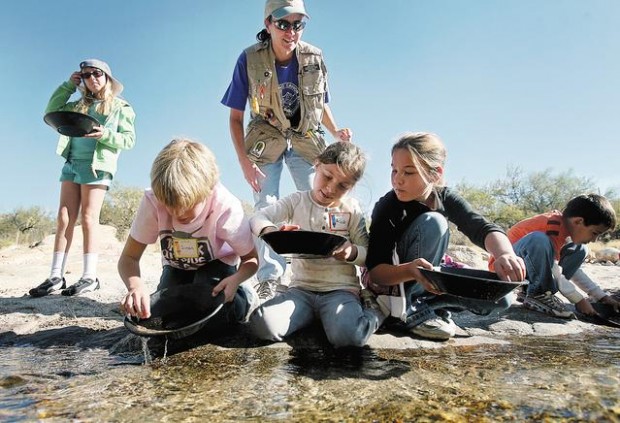
Some of us splash in Sabino Creek's pools. Others seek out the birds and other wildlife drawn to the stream. Many just marvel at the sight of water flowing at the foot of saguaro-studded slopes.
Except in times of flood, the creek is a modest little waterway — but one of the main reasons that Sabino Canyon attracts an estimated 1.25 million visitors annually, says Heidi Schewel of the Forest Service.
Canyon tram tours
Open-air shuttle buses, commonly known as trams, carry visitors on narrated, 45-minute tours on the 3.8-mile road in the heart of Sabino Canyon, which is off-limits to private vehicles.
"I'm really impressed!" exclaimed Brenda Allsop, a visitor from Canada, when she stepped off a tram at its highest stop in the canyon and took in the view. "I've never been to Arizona before. What a way to see it."
Some canyon aficionados, it should be noted, are not fans of the trams, which they see as disruptive.
Trams depart from the canyon visitor center area on the hour from 9 a.m. to 4 p.m. Mondays through Fridays and every half-hour from 9 a.m. to 4:30 p.m. on Saturdays and Sundays. Riders can get off at any or all of nine stops along the route and reboard with no additional fee. Fees are $8 for riders 13 or older and $4 for children 3 to 12. Kids 2 or younger ride free. Information: 749-2861.
Nature Trail
This 0.3-mile loop trail, which begins near the visitor center, is no hiking challenge — but it's an excellent introduction to Sabino Canyon's ecosystem. A flat, handicap-accessible, barrier-free route, the trail features information signs identifying native plants and animals. One of the exceptional sights along the way is a rare cristate, or crested, saguaro cactus.
Little secret: The Nature Trail is a fine place to greet the day at sunrise or savor a calming sunset. And you might well have the area to yourself at these "bookend" hours of the day.
Cacti and other plant life
The big, beautiful saguaro cactus might be the star of the vegetation extravaganza in Sabino Canyon — but lots of other cacti and plants might also catch your eye. Barrel, staghorn cholla, teddy bear cholla and prickly pear cacti add a comely and prickly presence on slopes above the canyon. Palo verde and mesquite trees, ocotillos, brittlebush, Mormon tea and numerous other plants fill in the lush desert landscape. Along Sabino Creek, cottonwood, sycamore and ash trees add summer shade and brilliant color in autumn.
Visitor center and bookstore
Yes, the real Sabino Canyon is right out the door, but a brief stop at the visitor center is a great way to get a quick overview and explanation of what you're going to see.
Exhibits include natural artifacts such as a saguaro cactus rib, white-tail deer antler and the skin of a Western diamondback rattlesnake. Displays offer an introduction to canyon life zones, geology, wildlife and human history. A color-coded "Sabino Canyon Herbarium" consists of dozens of pressed native plants and blooms. Visitors can pick up free handouts on canyon trails, cacti and wildlife. The adjoining bookstore is stocked with maps, nature books, T-shirts and stuffed-animal toys.
Center hours are 8 a.m. to 4:30 p.m. Mondays through Fridays and 8:30 a.m. to 4:30 p.m. Saturdays, Sundays and holidays.
Phoneline Trail
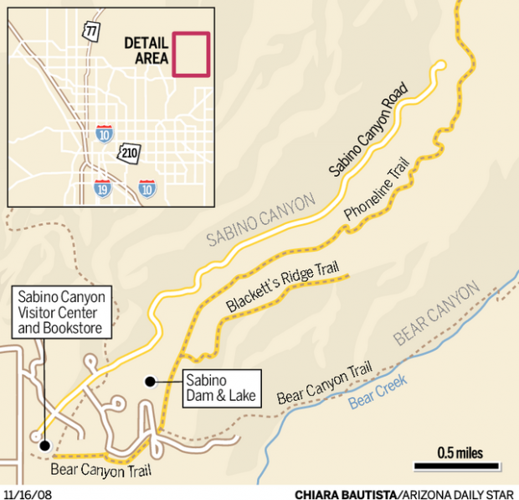
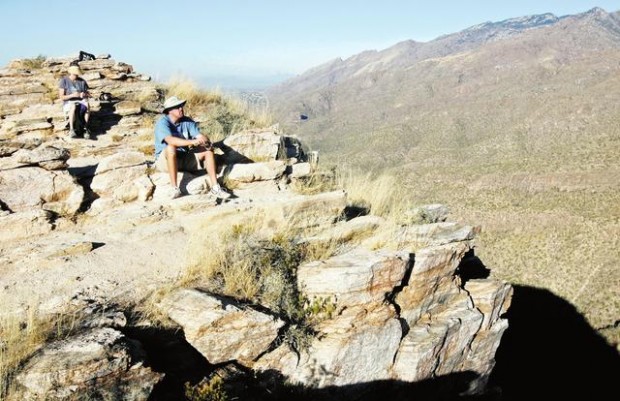
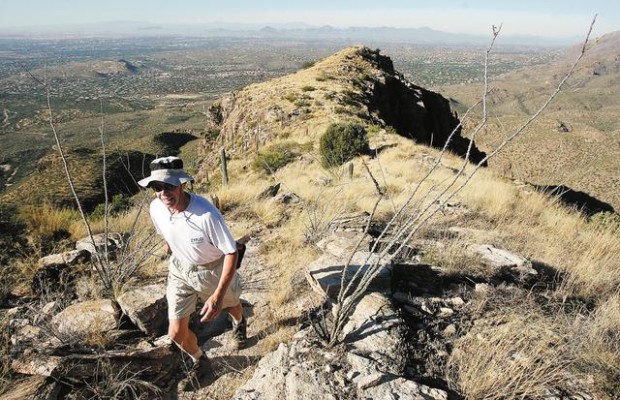
Hearty hikers looking for a bird's-eye view of the canyon — and a good workout in the bargain — will find both on the Phoneline Trail and an offshoot route called the Blackett's Ridge Trail. The Phoneline Trail — which, yup, was named for a long-abandoned phone line — is etched into a mountainside high above the canyon road and generally traces the road's route.
"It was just another day in paradise," says Dave Bushell, president of the Friends of Sabino Canyon, in an entry about a Phoneline hike on the group's Web site. "The view of the green desert and the dramatic canyon slopes was awesome. . . . Hugging the steep north-facing slopes, we bask in the vertical cliffs to our right and the tram and people walking far below."
Not counting an 0.8-mile approach walk from the visitor center, the one-way length of the trail is 4.2 miles. Hikers looking for a shorter but much steeper alternative can cut off on a spur route to Blackett's Ridge, which is both physically and scenically breathtaking. Maps in the visitor center show trailheads and trails.
Critters
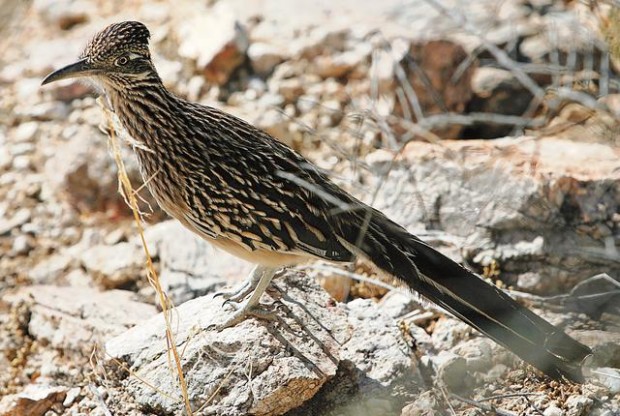
The wildlife of Sabino Canyon is, for many visitors, as much a part of the spectacle as sheer canyon walls. Birds range from roadrunners, sometimes seen near the visitor center, to hawks soaring over Blackett's Ridge. Collared lizards, regal horned lizards, Gila monsters, other lizard species and rattlesnakes fill the reptilian niche along hiking trails. Mammals include jack rabbits, spotted skunks, javelinas, deer, foxes and bobcats. And, yes, mountain lions — large and potentially dangerous predators — occasionally are seen in Sabino Canyon.
Bear Canyon
Hey, wait a minute, isn't this story supposed to be about Sabino Canyon? Well, yes, but here's the thing: The Sabino Canyon Recreation Area is the gateway to beautiful Bear Canyon, which lies over a ridge to the southeast of Sabino. The Bear Canyon Trail follows a watercourse to Seven Falls, a spectacular cascade after periods of heavy rain or snowmelt.
Even though it gets a fair amount of hiker traffic, the trail offers more solitude and perhaps more of a sense of wilderness than trails in Sabino. Options include hiking from the Sabino Canyon visitor center to the trailhead or taking the Bear Canyon shuttle. You'll find the trail and connecting routes on free maps available at the visitor center.
Picnicking
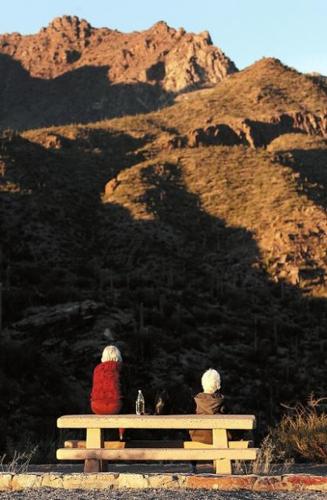
Let's do lunch in Sabino. That invitation doesn't refer to a fancy, pricey cafe but something even better: a picnic amid Sabino Canyon splendor. Pack some grub along on your next trip to the canyon and you'll find lots of alfresco dining options.
People walking up the canyon road or riding a shuttle bus can find picnic tables near several shuttle stops. Another good choice, with tables and restrooms nearby, is a lovely, shaded area near Sabino Dam and Lake. Free maps available at the visitor center show these developed picnic areas.
For hikers, of course, the entire canyon is a potential picnic site. Find a nice flat rock, spread out your backpacked feast and enjoy.
Canyon volunteers
Several volunteer groups play vital roles in enhancing the Sabino Canyon experience for visitors, says Heidi Schewel of the Forest Service. Among them are the Friends of Sabino Canyon — a group that works to protect, preserve and enhance the canyon by funding and supporting projects, inspiring and educating the public and working in partnership with the Forest Service.
The Sabino Canyon Volunteer Naturalists are members of the community who are specially trained to interpret the natural history of the Sonoran Desert and the stream-side area surrounding Sabino Creek. Among other things, they conduct educational programs and lead nature walks.
Other groups include the Santa Catalina Volunteer Patrol, whose members patrol on foot and provide information to visitors. The Sabino Canyon Bike Patrol and the Santa Catalina Mounted Assist Unit perform similar duties while traveling on bikes or horses.
See more photos of Sabino Canyon at www.azstarnet.com/slideshows
If you go
• Get to Sabino: One way is to take Tanque Verde Road to Sabino Canyon Road and continue north to the canyon entrance at 5700 N. Sabino Canyon Road.
• Cost: $5 per vehicle parking fee.
• Information: 749-8700.