
Most of the people reading these words weren't alive when Saguaro National Park was set aside as a federal preserve 75 years ago.
Ah, but here's a telling fact: Many of the saguaro cacti now growing in the park were alive 75 years ago — and at least a few of them were already a century old at the time.
Today, as Tucson's signature park celebrates its anniversary, we're reminded that saguaros grow very, very old in terms of years — with some specimens enduring for up to two centuries.
At the same time, many of us will marvel at the way saguaros never seem to grow old as objects of our interest, curiosity and affection.
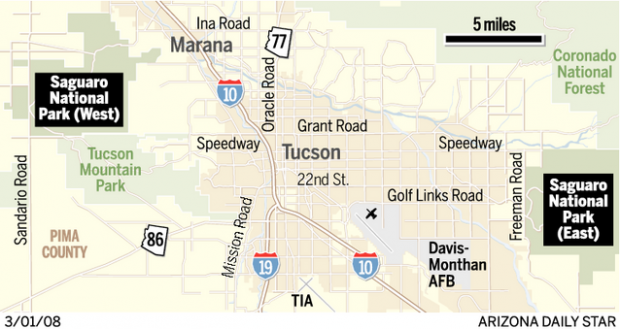
One indication of that faithful fascination: The park attracted 2,847,313 total visitors in 2007 — with 658,477 of those classified as visits in which people got out of their cars and interacted with the park rather than merely driving through. Many of the visitors are Tucson residents who just can't get enough of the cacti and terrain making up the 91,440-acre park, which has separate units east and west of Tucson.
People are also reading…
"The saguaro is iconic. It's a symbol known all over the world," says Meg Weesner, chief of resources management for the park. "I think people relate to saguaros because they sort of look like people. Instead of branches, we say they have arms.
"It's wonderful to live in the Tucson area where we've got this resource so close."
Established as a national monument by President Herbert Hoover on March 1, 1933, Saguaro was designated as a national park in 1994.
Officials estimate that the park is home to about 1.6 million individual saguaros — along with more than 1,000 other plant species.
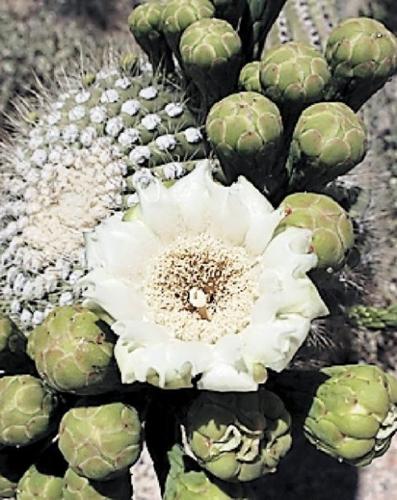
Today, we bring you striking photo images of the park — along with some historical highlights and a short course on the star of the show: Carnegiea gigantea, the saguaro cactus.
Historical highlights
Here are some of the key events in the establishment and history of Saguaro National Park, with information from rangers and the park's Web site.
1920Members of the Natural History Society at the University of Arizona bring up the idea of creating a preserve for saguaro cacti, which were gaining wide recognition as a symbol of the American West.
1928Homer L. Shantz, president of the UA, envisions protected desert areas near Tucson as part of a natural laboratory for the study of plants.
1933President Herbert Hoover signs a proclamation on March 1 establishing Saguaro National Monument in the desert about 15 miles east of Tucson.
1939The Cactus Forest Drive is opened.
1953A visitor center, still in operation today, opens.
1961President John F. Kennedy adds about 25 square miles of land in the Tucson Mountains west of the city to Saguaro National Monument.
1994Congress upgrades Saguaro National Monument to Saguaro National Park.