
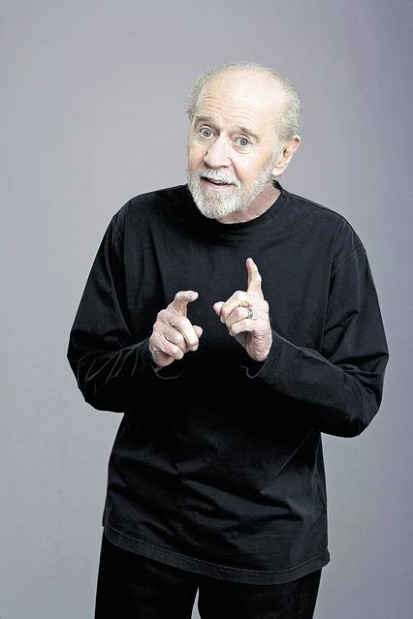
Someone recently asked me who was the biggest comedian I had ever interviewed.
It was a coin toss between Bill Cosby and George Carlin.
If the question had been who was the most intimidating comedian I had ever interviewed, Carlin, who died on Sunday of heart failure, would have been the easy answer.
He was a hard nut to crack, keeping his humor close to his vest. I once asked him what he would be talking about when he performed for UApresents in 1999. He said he didn't want to say too much. If he gave it away in the interview, no one would want to shell out the 30 bucks for his show.
That was my first interview with him; the occasion was his playing Centennial Hall. It was the heat of the Y2K panic and everyone imagined that as the clock was turning to the new millennium, computers would wig out and destroy the world as we know it. Carlin thought it was all laughable.
People are also reading…
"There are bound to be pockets of disruption," he said. "But I think . . . if you look at the map, it would look very random. . . . It'll be kind of interesting, and I always look forward to that. I love chaos in society and I root for it."
But he was also not taking any chances; he had a bunker in his home, a room actually, he said, where he had stocked some "ammunition and some dried food, and I will be waiting."
At that Centennial Hall show, Carlin railed on his theory that God doesn't exist. He offered as evidence that we are too cautious in life, especially when it comes to our kids. "Grown-ups have taken all the fun out of being a kid just to save a few thousand lives," he told the near-sold-out crowd. If there was a God, he argued, surely he would protect kids from things like falling off the jungle gym in the playground or falling off their bicycles when they weren't wearing knee pads and a helmet.
Carlin spent nearly 50 of his 71 years making us laugh and think, throwing our foibles in our face and calling it comedy. It's hard to escape the irony of his career-changing 1970s routine centered on seven words you can't say on TV; today, you would be hard-pressed to find anything off-limits on TV. His comedy has served as our reality check. Once you stopped laughing at those seven little words, you started considering the message and found it made some sense in life's big picture.
His career included dozens of albums, best-selling books, 14 HBO comedy specials, sold-out concerts around the globe and Grammy nods. His last kudo came a week ago when he was named a recipient of the Mark Twain Prize for American Humor.
In a 2005 interview, Carlin reflected on his footnote in American comedy. He blazed new trails, he acknowledged, and his work would be his legacy, speaking for him long after he was gone.
"I've infiltrated the culture," he joked. "Anyone who wants to write about or discuss American comedy in the last third of the 20th century has to deal with me because I made a mark. I had four gold records, four Grammys, three best-selling books on The New York Times list, and now it's 13 HBO shows. That's a longevity and an output that has to be reckoned with."
Carlin last played Tucson Oct. 14, 2007, at Casino del Sol.