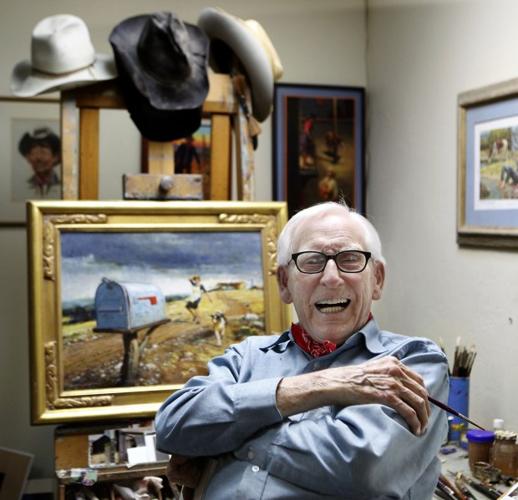
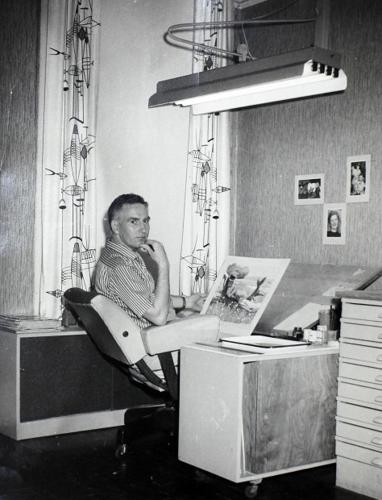
Danged if it isn't tough to classify Tucson artist Duane Bryers. He agrees. "I've had five separate careers: comic strip, calendar pinups, Western painting, portrait and commercial art. It makes me a freak."
Hardly. But it sure does make for an interesting tale to tell. That, too, he'll agree on.
"I've had an absolutely fascinating life," he says.
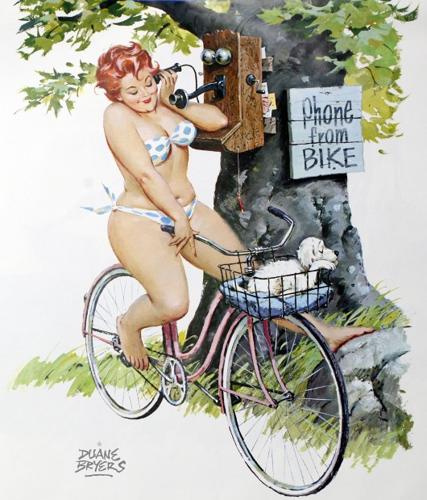
Born 98 years ago - and still painting - Bryers is perhaps best known for his amply-proportioned "Hilda" calendar girls, which he started churning out in the mid-1950s.
"I got the idea for a plumpy gal pinup and thought I'd like to make it into a calendar series," says Bryers. "But how was I going to sell a plump girl?"
Simple. Take it to Brown & Bigelow, the country's top calendar maker. "They reluctantly put it in the line and figured it would last a short time," says Bryers. "It went on for 36 years."
People are also reading…
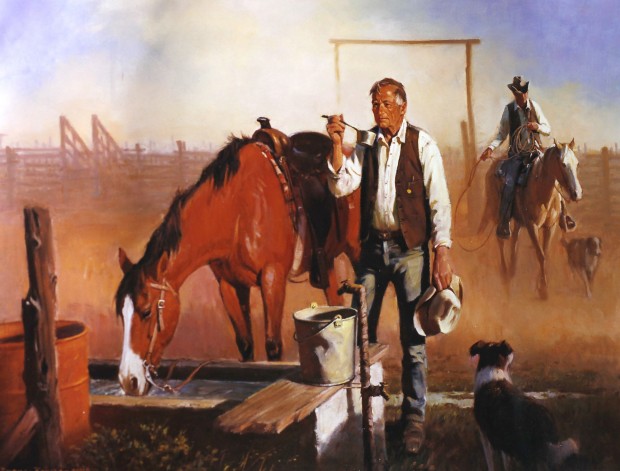
Bryers is also recognized for his Western art - which he delved into after moving to Tucson in 1959.
Though his larger oils in that genre now hang in the permanent collections of the Frederic Remington Art Museum and the National Cowboy Hall of Fame, he prefers that they be called American realism, rather than Western.
"I wasn't going to paint cowboys and Indians. I paint Americana.
"Millions of people have seen my works, but not very many ever know my name," says Bryers, who is represented by Tucson's Settlers West Galleries, where his most expensive painting sold for more than $25,000.
Growing up in the small town of Virginia, Minn., Bryers organized a couple of circuses with other neighborhood kids and excelled on the high school track team, where he broke the state pole vault record in 1929, the year he graduated from high school.
With few jobs around in the early '30s, he worked in a lumber mill and did other pick-and- shovel work.
But already his artistic talents - all self-developed - were emerging. In 1936, he created three huge ice sculptures, including ones of George Washington and Amelia Earhart.
He also carved what he calls "Scrubwoman" from a single cake of Ivory Soap and entered it in Procter & Gamble's National Soap Sculpture competition. He came in second, earning $150.
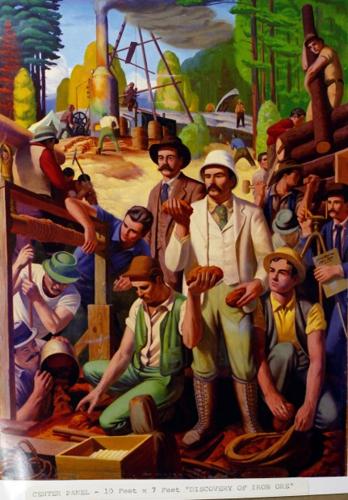
Bigger money was just around the corner. Around 1937, he persuaded the Virginia, Minn., school board to allow him to create a huge mural depicting the iron-mining industry of Northern Minnesota. The mural, which took months to complete, still looms inside a corridor of the town's high school.
"I got $3,000 for the mural," says Bryers, who took the money and a buddy and hightailed it to New York City. Mission: "Astound the art world."
In time, of course, he became yet another "starving artist," one haunting the city's great museums. "I spent hundreds of hours in those galleries and got my intellectual art education there," says Bryers.
He also spent a month at the Art Students League. "I heard they had naked women posing there. Sure enough, they did," says Bryers, who studied with a different teacher each week.
It was in those New York galleries and art studios where he says his mind became "wide open" to contemporary art. "Many of my Western artist contemporaries aren't open to it," he says.
To make ends meet, Bryers worked in various art studios, eventually sharing an apartment with his back-home buddy and two other fellows. "We had four iron cots. It was $125 a month."
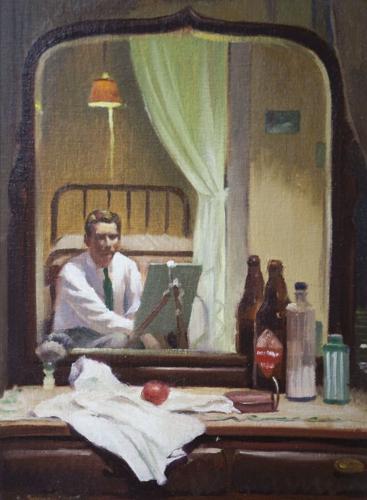
While living in New York, he also painted his self-portrait, reflected in a dresser mirror. "All of my life I have painted the aloneness of the human being," he says.
When his friends started getting inducted into the military, he was forced to downsize to a single, dollar-a-day room. But he also made friends with his Russian landlady and her friends. "We drank vodka, shared stories. Through her I had a direct contact with Russian culture and painting."
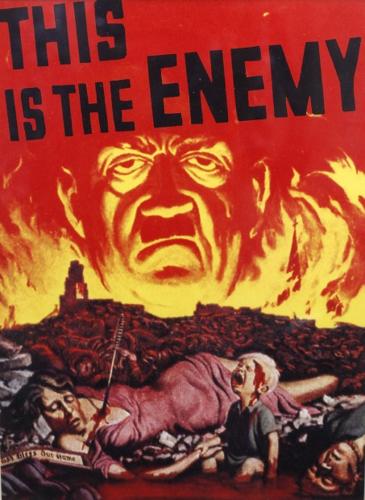
After World War II began, he won a top prize and exposure in Life Magazine for his entry in a national war poster contest sponsored by the Museum of Modern Art.
Not long after, he wound up in the Army Air Forces, where he was sent to aviation mechanics' school, despite telling authorities he "belonged in Washington as a propaganda artist."
Flight crews at his school in Texas did, however, hire him to paint pinups on their planes - four bucks a plane.
Finally, he was reclassified and allowed to do posters and other artwork at other airfields, including one in Topeka, Kan.
There, Bryers began inking a comic strip for the base paper, which was picked up for syndication. It ran until 1951, when its creator tired of it.
By then, Bryers was married and the father of three. About that same time he moved to Chicago and took a job as a commercial artist. "I did shredded-wheat and corn-flakes packages," he says. "The hand pouring the milk over the raspberries and corn flakes, I did that."
From Chicago, the family moved to Connecticut and Bryers went to work in New York City doing commercial art for big-time ad agencies, along with magazine covers. Here was where he thought up and sold the idea of the Hilda pinups.
Meanwhile, Bryers' wife, Phyllis, cajoled him into moving to Tucson, where her sister was moving. "I could do Hilda anywhere," says Bryers, who bought a house on the far east side and built a large art studio.
Gradually, he began painting the strange new world around him. "I started doing Western paintings just for my own amusement. Somewhere along the way I started showing at a small show in Stamford, Texas."
He also became good friends with Western artist Tom Ryan, who did paintings for calendars. When Ryan could no longer produce the calendars, Bryers took over.
"I did this for five or six years in the '60s," he says. "At the same time I was showing talent as a portrait painter."
In 1964, his marriage dissolved. Later on, he would meet and marry Dee Ray.
For three years in the early '70s, the couple lived in a small town 90 miles from Mexico City. Here, Bryers continued turning out his Hilda calendars, as well as Western paintings.
He and Dee left Mexico in 1975, eventually buying some land in Sonoita and building what Bryers calls "the most charming house in Sonoita."
But when Dee died in 2002, he moved back to Tucson, where he still paints, often starting at 3 or 4 in the morning.
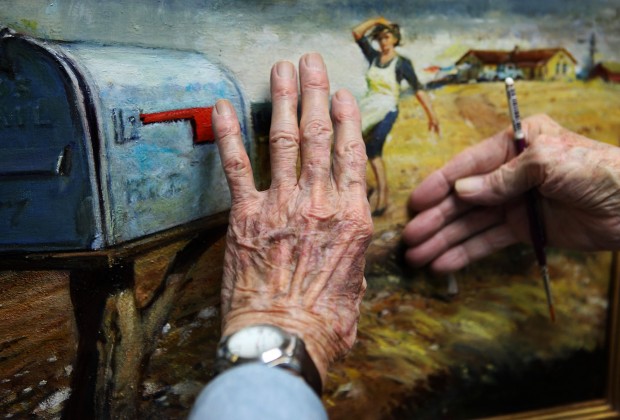
Right now he's putting the finishing touches on "Going for the Mail," which shows a woman and her dog heading from the farmhouse to the mailbox in a stiff wind.
"I did the whole thing out of my head without any models of any kind," says Bryers. "Can I create this believable landscape? I made the woman smaller, then bigger. I did the road 12 times. I changed the dog's head. I challenged myself."
Still.
What Bryers' contemporaries say
They're called the Tucson Seven - former illustrators who left the world of magazine covers and slick advertisements to set up shop in Tucson painting the American West.
One - wildlife artist Bob Kuhn - died in 2007. Among the six still with us are Duane Bryers and his good friends Howard Terpning and Don Crowley. Both have kind words to say for Bryers, whom they call "Dick." Neither shares his affinity for contemporary art, although it wasn't Bryers' primary style.
"No, I'm not a fan of contemporary art if it means abstract art," says Crowley, 83, whose subjects are mostly Apache and Navajo and "some ranch work." He met Bryers after moving from New York City to Tucson in 1974.
Terpning, 82, who moved to Tucson in 1977 and is considered one of the foremost Western artists living today, also cares not a whit for contemporary art.
"If I need to have a critic to explain what I'm looking at, I don't see the need for it," he says. "But I respect Dick's point of view."
He also respects Bryers' painting style. "Dick has always had a great sense of humor, and it often shows itself in his paintings," says Terpning.
Their mutual backgrounds as illustrators also helped bring about the realism inherent in Western art, says Terpning. "The academic training and the discipline of illustrating has been very helpful in our careers."
Bryers, says Crowley, is also a perfectionist. Referring to the painting Bryers is currently working on, he says, "I've told him four or five times, 'It's finished.' "
Both he and Terpning laud their friend's versatility and his energy. "I can't think of another artist with such a diverse background, from 'Hilda' to skilled renditions of cowboys and ranch life," says Crowley. "And his enthusiasm today is the same as when he was 67. He's just incredible."
On StarNet: Watch a slideshow at azstarnet.com/slideshows
Bonnie Henry's column appears Sundays and Mondays. Reach her at 573-4179 or at bhenry@azstarnet.com or write to P.O. Box 26807, Tucson AZ 85726.