SONOITA CREEK STATE NATURAL AREA — Here, human beings come second. First consideration goes to zone-tailed hawks, vermilion flycatchers, Gila topminnows, mountain lions, ring-tailed cats, white-tailed deer, orange skipperling butterflies, sycamores, cottonwoods, willows, ocotillos, wild grasses and countless other plant and animal species.
"The primary mission of a natural area is conservation," says Steven Haas, unit manager at Sonoita Creek. "It's more about preservation than recreation."
But here's good news if you're a hiker, bird-watcher, equestrian or other outdoor enthusiast who'd like to visit the natural area:
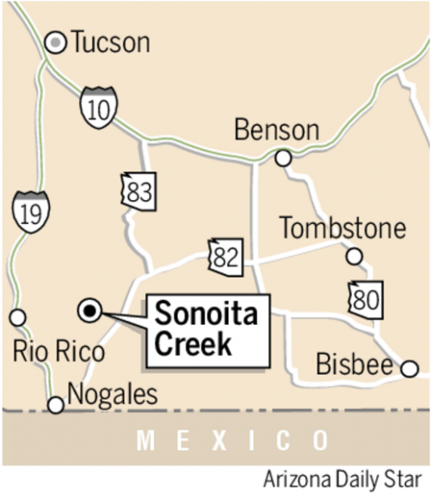
The 9,000-acre site southwest of Patagonia opened to limited public use last month.
Roam the cottonwood-shaded glades along Sonoita Creek or hike into the area's rolling uplands and you might share the views of frequent visitor Ron Hummel.
People are also reading…
"People today are so often focused on possessions, on wealth. This is a place to find your spiritual life — peace with your life and being," says Hummel, a Sonoita resident and president of a group called The Friends of Sonoita Creek.
"Every time you go to this area, there's something else to see," Hummel says. "It has more than 130 species of butterflies alone" and more than 275 species of birds.
"Every time we do an inventory out there, it goes right off the chart."
The exceptional biodiversity of the area, which is a unit of adjacent Patagonia Lake State Park, could be affected by heavy human traffic.
That, says area manager Haas, is why officials have set a visitation limit of 30 people per day. (See the accompanying "If You Go" box for information on visiting, which requires a permit.)
"We just don't know the impacts of hikers and horses, so we wanted to start conservatively with 30 people a day," Haas says. "If there were to be impacts, we'd be able to tell in a year or two" — and adjust the limits up or down.
Another reason for limiting the number of visitors: "We wanted people to have an experience of wilderness here, to find solitude," Haas says.
Recent visitor Sara Chase of Tucson says she found not only solitude but soothing scenery.
"It's really beautiful there, and it's kept natural," Chase says. "There's nothing artificial to distract you from the beauty.
"When I was there," Chase adds, "I saw a lot of birds. It's such a great opportunity to just sit quietly and watch the wildlife."
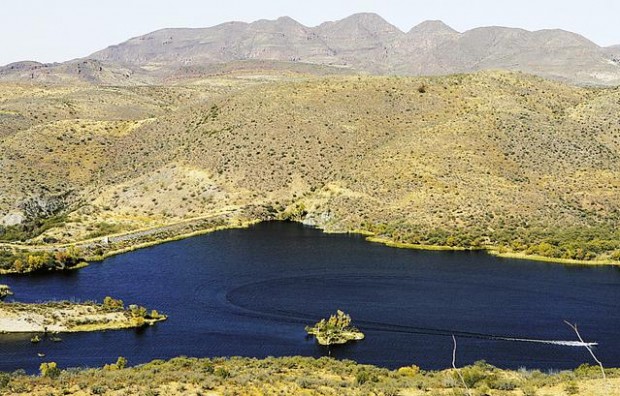
Hikers who want an overview before delving deeper into the area might start with a 1.4-mile round-trip trek up the Overlook Trail. The trail, shown on maps available at the Sonoita Creek Visitor Center, leads to a hilltop overlooking Patagonia Lake, the winding watercourse of the creek and the uplands of the Grosvenor Hills topping out an an elevation of 5,600 feet.
"From here, you can see pretty much all of it," says Haas at the top of the Overlook Trail. "The area has 20 miles of trails leading through all that varied terrain.
"You can walk a few miles and feel like you're in the middle of nowhere — even on a day hike," he says. "But we've also got three campsites in the area" for people who prefer a longer backpacking trip.
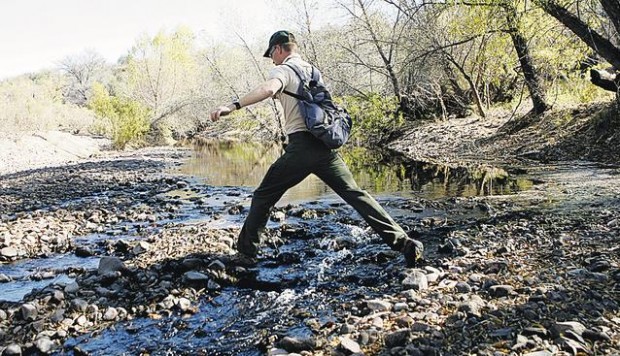
After taking in big vistas on the Overlook Trail, hikers find an entirely different slice of nature on trails tracing the creek, which is at an elevation of about 3,800 feet.
Here, the sound of a gurgling stream and the canopy of cottonwood and willow trees contrast sharply with the surrounding arid countryside.
"It's basically an oasis in the desert," says Hummel, an avid bird-watcher. "If you're a bird flying over, this is where you stop. . . . If you're an animal or a plant that requires surface water, this is where you are."
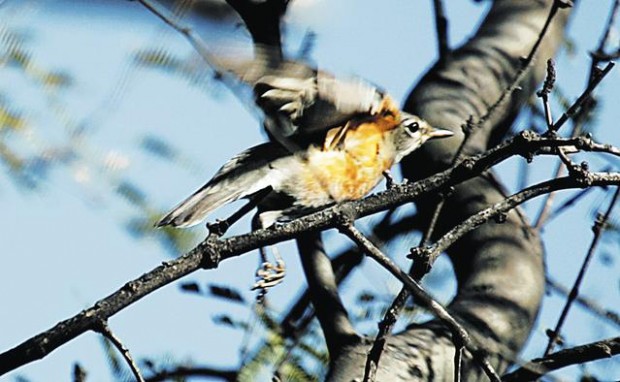
Haas, who walks the area frequently as part of his job as manager, reels off the names of birds in the trees overhead: "Black Phoebe! . . . Gila woodpecker! . . . There's an American robin."
Moments after the bird sightings, three white-tailed deer bound across the trail in front of Haas.
The area is home to some historical artifacts in addition to its natural wonders. Sections of the New Mexico and Arizona Railroad once ran along Sonoita Creek from Patagonia to Rio Rico — and here and there hikers and riders pass the remains of culverts, pilings, bridge abutments, spikes and rails.
"Some of these old abutments date back to 1881," Haas says, pointing out decaying structures near the creek. "It's fascinating to imagine people coming through here on a train in those days."
It must have seemed like wild country then.
And still does today.
Birds and butterflies
● The Sonoita Creek State Natural Area and adjacent Patagonia Lake State Park attract more than 275 species of birds and 130 species of butterflies. Here are just a few of the winged things you might see over the course of a year: Birds
Gambel's quail.
Great horned owl.
Say's Phoebe.
Bell's vireo.
Chihuahuan raven.
Gray hawk.
Inca dove.
Great blue heron.
Rufous hummingbird.
Elegant trogon.
Cactus wren.
Song sparrow.
Lesser goldfinch.
Cedar waxwing.
Dark-eyed junco.
American kestrel.
Butterflies
Sheep skipper.
Pipevine swallowtail.
Southern dogface.
Sleepy orange.
Monarch.
American lady.
Palmer's metalmark.
Painted crescent.
Tropical buckeye.
Marine blue.