
Poet Sherwin Bitsui says this about the raw material of his work:
"Words are sacred."
And this:
"In a poem, every word matters."
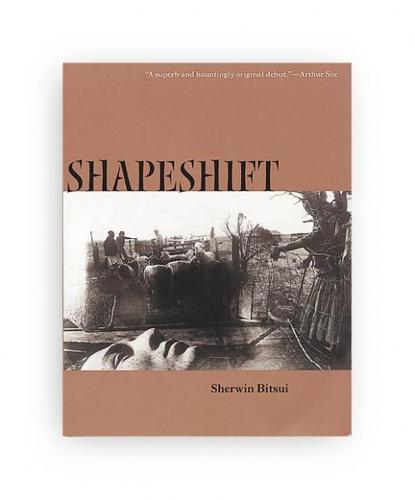
Bitsui wove his sacred words, one by precise one, into a book of poems called "Shapeshift." The book, published by the University of Arizona Press in 2003, and Bitsui's growing body of poetry in magazines and journals brought him a $40,000 prize last month as one of 10 recipients of the 2006 Whiting Writers' Awards.
"I feel very humbled," says Bitsui, 31, a Navajo from the reservation community of White Cone in Northeastern Arizona. "It was a wonderful ceremony, a great honor. . . . The money offers me time to work on my next collection."
A Tucson resident for the past five years, Bitsui traveled to New York City for the awards ceremony on Oct. 25.
People are also reading…
It was a milestone in a writing career spawned in the poet's Navajo homeland, honed at the Institute of American Indian Arts in Santa Fe, N.M., and brought to fruition with the publication of "Shapeshift."
"One of the things that makes Sherwin's work so exceptional is that it's truly grounded in his traditional Navajo culture," says poet Arthur Sze, who was one of Bitsui's instructors at the institute.
"He's an intense imagist," says Sze, who now serves as the poet laureate of Santa Fe. "The lyricism and immediacy of the world is always there in his work. He's engaged in a kind of ceremony with language."
That ceremony — or lyric love affair — with language is evident on almost every page of "Shapeshift."
This passage, from a poem called "Bodies Wanting Wood," is one example:
The wind in winter sleeps between our fingers
During prayer
It is released and blows into town
A swarm of locusts with wings on fire
Words, Bitsui says, must not only sing. They must carry a message. His words often speak of interfaces — of the hard edge between the natural world and technology, between native ways and modern life.
Here are the concluding lines of a poem called "Atlas."
How many Indians have stepped onto train tracks,
hearing the hoofbeats of horses
in the bend above the river
rushing at them like a cluster of veins scrawled into words on the unmade bed?
In the cave on the backside of a lie
soldiers eye the birth of a new atlas,
one more mile, they say,
one more mile.
Bitsui traces the spirit of his work to "a very free childhood in a beautiful, open landscape."
His mother, of the Navajo Bitter Water Clan, was a teacher's aide. His father, of the Many Goats Clan, was a carpenter.
"They always pushed for education," says Bitsui, who speaks the Navajo language but writes in English. "I come from a huge family, and the support of the family is immense."
As a student in middle school and high school, which he attended in Holbrook, Bitsui found that he had a way with words and a love of language.
Good thing, too.
"I come from a family of ranchers and cowboys, and I'm allergic to hay and horses," he says with an ironic smile. "But I had this writing."
After reading some poetry by Allen Ginsberg and others in his late teens, Bitsui tried his hand.
"I had no idea what I was doing," he recalls, "but it just felt right. I wrote a poem about the land — about a landscape being cut up by fences."
Following a stint in a community college, Bitsui was accepted at the Institute of American Indian Arts and studied there from 1997 to 1999.
Instructor Sze remembers Bitsui as a student of "enormous dedication and skill."
The young poet's work, Sze says, showed signs of the "intense lyricism" and the "touch of surrealism" that would flower in "Shapeshift."
It was during this period, in 1998, that Bitsui wrote what he calls "my first real poem."
That work, "The Northern Sun," along with a poem titled "Chrysalis," became the "pillars" of the book, Bitsui says.
A passage in "The Northern Sun" gives vivid expression to Bitsui's contention that American Indians sometimes have to deal with being viewed as a kind of "specimen."
Is this what I deserve: a white anthropologist sitting beside me at a winter ceremony? Listen. Your people speak like weeping Mongolians. Perhaps it is because we have been staring at airplanes too long, I tell him, that our throats have turned into hollowed-out spider legs extending over the rough wings of a salivating moth, who rejected its cocoon as a child, saying how ugly it made him feel to be in a bed that resembled an anchor rusting in the shadow of a feeble cloud.
Licks like that resonated in the wider world of verse.
Bitsui's poems found homes in journals such as American Poet and The Iowa Review. He received a grant from the Witter Bynner Foundation for Poetry, a Truman Capote Creative Writing Fellowship and the University of Arizona Academy of American Poets Student Poetry Award.
"I think that Sherwin's is one of the strongest new voices in contemporary poetry," says Frances Sjoberg, literary director at the University of Arizona Poetry Center. "His aesthetic reflects a new direction in Native American poetry.
"Sherwin really embodies poetry as an investigative art form," Sjoberg says. "It's an art form that uses language to explore or give some definition to mystery."
It's still all a bit of a whirlwind to Bitsui, who works a day job with the state to help pay the bills as he toils at a new collection of poems — sometimes taking months to complete a single work.
He says he makes time for a relationship with his girlfriend and work with Native American literacy programs such as ArtsReach in Tucson.
All in all, Bitsui would appear to be on the threshold of a fascinating career devoted to words that matter.
But the fact remains that he is a poet. This means that — like many other poets — he creates strings of words that sometimes don't make immediate, clear sense to those of us who are not poets.
So let us pose a final question: Why? Why don't poets just spit it out clearly — bravely eschewing inscrutability — if they have something to say?
"In our world," Bitsui replies, "everything is handed to us. It's all so convenient.
"I think the poet has to be able to allow the reader to reach the poetic moment. It's showing you a different hue of the same color. I think a good poet will leave you with questions — but also offer you sustenance for your hard work. Poetry is give and take."
'Asterisk'
By Sherwin Bitsui
Fourteen ninety-something,
something happened
and no one can pick it out of the lineup,
its rising action photographed
when the sign said: do not look
irises planted inside here.
But look —
something lurking in the mineshaft —
a message, ice in his cup,
third leg uprooted but still walking.
It peers over his shoulder at the dirt road dug into the mesa's skirt,
where saguaro blossoms bloom nightfall at the tip of its dark snout,
and motor oil seeps through the broken white line of the teacher's loom.
Something,
can't loop this needle into it,
occurs and writes over their lips with thread;
barnacles on their swings;
fleas hyphened between their noses;
eels asphyxiating in the fruit salad.
Remember, every wrist of theirs acclimates to bruises.
Twigs from their family tree flank the glove's aura
and asterisk water towers invisible,
while fragrant rocks in the snout remain
unnoticed in the bedroom,
because the bridegroom wanted in,
Pioneers wanted in,
and the ends of our feet yellowed to uranium at the edge of fear.
Reprinted with permission from Sherwin Bitsui and the University of Arizona Press, www.uapress.arizona.edu.