A bird lands on a limb. You look at it.
Voilà! You're a bird-watcher — at least in the simplest sense.
Ah, but there's much more to bird-watching than merely catching a glimpse of whatever happens to flutter by — so today we offer you a short course in the basics of birding.
"It's a fascinating hobby that can take you from your backyard to all over the world," says Sara Pike, manager of the Tucson Audubon Society's Nature Shop at 300 E. University Blvd.
The bonus for Tucson residents is that our extended backyard — Southeastern Arizona — is one of the best bird-watching areas in the nation.
"We're a 12-month-a-year birding paradise!" exults Sheri Williamson, co-director of the Southeastern Arizona Bird Observatory. "Our deserts and mountains, with so many different elevations and habitats, give us an embarrassment of riches where birds are concerned."
People are also reading…
To help you enjoy this wealth of winged wildlife, we've gathered information from Pike, Williamson, other experts, books and Web sites.
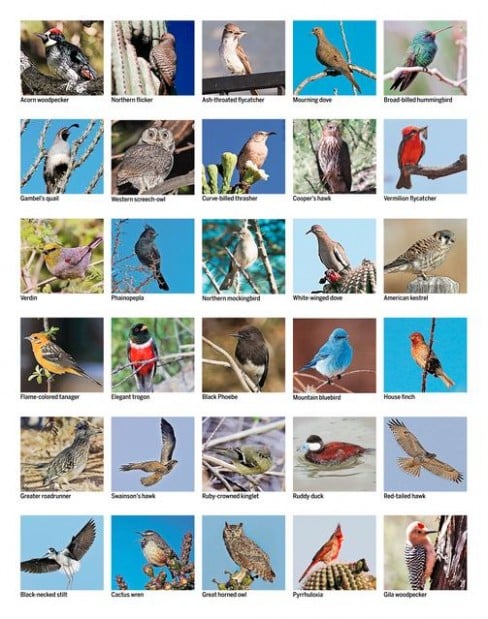
To show you what you're looking for, we've included vivid photos taken by Tucson birders Bob Wenrick and Doris and Doug Evans.
You might save this page — along with the map and additional information on Page E2 — as a take-along guide.
But don't get hung up on the words. Let's go for the birds.
Where
Avian activity is more likely at some sites than others. Pike, who leads bird walks for the Audubon Society, recommends these spots near Tucson:
• Sweetwater Wetlands — These tranquil lagoons, part of a water-treatment facility, attract not only waterfowl but lots of migrating species. Look for northern shovelers, American coots, red-winged blackbirds, Cooper's hawks and dozens of other species. Take the Prince Road exit from Interstate 10, then go west through a business center to Sweetwater Drive and the wetlands.
• Catalina State Park — Stroll the park's Birding Trail and you could see anything from white-crowned sparrows and pyrrhuloxias to phainopeplas and vermilion flycatchers. Go north on Oracle Road, which becomes Arizona 77, and find the park entrance at Milepost 81.
• Roy P. Drachman-Agua Caliente Regional Park — Mallards, hummingbirds, ospreys and great horned owls are just a few of the many species seen at this spring-fed natural oasis. Go east on Tanque Verde Road to Soldier Trail. Take Soldier Trail north to Roger Road and follow Roger Road east to the park.
• Reid Park — Tall trees and lagoons attract a rich mix of species in an easy-to-reach Midtown park. Look for American wigeons on or near the water and watch for a Wilson's warbler in the trees. The park lies generally northeast of East 22nd Street and South Country Club Road.
If visiting these spots in and near Tucson whets your birding appetite, consider a trip to any of the following highly recommended sites elsewhere in Southeastern Arizona:
• Santa Catalina Mountains north of Tucson.
• Madera Canyon south of the city.
• Patagonia-Sonoita Creek Preserve.
• San Pedro River east of Sierra Vista.
• Ramsey Canyon Preserve in the Huachuca Mountains near Sierra Vista.
• Cave Creek Canyon in the Chiricahua Mountains near Portal.
Tools
Binoculars are all but indispensable if you want to get a close look at birds. The most common magnification for beginning bird-watching is 8-by-42.
Prices range from about $30 to $2,500 or more. "Get the best you can afford," advises Pike. "They'll last you a long time and significantly enhance your experience. You can get a very decent pair of binoculars for $250 to $300."
• Tips: Make sure the binoculars feel good in your hands, are easy to focus and aren't too heavy.
Birding guide books come in a wide range of sizes and formats. Look for a book that's easy to use and sufficiently comprehensive without being too heavy or bulky. Among some of the currently popular guides are:
• "The Sibley Guide to Birds" — priced at $35.
• "National Geographic Field Guide to the Birds of North America" — which costs $24.
An assortment of binoculars, books and other birding supplies is available at the Tucson Audubon Society's Nature Shop, 300 E. University Blvd.
Rules
Here's a description of birding ethics and etiquette from the Tucson Audubon Society's Web site:
• Tucson Audubon Society encourages bird-watchers to adopt an ethic that includes appropriate behavior in the field. This means always acting in ways that protect birds and their environment. Tape-recorded calls are banned in some places, and birders should never use recorded territorial calls for birds that are actively breeding.
• Birders should observe nests from a distance great enough so birds are not disturbed. Birders should keep group size small to avoid disturbing or harassing birds. When birding in groups, use common courtesy and remember the leader is the only one who "pishes." When photographing, use artificial light sparingly.
• In Arizona, private property owners are increasingly concerned about their rights. Birders should respect private property in the following ways: Do not trespass — enter private land only with permission; respect the wishes of landowners; in ranching country leave gates as you find them, open if open and shut if shut. Remember that golfers have the right of way on golf courses.
— "Finding Birds in Southeast Arizona"
• Before advertising the presence of a rare bird, evaluate the potential for disturbance to the bird, its surroundings and other people in the area. Proceed only if access can be controlled, disturbance can be minimized, and permission has been obtained from landowners. The sites of rare nesting birds should be divulged only to proper conservation authorities. In any conflict of interest between birds and birders, the welfare of the birds and their environment comes first.
— American Birding Association
Contact reporter Doug Kreutz at dkreutz@azstarnet.com or 573-4192.