
Nothing is more wondrous in a desert region than water welling up from the earth and flowing across the land.
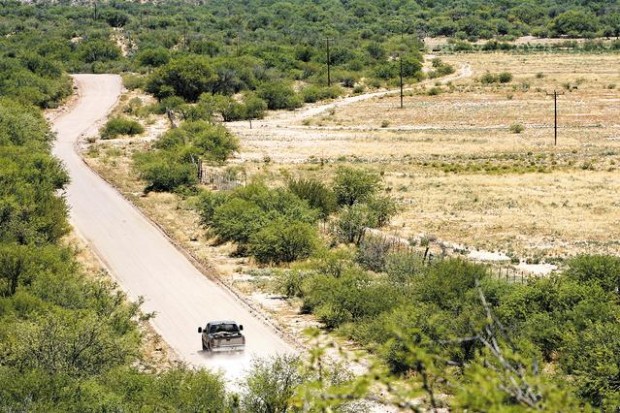
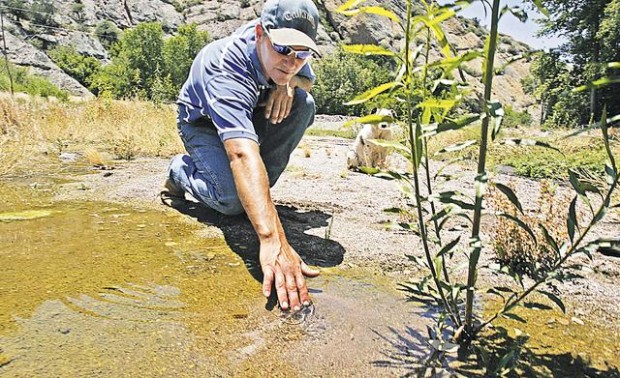
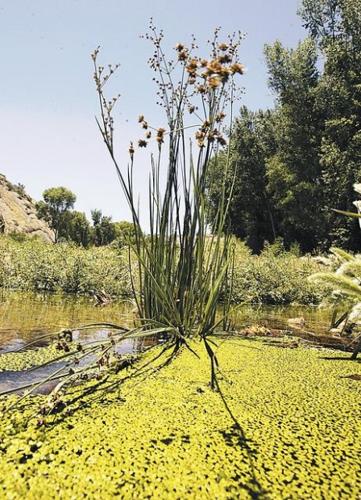
This spectacle of nature plays out dramatically at the remote Cobra Ranch, where water emerges from underground and forms a year-round stream in otherwise parched terrain.
Now, thanks to the generosity of a Tucson artist and businessman, the ranch and its invaluable water source are part of a Nature Conservancy preserve.
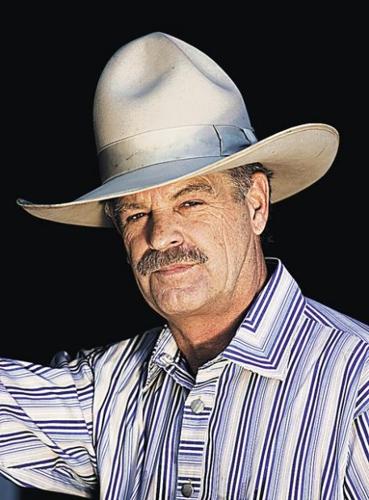
Sculptor and restaurateur Dan Bates recently donated the sprawling spread northwest of Willcox to the Conservancy, which added the land to its Aravaipa Canyon Preserve just downstream from the ranch.
See the cover story inside this section to learn about the history of the ranch — and how the Conservancy plans to use the land to benefit not only Aravaipa Creek but also wildlife and native vegetation. — Doug Kreutz
People are also reading…
It starts as a trickle of moisture seeping up from the soil of this historic ranch northwest of Willcox.
Then, fed little by little with water rising to the surface from a subterranean source, the trickle grows to a modest flow — and finally blossoms into a gurgling, life-giving stream as it enters spectacular Aravaipa Canyon.
The future of this year-round stream, a natural wonder rarely found in a desert place such as Aravaipa Canyon, was brightened recently in a single bold, generous stroke.
Dan Bates, a Tucson sculptor and businessman whose family had owned the Cobra Ranch for about 30 years, donated it to The Nature Conservancy.
The nonprofit Conservancy is adding the ranch land — 1,250 private acres and 10,000 acres of state and federal leases — to its adjoining Aravaipa Canyon Preserve.
That effectively assures that the ranch and its precious water sources won't be developed or tapped for groundwater pumping. It also will aid in securing habitat for wildlife and native vegetation on a preserve that now helps protect about 53,000 acres, including federal wilderness lands.
"It's a natural wonderland, a precious jewel," Bates says of the ranch, where he raised longhorn cattle, worked on bronze sculptures and spent time with his family. "We realized it was a vital piece of property that needed to be protected, and we decided that donating it to The Nature Conservancy was the best way to protect it."
Mark Haberstich, manager of the Aravaipa Canyon Preserve, says the Conservancy's acquisition of the land in January was nothing short of an environmental godsend.
"Not only does the ranch sit over the main aquifer that supplies Aravaipa Creek, it's also an important corridor for wildlife traveling from the Galiuro Mountains to the Santa Teresa Mountains," Haberstich says. "We've actually seen elk on the preserve" — a rarity at the site's elevation of 3,300 feet.
In an era that often seems dominated by bad news, the Cobra Ranch story is all about the happy convergence of three key elements: a remarkable place, a generous personal gesture and a conservation group's plans for preservation.
The place
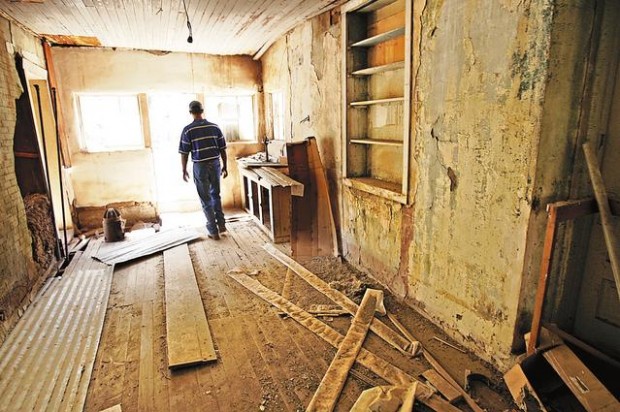
Pull into Cobra Ranch headquarters and you might feel as if you've slipped back in time a century or so.
The main ranch building, now partially restored and serving as Aravaipa Preserve headquarters, dates from about 140 years ago. The place, with its adobe walls and stone fireplace, exudes history — and Bates can tell you lots of it.
"The Cobra Ranch was homesteaded in 1867, two years after the Civil War, by Burt Dunlap," an Arizona territorial legislator, Bates says. "It was the Dunlap Ranch and after that it became the Davidson Ranch. . . . It was cattle ranching and alfalfa farming."
He notes that the Cobra name came into use in the 1940s when the ranch was taken over by subsequent owners.
Bates — owner of the Agro Land & Cattle Co., which operates restaurants such as Pinnacle Peak in Trail Dust Town on Tanque Verde Road — says his family acquired the Cobra Ranch in the late 1970s.
The name? Well, the ranch is not the domain of the very poisonous cobra snakes that inhabit parts of Asia and Africa. Its name more likely stems from a misspelling of "cobre" — the Spanish word for copper, which was found in the area.
A small post office for the area operated out of the original part of the ranch headquarters in the late 1800s — before the building was expanded to its current size.
"The majority of the headquarters building was built in the 1920s by the Davidsons," Bates says. "They built the big rooms."
If the ecological centerpiece of the ranch is its wealth of water and stream-side habitat, it's also notable for its rolling uplands, mesquite woods known as bosques, rich array of bird life and ancient Indian ruins.
Bates says some accounts indicate that the famous 1540-42 expedition of explorer Francisco Vásquez de Coronado traveled past Stowe Gulch, a drainage area contributing much of the water that emerges as Aravaipa Creek.
Bates, his mother, Mary, his wife, Christine, and their daughters, Jessica and Molly, spent much time at the ranch during the 1980s and 1990s.
"Our daughters got to grow up on the ranch — learning to love nature and wildlife," Bates says. "We were living out there at least all of the summers except during flood season. . . . We raised Texas longhorns. We did a lot of riding."
The ranch also was a place of inspiration for Bates' work. Longhorns, horses and cowboys show up frequently in his bronze sculptures — reflecting his love for ranch life and Western lore.
The person
If you've lived in Tucson for a while, you might have dined at one of Dan Bates' restaurants, including El Corral, at 2201 E. River Road, and Pinnacle Peak, at 6541 E. Tanque Verde Road in Trail Dust Town.
It's also likely you've seen some of his striking bronze sculptures. He created the towering horse and rider — called "Chief Trumpeter" — that stands in Fort Lowell Park. His sculptures of Wyatt Earp and "Doc" Holliday are on display at the restored railroad depot Downtown. Some of his work is shown at The Sanders Galleries, 6420 N. Campbell Ave.
With his successes in the worlds of business and art, Bates might have kept the Cobra Ranch for the pleasure of his family or sold it for its water, farming or development value.
When pressed to estimate its sale value, he replies: "A couple of million, you could say easily."
But he gave the ranch away. Why?
"We could have taken the money and run," Bates says. "But that wasn't what it was all about. I wanted to see the place protected — and it had gotten to the point where I couldn't protect the property the way I wanted to. I couldn't properly maintain the place or patrol it to keep off unwanted hunters."
Family and economic considerations also played into Bates' decision to give up the ranch.
"The kids had grown up," he says. "And with the drought, the cattle business with longhorns — those days are over. It just became unworkable."
But there must have been some temptation to "take the money and run."
Not for long, according to Bates.
"I knew if I was to sell it, it would be developed in some way," he says. "Our family loved that place. It was always our goal to preserve the wildlife, to protect the water.
"We were so fortunate to have the Conservancy as a neighbor. It worked out very well."
Officials of the Conservancy think they're the fortunate ones.
"Cobra Ranch is a tremendous gift," says Ken Wiley, the group's director of stewardship in Arizona, in a prepared statement. "It will allow recovery of 1.1 miles of riparian habitat and create new opportunities for improved grazing and watershed management in what is the richest biological region of the state."
The preservation plan
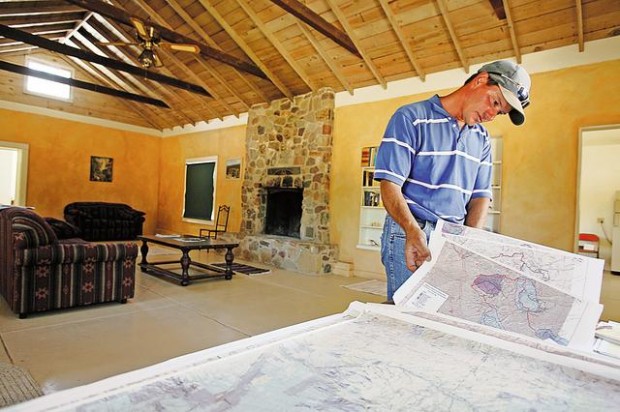
Preserve manager Haberstich displays a practical sort of yin-yang approach to the Cobra Ranch.
When he visits what he calls the "emergence area" — where underground water bubbles to the surface to form the stream — he sees much that is positive.
Towering cottonwoods, sycamores and velvet ash trees, all nurtured by the emerging creek, shade a watercourse that provides habitat for seven native fish species, lowland leopard frogs and more than 200 species of birds.
Stream-side plants such as watercress, duckweed and rabbit's foot grass carpet the lush landscape.
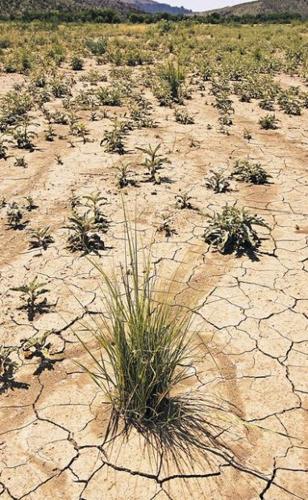
Elsewhere on the newly acquired land, Haberstich sees negative environmental signs. These include native grasses giving way to invasive exotic plants and long expanses of dry watercourse upstream from the emergence area.
"One of my main goals," he says, "is to restore surface water. To do that, I'd like to see more shade along the creek and improve the water-holding capacity of the soil."
Toward that end, Haberstich has begun painstaking efforts to replant native sacaton grass.
"By adding organic matter, the grasses increase the water-holding capacity," he says. "The more water we can get to soak into the ground on the Cobra Ranch, the more water we'll have in Aravaipa Creek."
Increased surface water could benefit wildlife in the area — everything from deer and bighorn sheep to black bears and mountain lions.
Unlike many other preserves, the Cobra Ranch addition to the Aravaipa Preserve will retain one traditional element of ranch life: cattle.
That, Haberstich explains, is a condition of keeping some of the grazing-lease acreage that came with the ranch.
"We'll run a small number of cattle — 20 to 40 of them," he says.
But the cattle, once the beefy stars of spreads like this one, will be little more than obligatory bovine tenants.
That's because things have changed on the Cobra. Now, this place is not so much a ranch as a farm — a farm with a main crop of pure, precious water.
Take a video tour of Cobra Ranch: azstarnet.com/video
Come with us on a guided tour of Cobra Ranch, the newest addition to the Nature Conservancy's Aravaipa Canyon Preserve near Klondyke, northeast of Tucson. Launch the video »»