 The white-moves-first rule became standard in the late 1800s. Nupat Arjkla / EyeEm / Getty Images Daaim Shabazz, Florida Agricultural and Mechanical University
The recent protests over racism have rekindled a longstanding discussion about whether chess promotes white privilege with its rule that the first move always goes to the player with the white pieces. In this Q&A, Daaim Shabazz, an international business professor and chess journalist, offers insight into whether there’s any merit to the idea that the rule is meant to uphold white privilege.
People are also reading…
Who decided that white should always go first?
Johann Löwenthal, a British master, put forth one of the first proposals of record to give white the obligatory first move. At the First American Chess Congress, held in New York in 1857, Löwenthal sent two letters to the secretary of the New York Chess Club, Frederick Perrin.
On page 84 of the congress’s proceedings, it refers to one of the letters by citing “the advisableness of always giving the first move, in published games, to the player of the white pieces…” This rule was not immediately adopted, and tournament organizers maintained flexibility on the first move. In the Fifth American Chess Congress in 1880, it was written on page 164 of the Code of Chess Laws, “The right of first move must be determined by lot. The player must always play with the white men.”
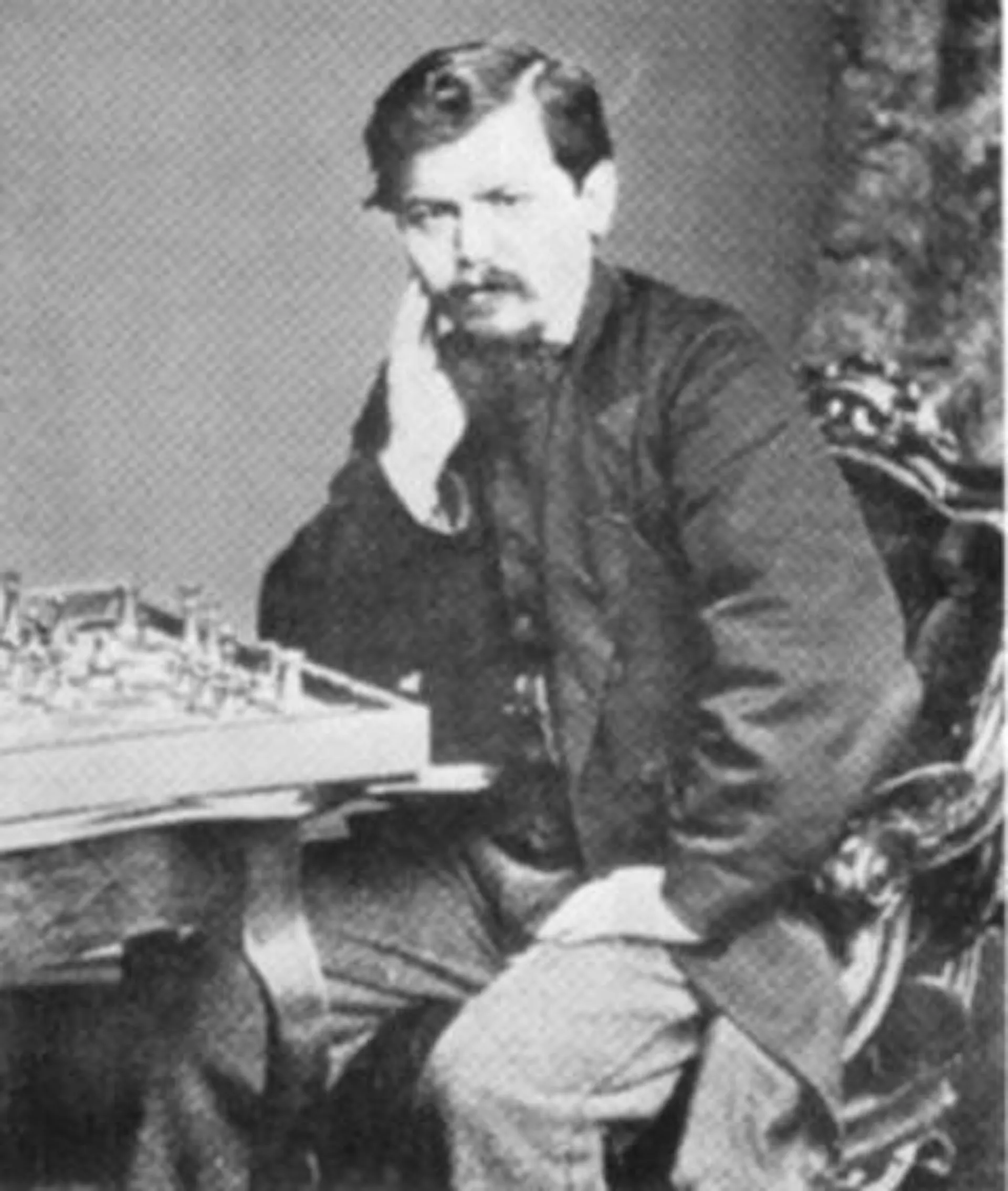 Steinitz wrote in 1889 that the player with the white pieces should move first. www.wikicommons.com, FAL
Wilheim Steinitz, the first world champion, repeated this idea in his 1889 book, “The Modern Chess Instructor,” where he wrote on page XII: “The players draw by lot for move and choice of color. In all international and public Chess matches and tournaments, however, it is the rule for the first player to have the white men.”
Thus, there was a growing consensus that white should move first.
Was that decision rooted in racism?
I am not aware of any direct evidence. However, chess players were not only part of the intelligentsia, but also men of their times. On page X in the proceedings of the Sixth American Chess Congress in 1889, Steinitz poetically extolled the virtues of chess as being among the “intellectual pastimes of civilized nations.” This is a time when Europeans generally did not regard Africa as a place of civilization. For instance, five years earlier at the Berlin Conference of 1884, Europeans had begun to execute their colonial plan and “aim at instructing the natives and bringing home to them the blessings of civilization.”
Further, in the 19th century, there was an awful period of satirizing and dehumanizing Blacks through darkened minstrel caricatures. There existed the perception that white was associated with that which was positive, and black was associated with that which was negative. Recent social science research shows that this perception still holds.
Does the rule give white an advantage?
It is my view that chess players, including grandmasters, overstate white’s first-move advantage.
Russian grandmaster Evgeny Sveshnikov stated back in 1994 that a player should win with white and be content to draw with black.
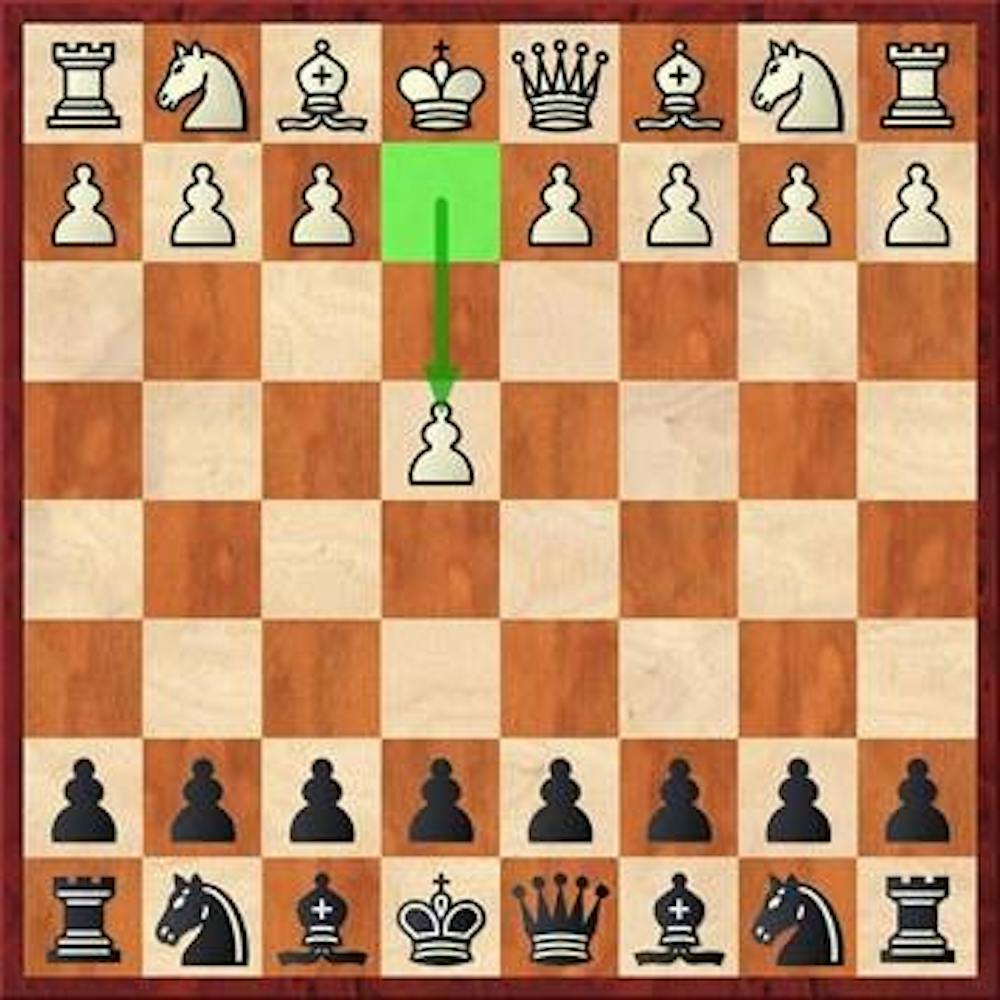 One chess theorist held that black is lost from the start when this move is played.
As early as 1939, American master Weaver Adams claimed white is winning after the very first move, at least when that first move was the pawn to the e4 square – that is, the square three spaces in front of white’s king. But he ended up losing a match to I.A. Horowitz, who wanted to prove a point by taking black in every game.
Since A.D. 1475, white’s overall winning percentage has been approximately 55% in nearly 1 million games. This includes percentage of total wins plus half the percentage of drawn games. Is this result because of the first move itself? Steinitz seemed to suggest otherwise when he stated on page XXXII in his classic book, “Modern Chess Instructor,” “by best play on both sides, a draw ought to be the legitimate result.”
How would things change if black moved first?
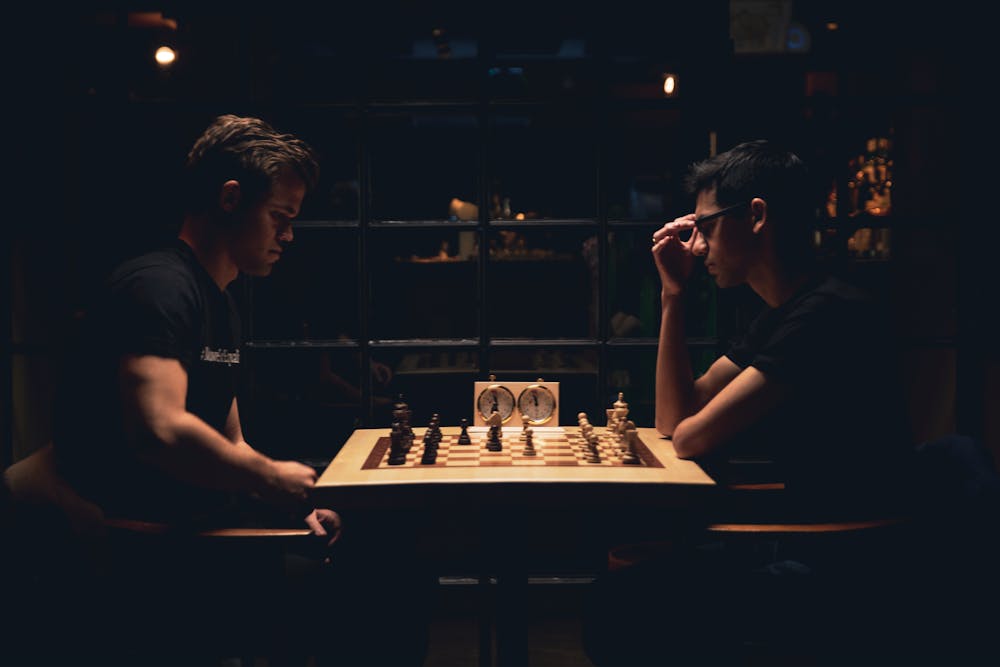 Magnus Carlsen and Anish Giri, two of the world’s top players, played a game in 2019 which the player with the black pieces moved first to call attention to racial inequality. #MoveForEquality
In 2019, Magnus Carlsen and Anish Giri – who as of July were the number 1 and number 10 players in the world, respectively – promoted a #MoveforEquality campaign as a way of acknowledging social inequalities. In their game, black moved first and the line was, “We broke a rule in chess today, to change minds tomorrow.” It was billed as an anti-racist statement, but some took it as a suggestion to change the rules of chess to black having the first move.
If black moved first, it would take some getting used to for players who are accustomed to white going first. This would be especially true for the opening moves, since the white and black chess armies are positioned slightly differently. For instance, as white, the queen is on the left-hand side. As black, the queen is on the right-hand side.
As it exists now, the lighter color always moves first. Some see this as analogous to racial privileges in society. The late Frances Cress-Welsing, a psychiatrist, made a chess analogy in her “Cress Theory of Color Confrontation,” noting that the psychology of white having the first move was as the natural aggressor against black forces.
Socially speaking, an ideal solution would be to give both colors a 50% chance to move first. That is the way it was in shatranj, a precursor to modern-day chess. Instead of picking which player gets the favorable color, something like a coin toss would determine which color gets to move first. Of course, this would be “equal opportunity” but result in a totally different approach to playing chess.
What are the psychological effects of white going first?
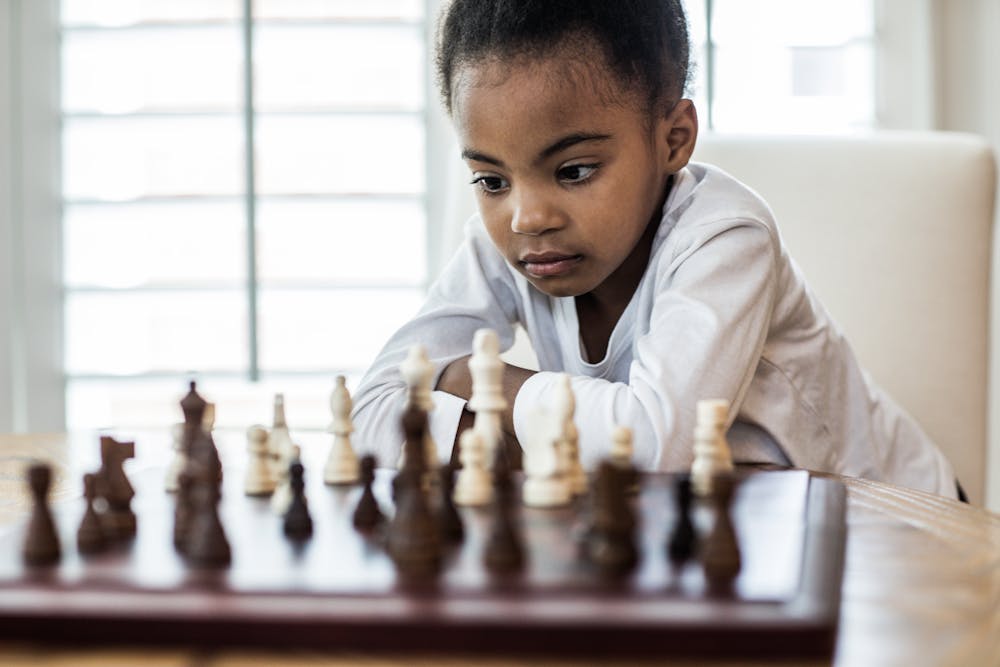 Beginners learn early on about the rule that white always gets the first move. MoMo Productions/Getty Images
There are several psychological factors at play. A beginner of chess learns the power of “white first” very quickly. They will see that an opponent will prefer the white pieces if given a choice. They feel a sense of empowerment even when they are playing a stronger opponent. For this reason, players who play white may be more motivated to win. Conversely, we have been conditioned to believe that black should be content with a draw.
This relegation of black to an inferior status has been reinforced in many ways. The early chess books focused on how to exploit the white advantage over black. It was an attempt to show the power of the first-move privilege.
When one looks at chess books, the diagrams are generally positioned to be from the white army’s perspective. This is even true for books focusing on strategic systems for black. However, the seminal “Black is OK” series by Hungarian grandmaster András Adorján feature diagrams from the black perspective and provides a theoretical framework for why black has adequate resources.
In many of the chess puzzles, it was common to see each problem presented as white who has the winning sequence. In fact, Theophilus Thompson (1855-1881), the first Black player of note, had authored such a book of chess puzzles.
To a great extent, books are still published in this fashion. I believe that strategic literature for a black response will continue to increase, and the game will move closer to a 50-50 result in the “white first” format. There are a great many systems where black seeks to be the aggressor.
Chess is more of a conversation where both sides engage in a battle of ideas. Someone has to initiate the conversation, but throughout the flow of the game, a unique story unfolds. In my view, it is not about who starts first, but what the essence of the story ends up being.
___
Daaim Shabazz, Associate Professor of International Business, Florida Agricultural and Mechanical University
This article is republished from The Conversation under a Creative Commons license. Read the original article.
___
40 hobbies the whole family can get into
Learn a foreign language

Making learning a foreign language your family’s new hobby is a très bonne idée. There are a wide variety of free and affordable softwares, apps and online resources. Along with doing lessons, you can practice vocabulary and conversation skills together as well as watch shows and movies and listen to music in the language you’re learning.
Gardening

Along with their bounties of beautiful flowers or fresh herbs, at-home gardens can offer numerous physical and mental benefits to you and your family. Gardening outdoors boosts your vitamin D intake, fights stress, decreases risk of dementia and is a form of aerobic exercise. Working in a garden can also help you maintain a healthy weight, get a good night’s sleep and improve your mood and self-esteem.
Photography

Look at the world around you with new eyes by picking up photography as a hobby. You can start just by using the camera inside your smartphone. Learn about and play with lighting, angles, composition, exposure and more. Stage a family photo shoot, or simply go on a walk around your neighborhood looking for beautiful images to capture. (Monzenmachi/Getty Images/TNS)
Dancing

Dancing is a wonderful way to exercise for people of all ages and fitness levels that doesn’t require much space, experience or equipment. Along with improving heart and lung health, coordination, agility, balance and flexibility, it challenges your brain, improves memory, reduces stress and anxiety and allows for creative expression. From ballroom to country line dancing to hip-hop, there’s a style of dance out there for everyone in your family.
Jigsaw puzzles

Jigsaw puzzles are a relaxing family activity that are also good for the brain. Putting a jigsaw puzzle together has many health benefits, including reducing stress and improving memory, reaction times and problem-solving skills. The activity can also help kids improve spatial skills and social skills like collaboration and cooperation. (filadendron/Getty Images/TNS)
Learn a musical instrument

Children, teens and adults alike can benefit from learning a musical instrument. Playing music leads to better communication skills, improved emotional release and decreased anxiety, and jamming and practicing together promotes mental health, brain function and social connection. (stockstudioX/Getty Images/TNS)
Volunteering

Volunteering is a rewarding way to use your time, skills and resources to give back to the community and support causes you care about as a family. You can agree on an organization or activity together or let different family members choose each time you volunteer. There are countless ways to get involved, whether it's getting your hands dirty cleaning up a local park or serving remotely by organizing a food drive or reading to seniors on video call. (Thomas Barwick/Getty Images/TNS)
Start a collection

Another hobby you can safely do from home is start a collection. Whether it's stamps or coins or dolls or trading cards, find something you and your family find fascinating and start learning as much as you can about it. Choose something that has a low entry cost to start collecting and that also has nostalgia or sentimental value to you and your loved ones. (Anna Usova/Getty Images/TNS)
Investing

It might seem intimidating, but investing can actually be a hobby for the whole family and teach kids — and even adults — financial literacy skills. You don’t need to be a high roller either. You can buy small amounts of shares in kid-approved companies like Walt Disney, McDonald’s or Apple, then keep up-to-date on the markets together. To get started, many mutual fund companies, such as Fidelity and Vanguard, have tutorials and resources for young or novice investors.
Hiking

Whether it’s a peaceful stroll or an arduous trek, hiking is great for the mind and body. Hiking is one of the best ways to get exercise. According to the National Park Services, it helps improve balance and heart health, builds stronger muscles and bones, and decreases the risk of certain respiratory problems. Hiking also allows you to spend restorative time in nature, which reduces stress, calms anxiety and can lead to a lower risk of depression.
Fishing

If you’re more interested in relaxing by the water, fishing could be the perfect fit for you. Fishing requires focus and awareness which can help you take your mind off of your problems and relieve stress. You’ll soak up vitamin D from being outside and still get exercise from casting, reeling and more.
Camping

Want to hike, fish and then enjoy a crackling campfire at the end of the day? Camping might be the perfect new hobby for you and your family. Whether it’s in your backyard or a beautiful local park, camping is the ultimate hobby as it combines fresh air, exercise, cooking, unplugging from technology and practicing practical skills like tying knots and starting a fire.
Jewelry making

Jewelry making is another hobby that combines many different skills and engages hand-eye-coordination, problem-solving and creativity. You and your loved ones can start with basic beading then build to more advanced techniques like metal work, clay sculpting, glass fusing and more. (Lucy Lambriex/Getty Images/TNS)
Dog training

Teaching your dog tricks can be a practical and fun way to engage your four-legged friends as well as your family. Obedience and tricks can provide mental stimulation for your dog as well as increase their flexibility, balance, endurance and concentration. It can also engage you and your family’s problem-solving skills and creativity and boost your confidence as pet owners.
Geocaching

Geocaching is a fun activity for families who enjoy scavenger hunts or treasure hunts and exploring outdoors. The goal is to find camouflaged containers, called geocaches, based on GPS coordinates. This hobby requires problem-solving and orienteering skills and amps up the excitement of basic walks or hikes.
Yoga

Yoga is another form of exercise for all ages and fitness levels that can easily be done by a group at home. Yoga’s focus on mind-body connection gives it benefits beyond physical fitness and flexibility. It also helps promote mindfulness, reduces stress and anxiety, improves concentration, and teaches patience and perseverance. It can be particularly beneficial for children with autism, attention deficit hyperactivity disorder (ADHD) and other special needs.
Candle making

Lighting a candle can help you relax or help you create boundaries between spaces or activities in your day. If you enjoy candles, you can try your hand at making your own. On top of potentially being economical, making your own candles means you can be creative and customize them just the way you want.
Canning

With people spending more time at home, many time-consuming, “old-fashioned” hobbies have come back into fashion, including canning. You and your family can make jams, jellies, sauces, pickles and more using tried-and-true techniques or modern conveniences like a pressure cooker. Canning is also a great hobby to go in tandem with growing your own fruit and vegetable garden at home.
Baking

What’s the use of homemade jam without something to serve it on? Baking breads, pastries, cakes and more is a fun, tasty activity for all ages. It can be stress-relieving, creative and a way to show thanks and appreciation to those around you if you plan on sharing your home baked treats. It’s also a wonderful way to celebrate and preserve family history by passing down beloved recipes.
Sewing

Along with knitting and crocheting, sewing has also seen a resurgence in interest for a variety of reasons, including being more sustainable and eco-friendly. This hobby can give you and your family an outlet to do something creative with your hands. The required concentration and hand-eye coordination can be relaxing and stress-relieving, while pride in the finished product can boost your mental health.
Cosplay

If you’re the type of family who has a costume trunk or enjoys going to fan conventions and events, perhaps now is the time to use your crafting or sewing skills to start cosplaying. Short for “costume play,” cosplay involves dressing up as your favorite characters from movies, books, video games and more. Many cosplayers make their own costumes and accessories to bring their favorite characters to life.
Start a business

If you and your family have been batting around the idea of starting a business or turning a hobby into a side hustle, now could be the time to make that dream a reality. Dedicate time every week to work together to develop your products, build a website, do research, take training courses and more. (svetikd/Getty Images/TNS)
Origami

Origami, the art of paper folding, is an affordable, accessible craft that is physically and mentally engaging. It requires hand-eye coordination, spatial skills and concentration and can be a meditative and relaxing experience.
Scrapbooking

Another hobby that’s been around for generations, scrapbooking is a way to preserve and creatively display family photos and memories. The blank pages of a scrapbook can be filled with photos as well as other memorabilia like ticket stubs then decorated with a wide variety of embellishments as well as notes with details like names, dates and places.
Quilting

Another way to stay connected to your family history or to American history is quilting. Quilts are blankets made out of three woven layers that often tell stories through their designs. Quilts can be traditional or modern using updated fabrics and patterns that can fit any style.
Book club

Another classic hobby that can include family members in-person and remotely is a book club. Everyone reads the same book then comes together to discuss it. Family members can take turns leading the conversation and coming up with discussion questions. You can make things more interactive by doing a craft or activity or making snacks based on the setting or theme of the story.
Film club

Take family movie night to the next level by starting a film club. Choose a slate of movies to watch from family favorites to Hollywood classics to decorated foreign films. Discuss the films afterward or each write your own review of the film. Flex your analytical skills by considering why certain scenes were impactful, what you thought of the score and more.
Board games

Board games are a great way to pass the time with family and friends of all ages and interests. For kids, they’re a great way to learn about teamwork and winning and losing gracefully and can also encourage brain development, language and organization skills and longer attention spans. For adults, they can engage the mind and promote memory function, language skills and spatial ability.
Scrabble

Word games like Scrabble work multiple regions of the brain, including memory, can help keep your brain sharp and can help you and your family members expand your vocabulary. (Mitch Hutchinson/Shutterstock.com/TNS)
Mahjong

Another social, brain-boosting game is Mahjong. Studies suggest the challenging Chinese tile game can improve overall brain health, help treat dementia and reduce rates of depression in older adults.
Chess

Fans of the popular Netflix series “The Queen’s Gambit” have been buying chess sets in droves, and it could also be the perfect new hobby for you and your family. This strategic, two-person game improves concentration and memory, increases intelligence, hones planning skills and helps players learn to think from another person’s perspective.
Blogging or vlogging

It’s easy to get so caught up in the hustle and bustle of daily life that you lose touch with friends and family. One way to stay connected with them and flex your creative muscles is to start a family blog or vlog. Use words, pictures or videos to document your daily life while learning all about different editing tools, effects, equipment and more.
Magic tricks

Magic is another style of performing arts that is not only entertaining but also beneficial. Learning tricks can help develop creativity and problem-solving, help you practice public speaking and presentation skills and build up confidence. It also tickles the brain of whoever is watching the trick being performed, engaging critical thinking skills and curiosity.
Dungeons and Dragons

Dungeons and Dragons is a creative role-playing game that lets people imagine a rich fantasy world. The highly collaborative game helps hone social, spatial and problem-solving skills.
Astronomy

If you and your family are tired of staring at screens, consider taking up astronomy and looking at the night sky instead? You can invest in a pair of binoculars or a telescope, but there is plenty to be seen with the naked eye. You can use online resources like sky maps, phone apps and more to help you and your family navigate the galaxy from your own backyard.
Start an aquarium

You and your family can start your own captivating underwater world at home with an aquarium. An aquarium hobby is a great way to learn about and interact with marine life, from fish to snails to coral. (Tang Ming Tung/Getty Images/TNS)
Interior design

If you and your family are spending more time at home, you might be inclined to spruce things up. And redecorating different spaces can be a collaborative family activity. You can work as a family to pick out color schemes, shop for furniture and more so everyone can take pride in the outcome. (visualspace/Getty Images/TNS)
Woodworking

If you’re in need of some new furniture, perhaps you solve your problem and learn a new hobby by making something yourself. Woodworking can be a peaceful and relaxing way to work with your hands and employ both logical and creative thinking.
Soap making

There are plenty of hobbies that will allow you and your family to have finished final products you can enjoy and share, including soap making. Making your own soap involves chemistry and creativity, allows you to save money and is a way to avoid irritating ingredients if you have allergies or sensitivities.
Genealogy

If you have always been curious about your family’s history, perhaps it’s time to take a deep dive into genealogy. With a variety of online resources as well as DNA testing services, it’s never been easier to trace back your family tree. Finding your roots can help make history come alive and connect you with people with similar backgrounds.