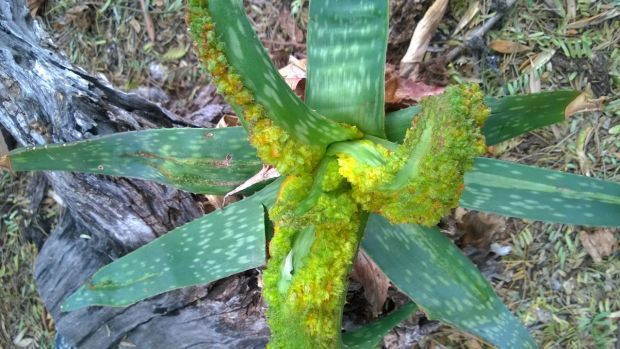
Q: I have had aloe in my Tucson yard for years. A few days ago I noticed this one plant, which I have dug up. Can you tell me what is the growth on it and what should I do about it?
A: Those growths on your aloe are caused by the eriophyid mite (Eriophyes aloinis). These microscopic mites feed on the plants and cause them to form the odd structures you see. Digging up the plant and removing it is the easiest fix and the only one that is known to work well. The mites are very small and can travel on the wind so it might spread.
Q: I would like to plant a fruit or citrus tree in my backyard in Marana. I have always liked Asian pears. Would that be a good match and if so what variety? If that is not a good match, what would you recommend?
A: Asian pears could be a good choice for Marana since there are varieties that require a low amount of chilling hours. You can consider other hybrid pears that can handle the heat as well. You should consider the microclimate where you live to be sure and probably shoot for one you like that has approximately 300 to 400 chill hours requirement. You might have neighbors growing them and that is a good way to know what grows well there. By selecting a variety that requires lower chill hours you are more likely to get a nice crop each year. You might visit the local farmers markets or grocery stores to taste what is grown locally before you make your choice. Also consider that some pear trees need a nearby pear tree to pollinate and produce fruit so you might end up buying two. Be sure to consider their mature size before you plant so you leave enough room between the tree(s) and the rest of your landscape plants.
People are also reading…
Q: What is the general recommendation for the amount of soil sulfur that should be added to our average desert garden soil per 100 square feet of space each year? Why is a soil sulfur supplement needed for the garden soils in our area?
A: The amount of any nutrient to apply is related to the pH of your soil and levels of these nutrients already available. It would be good to have your soil tested to determine these before adding any amendments.
Sulfur can be used in place of gypsum in
calcareous soils to free up calcium that is otherwise not available to plants. Calcium is important to plants such as tomatoes, for example, to prevent blossom end rot. And if you want to acidify soil, elemental sulfur is an excellent amendment. In both of these uses, elemental sulfur is converted to sulfuric acid by soil bacteria. This happens over a period of a several weeks (depends on soil temperature and other conditions). Acidifying soil can make sense with things like azaleas or camellias in pots or beds. But one caution: Mixing too much sulfur into soil can over-acidify the soil. The soil pH should be kept above 5.5. For more information, you can check out our excellent publications by our University of Arizona soil scientist, James Walworth. Just use your favorite search engine to locate “Soil Sampling and Analysis” and “Using Gypsum and Other Calcium Amendments in Southwestern Soils.”
Peter L. Warren is the urban horticulture agent for the Pima County Cooperative Extension and the University of Arizona. Questions can be emailed to plwarren@cals.arizona.edu