
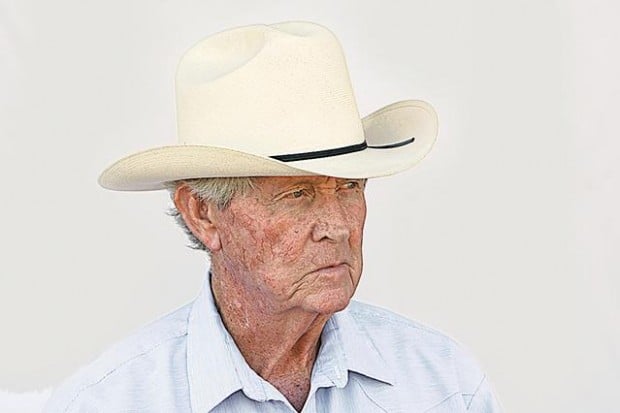
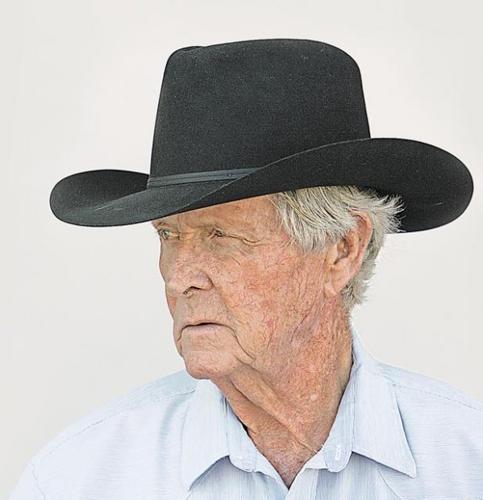
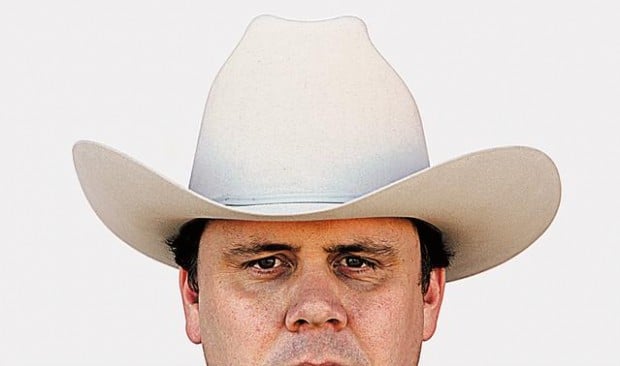
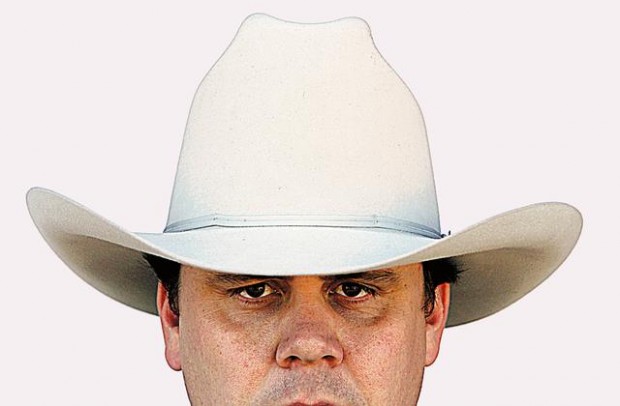
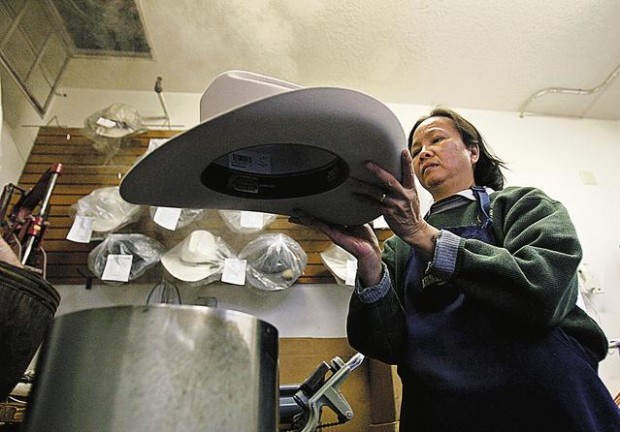
The subject is hats — cowboy hats. But we're not talking straw hats with low crowns, brims curled up the sides, feathers trailing down the back.
Those may look great with low-slung jeans, a T-shirt and battered boots. They may even fall into the "Western-style" category and adorn lots of heads at the 2007 Fiesta de los Vaqueros, which opens today, but they're not the real thing. They're not cowboy hats.
A real cowboy's hat is not frivolous, not an affectation; it is utilitarian — as much a part of the cowman's gear as his saddle or footwear.
It can be used to fan a fire, whip a horse or slap at pesky flies. It's also useful for shading a face and neck from the sun or keeping rainwater from running down a neck.
But, said Tom Hunt, whose family started ranching in Southern Arizona in the early 1900s, no matter how old or battered a cowboy hat becomes, it belongs to one person and one person only.
People are also reading…
"Don't mess with another man's hat," Hunt warned. "That'll stir him up considerably."
A cowboy will spend his money on his head and his feet, Hunt said.
"He'll buy good boots and a good hat," he said. He may not spend much on everything in between.
Since the best hats are made of fur, putting them in a pricey category, it's understandable that a cowboy would be a tad possessive of his hat.
And careful, Hunt said.
"No matter how dirty, how old, how trashy your hat gets, you always put it down the same way: with the front brim over the edge of a table. Or you put it upside down or on its side.
"But you never put it full square on a flat surface because you don't want to flatten the brim."
When it comes to wearing a cowboy hat, there's a protocol that cowboys follow — true cowboys, that is. The ones who have grown up with the cowboy — read gentleman's — code of conduct.
Hunt's younger son John grew up hearing those rules.
"Every day," John said. So impressed was he by his dad's dictates that there's no doubt he'll pass on the code of conduct to his son, Cameron, 2.
"If you meet a lady on the street, you touch the brim of your hat (in salutation)," Tom Hunt explained. "If you're acquainted with her, you might tip your hat to her. If you know her well enough to stop to talk with her, you take your hat off. Take it off, too, if you step into an elevator or enter a house or restaurant."
And in a bar?
"It's permissible to wear your hat in a bar," Tom Hunt said, "but you never sit down to eat wearing your hat. Only snot-nosed buckaroos do that."
And what's a buckaroo?
"Somebody who thinks he's a cowboy."
Consider color, price, material in choosing hat
A cowboy's hat speaks to his profession and his personality, says Richard Morrow of Arizona Hatters and VisionQuest, an intervention program for at-risk youths and their families.
And because they're so important, the wearer doesn't just pick one off the shelf, pay for it and walk out.
Selection is based on the wearer's height, build, face shape and even hair coloring, Morrow said. After that, the hat must be shaped and fitted to the wearer's head.
Otherwise the person just doesn't look right. Nor is the hat as comfortable as it should be.
Arizona Hatters, 2790 N. Campbell Ave., has been fitting hats for cowboys for more than 50 years, Morrow said. The store was acquired by VisionQuest in the 1980s.
It was a good match because VisionQuest founder Bob Burton used the cowboy hat as a badge of honor, a symbol of a young person's growth in learning to take charge of his life, make serious changes and acquire self-discipline.
John B. Stetson is credited with creating the first cowboy hat in 1865.
It began as a joke during a hunting trip out West, but with its wide, flat brim and flat crown, it offered so much protection from the elements that soon others wanted a hat like it. It became known as "The Boss of the Plains."
Today's styles have names such as Rancher, Tycoon and Tom Mix.
Colors include, among others, gray, brown, black, white and silver belly (a very light, silvery gray).
Prices vary, but generally speaking, you can expect to spend at least $142 for a dress hat. That would be a wool felt dress hat.
Those made of fur, beaver or rabbit are more expensive. The price depends on the quality — identified on the sweatband by X's; the more X's, the higher the quality.
For example, a Rancher hat in a light color might start at $173 and go as high as $1,000 for four X's.
One hat, displayed under glass, carries 100 X's and is priced at $1,260. It's made of cashmere and beaver fur.
Why would anyone pay so much for a hat?
There's that old maxim: You get what you pay for. And in the case of a cowboy's hat, it's not something that he wears for fun. It has to be able to hold up under the hot sun, rain and even snow.
Straw is fine for summer, but probably not what you want in winter. Wool won't hold up in the rain. And neither can be cleaned.
Fur, however, won't be hurt by water. In fact, a fur hat can be cleaned over and over and then reblocked.