

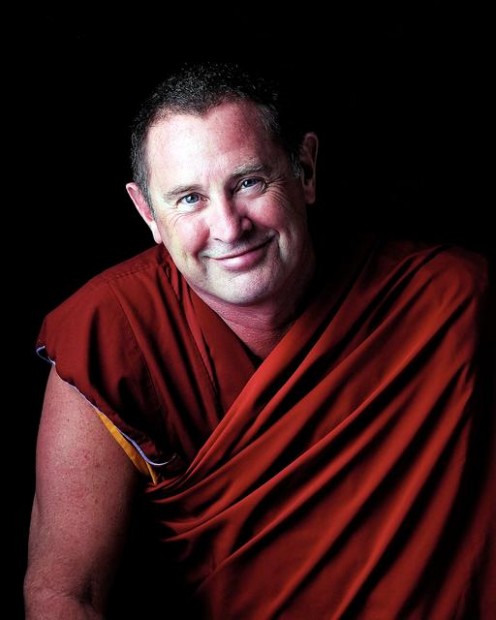
When Sumati Marut gives a talk, he often emphasizes a simple concept: The time for joy is now.
Life passes quickly, Marut says, and many don't live with happiness as their focus.
"Most of us, most of the time, are not prioritizing the things that really matter — our personal spiritual training and self-discipline, and acts of kindness, altruism, and compassion toward others," he said. "We are instead consumed with, and diverted by, the very things that cause us more and more dissatisfaction."
Marut, who grew up Brian K. Smith and the son of a Baptist minister in St. Paul, Minn., has been a student and teacher of Tibetan Buddhism for more than a decade. His students call him Lama Marut— or teacher Marut.
As an ordained Buddhist monk and retired professor of comparative religion, Marut spends his time teaching, providing guided meditation and giving informal talks and workshops in Tibetan Buddhism. He is the spiritual director of two Buddhist centers, one in Los Angeles and one in Massachusetts.
People are also reading…
Beginning Wednesday, Marut is offering Tucsonans a free, three-part series on happiness at Three Jewels, 314 E. Sixth St.
Marut, 56, has an apartment in Tucson, but spends much of the year traveling and teaching. He spends about 15 weeks each year at the Diamond Mountain University and Retreat Center, about 120 miles east of Tucson.
Here are excerpts from a recent interview with Marut:
Your upcoming lecture series is titled "The Happiness Revolution: Ancient Techniques for Radical Transformation." Please tell us about the series.
These talks are how to obtain the deep-seated happiness we are all looking for. True happiness cannot be found in more money, cooler products, or more entertainment. The consumerist culture has seriously misled us into a mindless, greedy and selfish pursuit of more and more to devour, and it has turned out to be a dead-end. Real contentment and joy have to be found and developed within.
So in these lectures, we'll offer a radical but traditional alternative to consumerism, our addiction to work, and our setting our loved ones up to fail.
In the first talk, "Changing the Past," we'll concentrate on the importance of forgiveness and gratitude as the key to thinking about the past in a healthy-minded way.
The second talk is titled "Controlling the Future" and will review ways we can live happier lives in the present by eliminating the anxiety about what lies ahead.
In the third talk, "Being Happy, Here and Now," we'll offer suggestions on how to embrace what's happening in the present with joyful enthusiasm, and how to get the most out of every minute of this precious life.
Since 1998, you have been a student and teacher of Tibetan Buddhism and in 2005 you became an ordained monk in Gelukpa lineage. Please tell us about this journey.
My professional study of religion, beginning in graduate school and continuing through over 20 years of teaching in the academy, centered on the religions of India, which, of course, included Buddhism. But until I reached my mid-40s, I was not drawn to Buddhism as a religious practice.
It was in the late 1990s that I underwent a sort of midlife crisis. I had reached the apogee of my profession — I was a published author and a tenured, full professor in a prestigious university. I had three children and three marriages. I had traveled extensively, pursued hobbies like surfing seriously, and rode a motorcycle. But none of it had brought me the fulfillment and satisfaction in life I was searching for.
So I decided to try something different. I started an intensive study of a more personal, practice-oriented approach to Buddhism in 1998 under the guidance of my teacher, Geshe Michael Roach. By 2000, I was teaching what I had learned to a small group of students in my living room in Venice Beach.
In 2005, my teacher graciously consented to ordain me as a novice monk, a mark of my lifetime commitment to the serious pursuit of the religious way of life. It is a great honor and a beautiful way of life to be a monk, and I have never regretted it for a moment.
What does it mean to you personally to be a Tibetan Buddhist?
The term "Tibetan Buddhist" can be a bit misleading. While I am a Buddhist within the Tibetan Buddhist tradition, I am not a Tibetan. I am an American living in the modern, Western world.
I strongly feel that the teachings of the Buddha must be clearly and persuasively presented as relevant to our own culture and times. Buddhism will not survive in the West if it remains encased within the traditional forms of what is for most of us an exotic, foreign religion.
If You Go
What: A free series titled "The Happiness Revolution: Ancient Techniques for Radical Transformation," by Sumati Marut, a Buddhist monk.
When: The series begins Wednesday and will continue for the following two Wednesdays. Talks begin at 7:30 p.m.
Where: Three Jewels, 314 E. Sixth St.
To learn more: Marut also offers daily inspirational messages sent to cell phones, as well as free weekly podcasts, videocasts and online audios of his teachings. Go to www.lamamarut.org for more information. Go to www.3jewels tucson.com to learn more about Three Jewels.