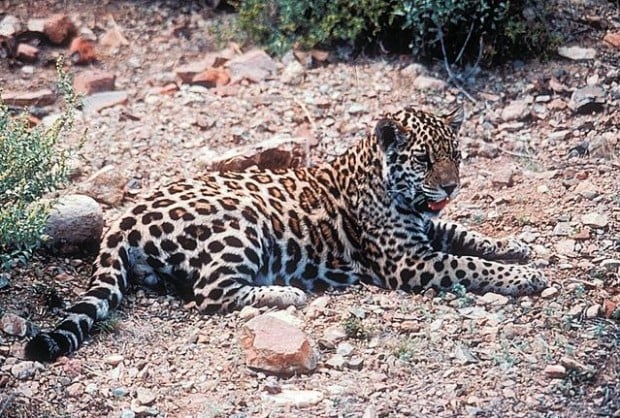
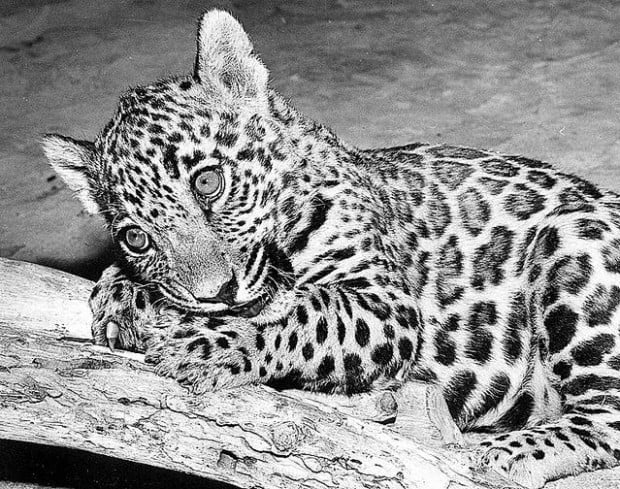
I believe I have made it clear to my readers that at the Desert Museum I am the Big Cat! However, I have learned that previously there have been other large cats of a different species on display here! They were jaguars, and I must admit that some of them might have outweighed me, although it is obvious that it is only I, a proud mountain lion, who is both literate and an author!
Jaguars are the largest species of cat native to the Western Hemisphere, males measuring 5 to 8 feet from nose to tail and weighing 140 to 300 pounds. Females are usually smaller. They are beautiful and powerful animals, heavily muscled, with a large head and strong jaws and teeth. Jaguars are capable of killing prey by biting through its skull.
Jaguars' coats are a tawny yellow, with white underparts. The fur on the back and flanks is marked with dark, open-ring rosettes, similar to those on a leopard. However, jaguars' rosettes have small dots or shapes within the ring, which the leopards lack. No two jaguars are marked exactly the same, and coloration patterns can be used to identify individual animals. Occasionally in South America, melanistic (black) jaguars, often referred to as "black panthers," occur.
People are also reading…
Jaguars range from southern Argentina, up through parts of Central America and Mexico, and formerly into the Southwestern United States, reaching as far north as the Grand Canyon. Over their range, the cats' habitats vary from lowland wet areas (they are accomplished swimmers) and tropical rain forests to warmer, drier types, including oak and pine woodlands. Jaguars are capable of traveling long distances (their range covers up to 500 miles). They feed on more than 85 different species, depending on animals available in their habitat, including deer, javelina and livestock.
Litters of usually two young stay with the mother for up to two years. Jaguars snarl, growl and "roar" as a means of communication. The roar is a series of three to 50 (or more) short, hoarse coughs or grunts, increasing in rapidity.
Jaguars are of conservation concern throughout their range. Indiscriminate hunting and loss of habitat have severely impacted the species. It is estimated that jaguars currently occupy only 46 percent of their former area.
Jaguars are listed as endangered and are protected under the Convention on International Trade in Endangered Species. Jaguars were common residents in the Southwest until the beginning of the 20th century, when loss of habitat, hunting and predator-control programs eliminated the resident populations. The last documented female jaguar in Arizona was killed in 1963.
Recently, the presence of a limited number of jaguars in Southern Arizona has been confirmed. Extensive, exciting programs are under way with the goal of protecting the jaguars' current northernmost breeding grounds in northern Mexico and returning jaguars to their former range in Arizona and New Mexico.
Jaguars may return to the Desert Museum, also! We hope to have a new jaguar exhibit with a jaguar in residence in the not-too-distant future. That gives this Big Cat something to think about!
Learn more about jaguars and other big cats in these books:
● "What Is a Cat?" by Amanda Bishop and Bobbie Kalman (Crabtree Publishing, $6.95)
● "Big Cats" by Dorothy Hinshaw Patent (Walker Books, $17.95)
● "Big Cats" by Seymour Simon (HarperTrophy, $6.99)
● "The Life Cycle of a Lion" by Bobbie Kalman and Amanda Bishop (Crabtree Publishing Company, $13)
● "Project Tiger" by Susan Ring (Weigl Publishers, $6.95)