
"One rudder. Two rudders. Pattern clear. Go!"
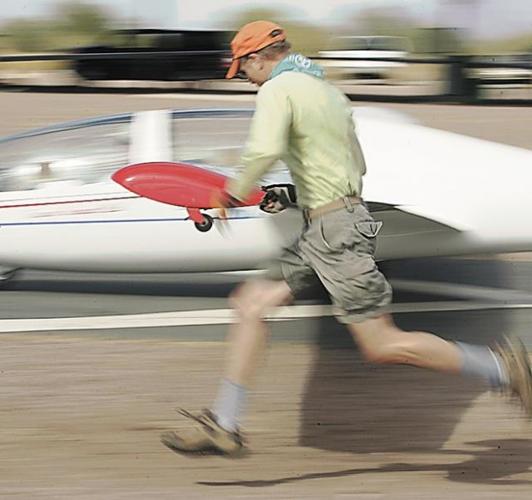
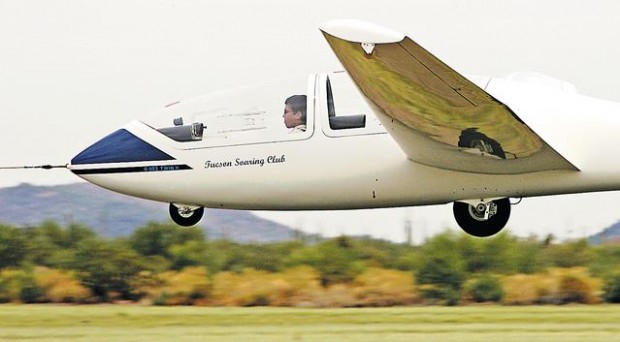
The wing runner sprints alongside a small motor-less glider as a tow plane drags it down a runway and up into the brilliant blue sky.
At 3,000 feet the towrope is cut. The aerodynamic glider is on its own with only the power of the air and the skill of the pilot to keep it aloft.
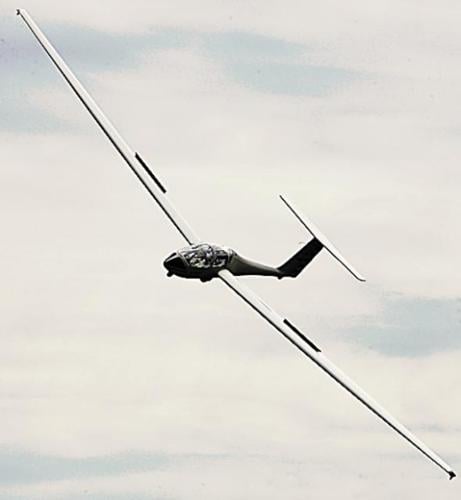
Silent but for the whooshing of wind over the wings, the slender-winged glider slices through the air. From those great heights the cactus and trees of the Ironwood Forest National Monument are tiny green speckles on a sand-colored canvas. The glider circles and rises and soars and dips as long as it can before gravity forces the craft back to Earth.
The Tucson Soaring Club has been quietly occupying the sky above the Old Pueblo in this way for 40 years, taking delight in Tucson's year-round, world-class gliding conditions. — Sarah Mauet
People are also reading…
Scott Olsen is battling nerves. He didn't expect to fly solo for the first time today. He's been training for his private pilot glider license for about a year and has flown with an instructor 37 times so he's technically ready. But he's also a little conservative — a self-proclaimed over-learner. Plus, it's the Tucson Soaring Club's 40th-anniversary celebration so there's an audience watching.
"God, let me get back," he says to himself as he sits alone in a dual-seat glider on the tarmac at Marana's El Tiro Gliderport.
His instructor, reclined in a golf cart by the runway, is more confident.
"I think he had it in his head that he wasn't going to solo today — that he'd do it next week or the week after," Dan Rovey says. "But there's no reason to wait so I encouraged him to do it. His flying is really good. I'm not worried about him."
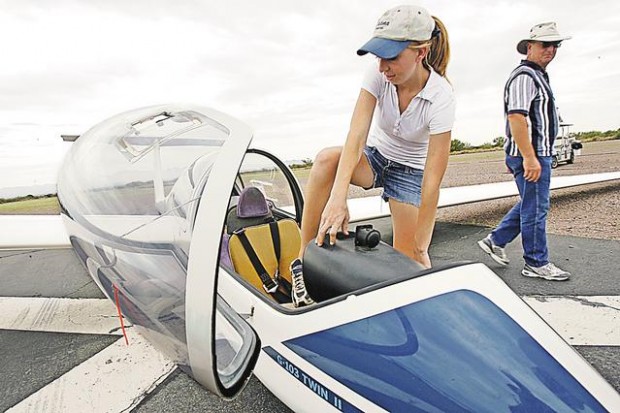
With the engine rumbling on the Piper Pawnee, a white tow plane with a red stripe, another club member, Ron Olson, double-checks the aircrafts and the 200-foot towrope connecting them.
"One rudder. Two rudders," he yells as the tow plane and the glider wiggle their tailpieces to indicate readiness. "Pattern clear. Go!"
He runs alongside Olsen's glider supporting a wing for a few feet as it's towed down the runway. Within a few seconds the pilot-in-training is airborne.
At 3,000 feet above the Ironwood Forest National Monument he releases the towrope. Without a motor Olsen is on his own with only his skills as a pilot and the power of the air keeping the glider aloft.
Thrill of motor-less flight
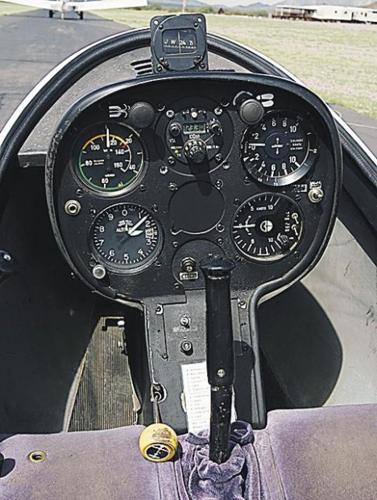
Modern gliders (or sailplanes — the terms are interchangeable for the most part) are typically made of fiberglass or carbon fiber and have long, thin wings, a plexiglass-topped cockpit and a highly polished surface. They are very aerodynamically efficient, which is important because they're missing what most would consider an essential element in an aircraft — a motor.
Though self-launching gliders with motors now exist, traditional gliders are motor-less and are launched by aero tow or winch. They have the same basic controls as an airplane and fly and land under the control of the pilot.
The glider Olsen is piloting is a Grob-103, one of the club's fleet of seven single- and dual-seat gliders that members can reserve for flights. About one in eight members of the Tucson Soaring Club own or co-own gliders, which can range in cost from $8,000 for a used model to $200,000 for a spiffy new one, said club president Bob Perry.
Generally, when a glider is released from a 3,000-foot tow, it results in a 20- to 30-minute flight. Unless, of course, the pilot finds rising air currents — rising columns of warm air called thermals or wind flowing up and over mountains — to extend the flight.
Stunning views of desert and moutains
Olsen scans the area for circling birds, dust devils or puffy, flat-bottomed clouds — all signs of airlift. He finds lift under a cloud and begins "thermaling" — rising by circling within a column of warm air — his variometer (vertical speed indicator) shows him rising 600 to 800 feet per minute.
The desert floor falls away beneath him, giving him a stunning view of the rugged Silver Bell Mountains as well as the ironwood, mesquite and palo verde trees, creosote bushes and saguaros blanketing the ground.
He has dreamed of this moment since childhood when he watched a cartoon with a small airplane flying over a desert dotted with small cactus and plants. Today he is the one soaring over the desert vegetation, which looks cartoonlike from the great heights.
Olsen has to work to stay focused and not get distracted by the fact that he's alone, but since the moment he became airborne it's been obvious that he's on his own.
"I got off the ground really light," he says later. "Landing and turning you could feel that there wasn't someone back there. It felt different. There was more adrenaline."
He practices routine flying moves to keep his mind off the fact that an instructor is not behind him ready to give tips, advice or bail him out of a tricky situation.
Without a motor the glider ride is fairly silent, with the exception of the whooshing of air over the wings. It's a sunny day in the low-80s with scattered clouds and a light wind from the west. It's great weather for a smooth ride — perfect conditions for a first solo flight.
Summer days and longer flights
Tucson has some of the best soaring conditions in the world.
"I've flown nationally," club member Tony Smolder said. "This is definitely the best year-round gliding of any place. Almost every weekend is good for flying. That's why I moved here. I wanted to move here for soaring."
Several elements give Tucson its ideal soaring conditions — low altitude, year-round heat from the sun, many mountain ranges, moisture from the Gulf of Mexico and a long, hot summer with a rainy season.
"You need heat and a little moisture to get cumulus clouds," said club member Michael Stringfellow, an atmospheric physicist turned lightning consultant who has been soaring since 1967. "Pre-monsoon — that's when we're doing the long flights."
During Tucson's summer days, it's possible to stay aloft for 11 or 12 hours, if a bit impractical (pilots have to bring food, water and a "relief system"), Perry said. In 27 years of soaring, his longest flight was around 6 hours. Club member Greg Armstrong took a 7-hour flight after getting his license last year.
"I was having so much fun I decided to stay up as long as I could," he said, adding that the gliders are quite comfortable. "You don't sit in a glider — you wear it. It's like a lawn chair, with your feet out and you're leaning back. You have a great view."
With cruising speeds generally 50 to 100 knots — about 58 to 115 miles per hour — a glider can travel hundreds of miles in good conditions. In the past 40 years, club members have broken state and world soaring records for distance, duration and altitude gain.
"There's nothing artificial about flying," said club member Brad Boesel, who got his license 11 years ago when he gave up endurance motorcycle racing. "There are no artificial limits. There are real limits. If you pass a limit the plane will stop flying and start falling. The situation is it's me and the machine and nature and how much can I extract from the situation."
While soaring is certainly a thrilling sport, it's actually pretty safe.
"It's a lot safer than flying in a plane with a motor," said Charlie "Lite" Minner, who joined the club in 1972 and is now the director for Region 9 (which includes Arizona) for the 14,000-member Soaring Society of America. "Just think of it. All you're doing is flying. You're not having to worry about managing an engine, a fuel system, an oil system — all that other stuff. I think it's a lot safer."
The Federal Aviation Administration allows 14-year-olds to fly gliders solo and 16-year-olds to get pilot licenses. It's a common saying among glider pilots that the most dangerous part of soaring is the drive to the airport.
"They're pretty safe," Perry said. "They're as safe as the pilot. . . . In the years I've been there I don't think we've had a member fatality from flying."
Completing a successful first step
Olsen practices the landing pattern while still a couple thousand feet up. It's the most challenging part of the flight. He has to control airspeed, direction and height all at the same time while keeping his eye on the point where he wants to touch town. At 1,000 feet it's time to do it for real.
He approaches the landing strip from the east, aligns his small craft over one of the five dirt runways and makes the transition from the air, where he's gliding almost silently, to the ground, where the glider rumbles loudly before it rolls to a stop.
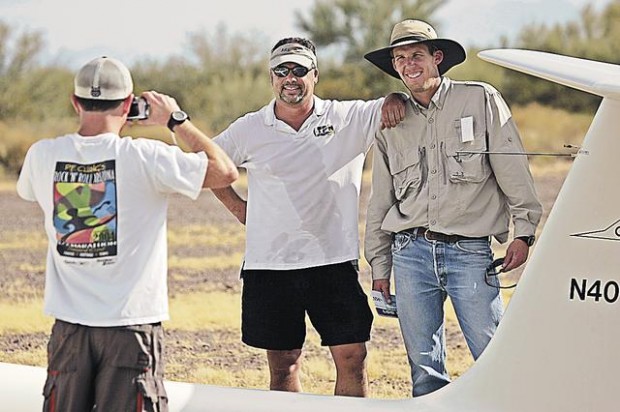
A small group of club members gathers around the new soloist to offer congratulatory smiles and handshakes as he climbs out of the glider after his exhilarating 30-minute flight.
Olsen still has to fulfill several requirements before he can get his private pilot glider license, but a successful first solo flight is a big step toward that ultimate goal.
"It was incredible," Olsen says, grinning wildly. "I did a lot better than I thought I would. . . . I think when we do anything a little bit challenging we grow."
TUCSON SOARING CLUB
Tucson Soaring Club celebrated its 40th anniversary on Nov. 10. The club, formed by 25 charter members in 1967, was originally operated out of Ryan Field Airport.
In 1983 the nonprofit club, a chapter of the Soaring Society of America, moved to Marana Number 5 Auxiliary Field, which was used during World War II. Members cleared brush for runways, built hangars and renamed the place El Tiro Gliderport after the road that leads to it.
"I remember when we first got it there was nothing there," said Charlie "Lite" Minner, who joined the club in 1972. "We all linked hands and shovels and cleared runways one at a time."
When the first 10-year lease expired in 1993, the club signed a 20-year lease agreement with the Bureau of Land Management for the 184 acres for about $2,000 a year.
Today the Tucson Soaring Club has around 125 members ranging in age from 14 to veterans in their 80s. Club membership is open to the public regardless of age or previous flying experience.
"It's a really neat group of people," Greg Armstrong said. "They tend to be highly educated with a sense of adventure."
The members also have a team mentality. In addition to paying monthly dues, club members volunteer their time at least once a month to make the club run.
"Everyone does the work for free to keep expenses down," said Ron Olson between line chief duties.
Joining the club requires a $400 initiation fee plus $64 for a one-year membership in the Soaring Society of America and the first of the $65 monthly dues. Members pay $25 for a 3,000-foot tow. Student discounts are available.
"The club here gives you an opportunity to learn how to fly probably cheaper than any place in the country," said Minner, who is also a regional director of the Soaring Society of America. "Learning to fly in a club is about the least expensive way to fly because you join the club and you help out at the field and in return you get to fly."
LICENSING
People thinking about becoming pilots should learn the basics of flying in a glider first, said club member Sheena Stogsdill, because they will gain the skills and confidence needed to fly and land a plane — with or without a motor.
The 16-year-old wants to join the Air National Guard and fly F-22s so she got her license as soon as she could.
"I started training when I was 14," said the Sahuarita High School sophomore. "A week before my 15th birthday I soloed. I took the written test during the summer and I'm really proud of getting my pilot license."
"Having your pilot license gives you a lot of confidence in life because you conquered something," she added.
Tucson Soaring Club provides pilot training for glider licenses issued by the Federal Aviation Administration.
The club's instruction is tailored to the needs of each member. A member with no previous flight experience is required to take at least 30 flights with a FAA-Certified Flight Instructor for Gliders and must be at least age 14 before he or she is endorsed to fly solo.
After soloing, student pilots may qualify for a private pilot glider license if they meet the minimum requirements of being age 16, logging 10 hours of flight time during at least 20 flights in a glider, logging 2 hours of solo flight time in a glider and passing both the FAA written examination and flight exam with a FAA examiner.
"Many years the Tucson club has been the club that has generated the most new soaring pilots in the country," said Charlie "Lite" Minner, a regional director for the Soaring Society of America. "For many years they were right up there on the list of the most recruitments. They have a beautiful field and they have a nice, very well organized club."
GUEST RIDES
Tucson Soaring Club offers guest rides in dual-seat gliders with pilots who have Federal Aviation Administration commercial licenses — the highest level of competency.
Though anyone can take a ride, glider seat capacity is limited to about 220 pounds and anyone taller than 6 feet, 6 inches may feel cramped, club president Bob Perry said.
After taking his first guest ride, Jerrin Beebe was hooked and now plans to get his license.
"I've always wanted to learn how to fly," he said. "It's fun. Flying is peaceful."
Because conditions vary with the weather, rides can range from smooth to choppy, but Perry says the sensation is comparable to flying in a passenger jet.
"Do it in the morning when the air is smooth," he recommends to people with a propensity for airsickness. "Tell your pilot about it, but it shouldn't be any worse than flying in an airliner."
Guest rides typically last 25 minutes and cost $95. A three-flight introductory package is $175.
IF YOU GO
Where: El Tiro Gliderport in Marana.
When: Individual guest rides are scheduled during regular hours — 9 a.m.-5:30 p.m. Saturdays and Sundays and noon-5:30 p.m. Wednesdays. Group rides are scheduled on the other days.
Drive: Take Interstate 10 west to Avra Valley Road, Exit 242. Continue about 11 miles (past the Marana Northwest Regional Airport) and turn right on Trico Road. Turn left on El Tiro Road, continue two miles after the pavement stops, and enter the gate with the Tucson Soaring Club sign.
Information: www.tucsonsoaring.org or 575-2500.
check out these soaring videos
Visit this story online at www.azstarnet.com/accent to watch two soaring videos and a slide show of pictures taken at the Tucson Soaring Club.