

Burial or cremation — Tucsonan Benjamin Laguna never expressed a preference to his family.
When he died recently, his children sat down and discussed what should be done. As in many families, the decision was based on what would bring them the most solace and what was most financially feasible.
"Like any death, it was unplanned and caught us off-guard," said his daughter, Elvia Duran of Avondale. "We sat down to make the decision together as a family, and we decided it (cremation) would be the best option for us. As far as the expenses of funeral costs, it was the most affordable."
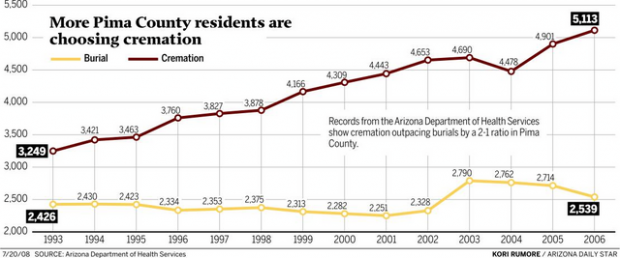
Laguna's family is part of a growing trend. More people are choosing cremation over burial for loved ones. In addition to a lower cost, cremation is, more and more, becoming a viable option because people are living longer and making their own arrangements, they're moving away from their hometowns, and religious restrictions and community attitudes toward cremation are loosening.
People are also reading…
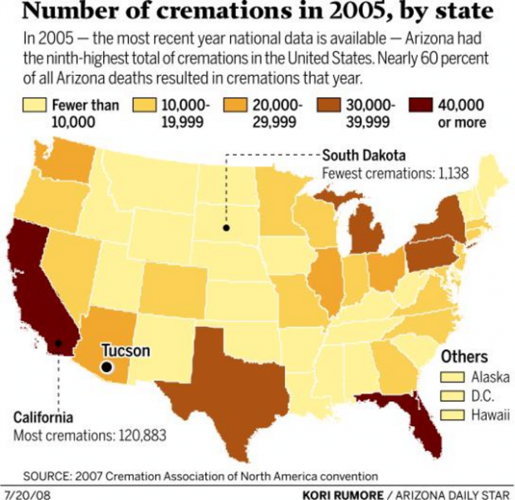
Arizona is among the top five states in the nation for cremation, and some local experts say the percentage of cremations in Tucson is higher than more rural areas in the state.
Laguna's children preserved some traditional, religious funeral rites — a rosary, a Mass and a military service — even though they made the choice to have their father cremated.
"Even though people are choosing cremations, they are having traditional cremations where the body is present for the services. Especially with the Catholic faith, this is really common," said Belinda Motzkin Brauer, of Bring Funeral Home.
The Laguna siblings also decided they each wanted to keep some of their father's cremains.
"We were wanting something physical to hold on to, rather than going to a place to look at a nameplate," said Benjamin's son, Tucson glass artist Anthony Laguna.
"When we were all at the mortuary discussing the funeral costs and the arrangements, they were telling us the price of the urns and we all looked at my brother and said, 'Couldn't you do that?' " Duran said — meaning, couldn't Laguna create the urn himself?
Laguna picked up his father's cremains last week from Bring Funeral Home. This week he will begin work in his studio, IK Glassworks, on five blown-glass urns, one for each family member and an extra one the siblings may give to Benjamin's brothers or may take to California to scatter the contents in the ocean.
Cremation is being chosen for one out of every four deaths today in the United States, Cremation.com says. The choice is even more prevalent in Arizona: Cremation is chosen 61 percent of the time, according to the most recent figures from the Arizona State Board of Funeral Directors and Embalmers.
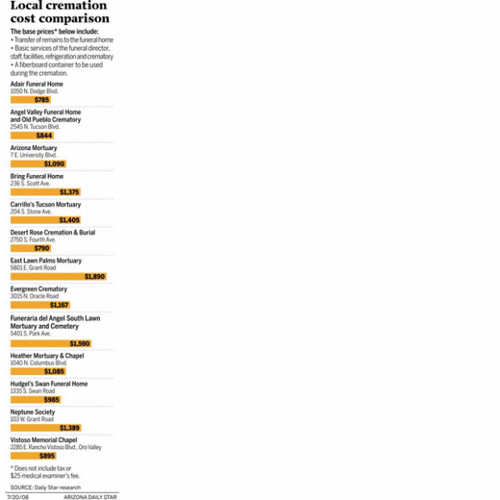
Mike Orcutt thinks that percentage is even higher in Tucson. He and his wife, Deanna, own Angel Valley Funeral Home and Old Pueblo Crematory.
"You take your population centers, Tucson and Phoenix, it's going to be higher — 70 to 75 percent cremation in Tucson," Orcutt said.
Key trends driving interest in cremation, according to the Cremation Association of North America, include:
● Longer lifespans, which means people are choosing cremation for themselves.
● Increasing migration to retirement locations.
● More societal acceptance of cremation.
● More consideration of environmental factors.
● Weakening ties to tradition.
● Diminishing religious restrictions.
● Increasing options for memorial services.
About one-third of those who opt for cremation choose it because it is less costly than burial, the association says.
Cremation numbers began increasing 15 to 20 years ago and have risen steadily since, said Bill Addison, president of Evergreen Mortuary, Cemetery and Crematory. He attributes the increase to a more transient population, people moving to cities and states where they don't have family ties.
He has noticed more recently that "People don't look at cremation so much now as direct disposition — cremation, no viewing, no services, scatter the cremated remains.
"More and more people are determining they don't have to just do that," he said. "They understand viewings, services, gatherings are allowable."
Dr. Kenneth Iserson of Tucson has authored a number of books, including "Death to Dust: What Happens to Dead Bodies?" and "Grave Words: Notifying Survivors About Sudden, Unexpected Deaths."
The retired director of the Arizona Bioethics Program at the University of Arizona College of Medicine thinks funerary rites in the past were a function of community mores — an occasion for family, friends and neighbors. Lack of community ties for Tucson transplants and expenses associated with burial make cremation more appealing even among communities with a long tradition of burial, he said.
"Places that are so traditionally funeral-oriented, like northern Mexico, are starting to move toward cremation. People can't see paying for this enormous and expensive ritual when there's a much-less-expensive option," Iserson said.
Oro Valley sculptor Robert Raikes has spent more than 30 years creating high-end collectible wooden dolls and bears. Four years ago he expanded his business to take advantage of what he saw as an emerging trend and developed a line of hand-carved wooden urns. He realized more and more people were opting for cremation and that baby boomers were looking for urns that reflected their interests and individuality.
His work is represented in two galleries, and his clients are "people who are looking for something really special, out of the ordinary. It's usually someone who's buying something for a loved one and they want to say something really special about that person. A lot of times they want me to carve something in the piece that represents that person," Raikes said.
Finding a way to memorialize a loved one that is meaningful to the family and friends and representative of the deceased has resulted in more families choosing to scatter cremains.
"A lot of people want to find a nice saguaro out in the desert to be scattered. Some people say, 'I want to play golf at Tubac — put me there,' " said Orcutt, the Angel Valley Funeral owner.
Mount Lemmon, Sabino Canyon and Saguaro National Park are popular locations for the scattering of cremains in the Tucson area, he said.
The Tucson Aeroservice Center, based at Marana Regional Airport, gets a call about once a month to scatter ashes, said Ron Herbert, business manager.
"Sometimes they request places we can't go depending on population and prevailing winds," he said. "The most common is over the Catalinas because it's such a pretty place."
Cremains can be scattered on one's own property, but permission must be obtained to scatter on private property and public lands, said Rudy Thomas, executive director of the Arizona State Board of Funeral Directors and Embalmers.
Saguaro National Park East issues about half a dozen permits a year to families seeking to scatter cremains there, District Ranger Michelle Uhr said.
Families must fill out an application for a special-use permit, pay a nominal fee and abide by the guidelines of where cremains can be scattered.
"People enjoy the outdoors, and they've had favorite places they've visited over the years that mean something to them," Uhr said.
ON STARNET
Author Hunter S. Thompson's cremains were launched from a cannon in a burst of fireworks. "Star Trek" creator Gene Roddenberry had his cremains launched into space.
More and more people in the United States are opting for cremation. Increasingly, they are looking for ways to commemorate their exit — or the departure of a loved one — from this life in personalized ways.
Read more about your options and tell us what you'd like done with your cremains at go.azstarnet.com/ burialoptions.