

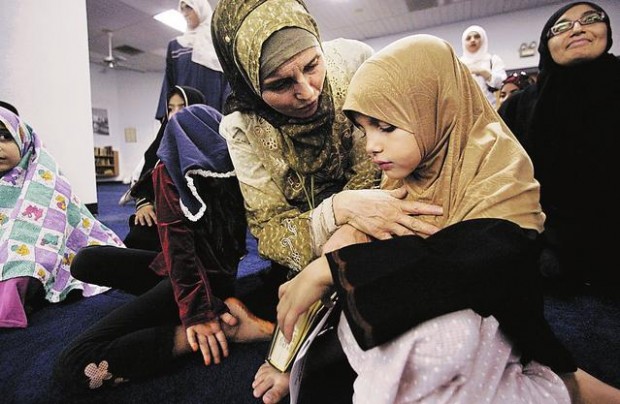
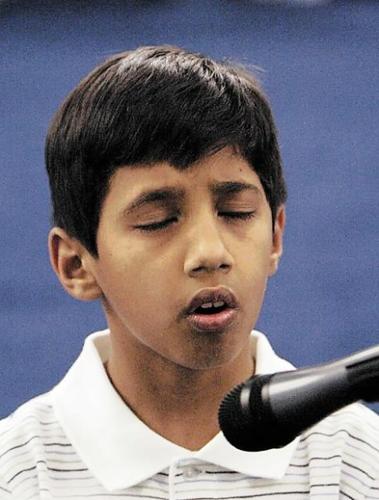
After a quick hug from her mother, 6-year-old Mihed Lezzar strode confidently to the empty chair, sat down in front of four judges, adjusted the microphone, and recited an entire chapter of the Quran in Arabic.
Her recitation of surah 90 — translated as "The City" — was melodic, like singing. The judges, who score on pronunciation, memorization and presentation, nodded in approval.
Like most of her fellow competitors in the Islamic Center of Tucson's Quran recitation competition this week, Mihed began memorizing the Quran at the age of 2.
That's the best age for children to learn the difficult nuances and inflections of Arabic without allowing English to take over, explained Mihed's mother, Farida Lezzar.
The contest occurs each year at Tucson's largest mosque during Ramadan, a monthlong observance in the Muslim faith that this year will end Saturday morning with the festive celebration of Eid al-Fitr. Members of the Islamic Center will hold a large prayer gathering at Udall Park. Other Muslims hold Eid celebrations in private homes.
People are also reading…
The word "Quran" means recitation and children typically learn the tradition by listening to others during prayers.
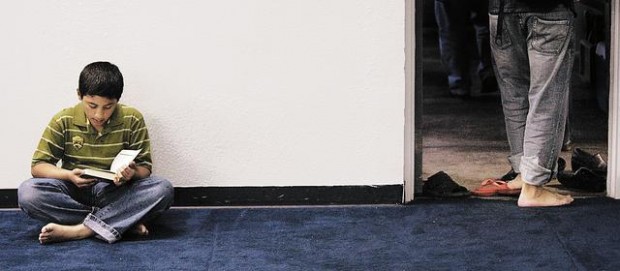
Not unlike a spelling bee, the contest had its share of tense moments. Some children froze as they looked at the microphone. A few asked for their mothers. A couple shed tears. And throughout the contest, many small boys and girls sat with their heads down doing last-minute studying.
Similar Quran recitation competitions, which occur around the world during Ramadan, date back to the time of the Prophet Muhammad as a way of preserving the Muslim holy book, mosque leaders say.
"By memorizing it, we protect it from mortification, subtractions. . . . Even if everything burns down and all the Quran books are gone, we have preserved it in its pure form," said Farid Farooqi, the mosque's imam.
Farooqi is also a hafiz— someone who has memorized all of the 6,200 verses in the Quran's 114 chapters. He achieved his hafiz status by the age of 11 when he was a child in Pakistan.
Farooqi has four of his own children and does not expect them to memorize the whole book. There are too many distractions in American culture, he said, noting the title of hafiz is more rare in the United States.
Competitors in the mosque's contest ranged from age 3 to adult. Some of the surahs — chapters — are short. "The City," for example, has 20 verses, which Mihed had been practicing for three weeks.
Older competitors like Qasim Mahmood had to memorize longer chapters, like surah 55, "Most Gracious," which has 78 verses.
"My section is 3 1/2 pages," said Qasim, 12, who was busy studying the Arabic words before taking his turn. "I know other sections, but just small bits. It's hard."
Both Qasim and his brother, 9-year-old Tahir, say that memorizing the Quran helps them to understand it. Indeed, mosque leaders say they believe the practice fosters improved knowledge of the faith, deeper thinking and discipline.
The fact that children are able to memorize the book at such a young age is the miracle of the Quran, Farooqi said.
Farooqi, who joined the mosque in August, wants to expand the Quran competition next Ramadan and invite competitors from other parts of the state. He'd also like to make it a more public event.
DID YOU KNOW ...
About 8,000 Muslims live in the Tucson area. The Islamic Center, at 901 E. First St., with about 1,000 regular worshippers, is the largest of three local mosques.