

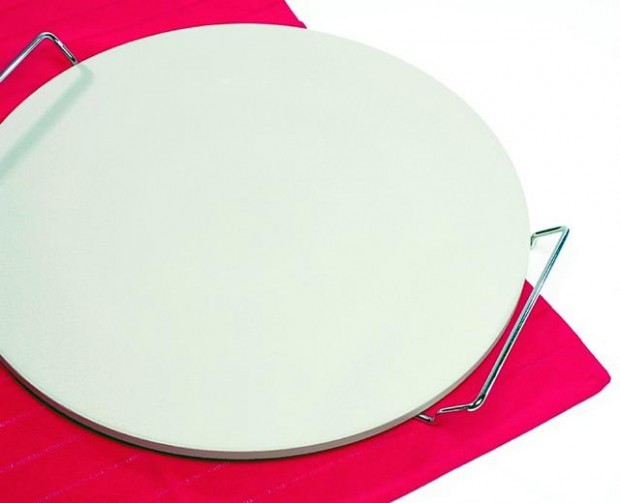
RALEIGH, N.C. — For many years, my pizza stone languished on the top shelf of a closet with the other one-trick kitchen tools: a wok and the canning utensils. The $14 stone was there because it had failed me.
I thought it would be fun to make homemade pizza to eat before the final episode of "The Sopranos." I likely used the pizza dough from Trader Joe's. Knowing our tastes, I'm positive the pizza was loaded with toppings. I threw that raw dough, loaded with toppings, onto a cold pizza stone and into a hot oven. The result was that the dough took forever to bake as the cheese and other toppings became more and more brown. That night we ate a lovely salad brought by my friend Sarah and a pizza with a not-very-done crust and overdone toppings.
Sarah mentioned that she often baked her pizza crust for a few minutes before adding the toppings. That germ of an idea didn't really take hold, though, until I thought about trying to make pizza again. In the midst of a recession, I can't bring myself to pay for pizza delivery.
People are also reading…
It's no wonder. I calculated that ingredients for a homemade pepperoni pizza cost $5.62. Compare that with $15.29, without tip, for a Pizza Hut pepperoni pizza delivered to your door. Plus, each of the recipes I made turned out two, three or four balls of pizza dough that could be frozen for future dinners with a little effort and the cost of fresh toppings.
My pizza stone epiphany came when I picked up Peter Reinhart's "American Pie: My Search for the Perfect Pizza." Reinhart, a renowned baker, teaches at Johnson & Wales University in Charlotte, N.C. He also is a partner in Pie Town, a Charlotte pizza parlor.
In the book, Reinhart explains several methods for turning out great pizza from a home oven. Beyond installing a hearth kit oven insert at a cost of about $200, the next best option seemed to be spending less than $15 on a pizza stone. The key is to crank up the heat in your oven to heat the pizza stone for 45 minutes to an hour before baking the pizza. My electric oven goes up to 550 degrees.
Reinhart explains that the pizza stone is a thermal mass that absorbs the oven heat, acting much like the brick-lined ovens used in pizzerias. Those ovens can reach temperatures of 600 to 1,000 degrees, but we have to work with what we have. Reinhart offers one caution: You will need to figure out on which shelf to place the stone in your oven to turn out the best pizza. The middle shelf worked best for me.
For my first round with this method, I used a recipe from allrecipes.com. I baked the pizza crust for about five minutes before adding toppings. (This was done to avoid repeating my "Sopranos" pizza disaster.) What came out was thick crust filled with flaky air bubbles and perfectly done toppings. It was a far cry from the dense frozen pizzas that I had relied on for a cheap pizza fix.
That thick, airy crust made the best pizza to ever come out of my oven.
The second round involved a whole-wheat dough recipe, also from Allrecipes, that a friend had recommended. It turned out denser dough with fewer air bubbles. But it pleased my sister-in-law and will satisfy those who prefer more whole wheat.
But the third round was pizza nirvana for me. I used a recipe from Reinhart's book for Neo-Neopolitan pizza dough. It produces a super thin crust that flops when you pick up a slice. Several years ago, I ate at Sally's Apizza in New Haven, Conn., a Mecca for pizza lovers, along with neighboring Frank Pepe's Pizzeria Napoletana. This pizza brought back Sally's memories.
That style of pizza is so thin and addictive that I always surprise myself with the number of slices I devour.
I can probably eat a whole pizza on my own, which may not seem like a good, money-saving proposition. But that one recipe makes four pizzas for less than the price of pizza delivery.
These days, that would be pizza nirvana for anyone.