
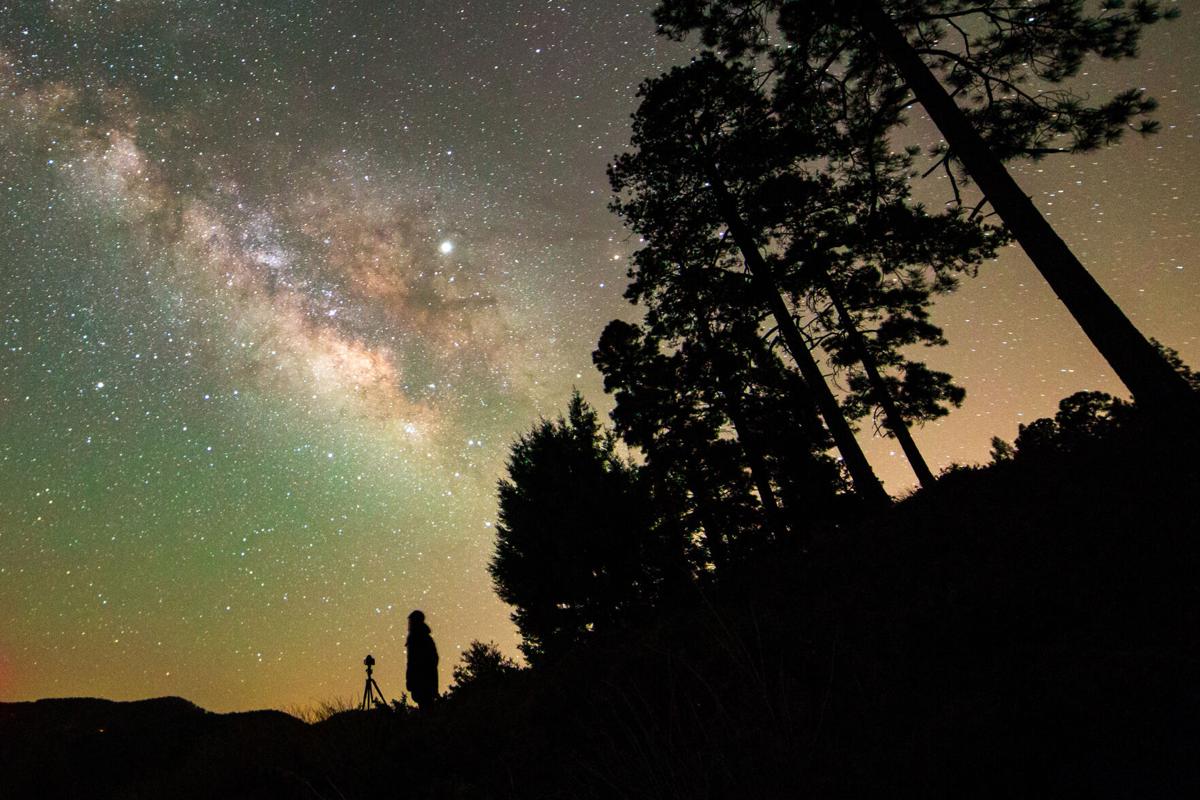
Supporters of DarkSky International encourage people around the world to embrace the dark.
“There are so many things to worry about in our society and light pollution can seem like a bit of a fringe idea when you first think about it, but I have learned that it is connected to everything: It impacts the environment and climate change and has economic and social impact,” said Bettymaya Foott, DarkSky’s director of engagement. DarkSky is headquartered at the Community Foundation for Southern Arizona Campus, 5049 E. Broadway Blvd., Suite 105. The office is also the home of DarkSky Southern Arizona chapter.
A global nonprofit with 66 chapters in 23 countries, DarkSky is dedicated to restoring the nighttime environment and protecting communities and wildlife from the harmful effects of light pollution through outreach, advocacy, and conservation.
Foott said that more than $5 billion is spent annually on lighting across the United States, resulting in 99% of the public being unable to experience a natural night. According to the 2016 “World Atlas of Artificial Night Sky Brightness,” 80% of the world’s population lives under a skyglow that disrupts natural day-night patterns and shifts the balance in the environment.
People are also reading…
This skyglow not only results in increased energy consumption but disrupts the ecosystem for birds, insects and mammals, 69% of which are nocturnal.
“When you add light to the nocturnal environment, it destroys our habitat no less than bulldozing trees in a rainforest. Almost every species studied has been found to be impacted,” Foott said.
The social implications are also vast: lighting affects crime and safety in every community, including those of indigenous people.
“Many indigenous communities rely on the night sky for cultural continuity. If we erase the night sky, we erase a huge part of their cultures around the world,” Foott said.
She emphasized that neighbor- and community-friendly lighting reduces glaring flood lights and utilizes warm, amber tones, resulting in improved visual acuity so it is easier to see pedestrians and people in neighborhoods.
“The dark can be seen as scary, but we want to own that and give darkness a better reputation. Tucson is an example of a community that does this really well,” Foott said.
She cited a 2019 study in which 20,000 local street lights were retrofitted to amber LED lighting with adaptive controls that dim as directed.
“We experienced $2.16 million in annual energy savings and 63% reduction of total illumines emitted by street lights,” Foott said.
Reduced light pollution is also vital to the state astronomy industry, comprised of facilities including observatories at Kitt Peak, Mount Graham, Mt. Lemmon, Mt. Whipple and the University of Arizona Richard F. Caris Mirror Laboratory. Arizona astronomy represents a capital investment of more than $1.3 billion with an economic return of more than $250 million annually, according to Foott.
“We have observatories and research facilities throughout Southern Arizona that are all impacted by light pollution from Tucson and even from Phoenix and the communities along the Interstate-10 corridor. Arizona and Pima County have a financial interest in preserving the night skies for those facilities,” said Zane Landers, an amateur astronomer and board member for DarkSky Southern Arizona.
Landers said that moving forward, DarkSky Southern Arizona hopes to further its mission by building collaborations with the Tucson Audubon Society and other nonprofits. It will also continue to ramp up advocacy with city and county lighting and building ordinances.
“We need to get environmentalist groups, nonprofits and others besides astronomers on board. Our movement is gaining traction and we are on track to greatly reduce light pollution in Southern Arizona and the state at large in the near future,” Landers said.
Supporters hope that local success will translate into national and international improvement in night skies around the globe.
“Seeing the night sky is something that most people never get to do in their entire lives. If our chapter sets an example and gets local governments to step up with compliance and bring more awareness to the issues, that will signal to folks around the country that they can make a difference in preserving the night sky,” Landers said.
Get your morning recap of today's local news and read the full stories here: http://tucne.ws/morning