

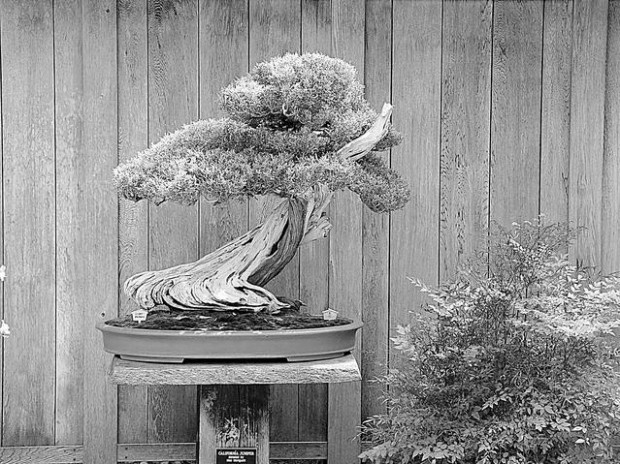
Years ago I used to climb into the High Sierras to drink wine and hunt rare wild bonsai trees.
In the high country, an extreme regimen of wind, snow, drought and impossibly thin soils create nature's original dwarfs that so inspired the Japanese art form. Bonsai master Norio Kobayashi wrote once that these sculptural small trees express the beauty of nature as brought out by all sorts of phenomena imaginable.
Natural bonsai trees are few and far between. Those conifer seeds that managed to become lodged in the clefts of the rock miraculously germinated. Year after year the seedling is pressed down by the snow. The stem, repeatedly bent, broken and healed, bears little resemblance to the straight symmetrical form of its kin. The tips of these tender new shoots die back from cold wind, with roots unable to obtain enough moisture to compensate. So the natural bonsai tree grew gnarled and close to the ground to remain out of the drying breezes.
People are also reading…
Roots packed into a fissure in the rock find scant nutrition, further stunting the tree's development. Growth slows to barely perceptible levels. This explains why a true pot-grown bonsai tree can be supported by such a small root system; it, too, compensates with slowed growth and proportionately smaller features.
Early Japanese gardeners also found stunted sculptural trees along their nation's windswept coastline and on the slopes of Mount Fuji. They saw in those small gnarled specimens the very embodiment of nature and all of its phenomena.
Japanese pruning style for conifers in the landscape began with the same shapes they appreciated in the sculptured natural bonsai. Pruning could lend a more aged and attractive character to younger trees. Seeking the same effects with potted trees became the birth of true bonsai as we know it today.
A gardener once told me about a Japanese nursery where the owner featured really outstanding aged bonsai trees close to a century in age. They were personal treasures and he would not sell the trees to just anyone. He would first interview the customer to determine if he or she was worthy of taking on such a priceless and vulnerable plant. If they didn't pass muster, there was no sale, because even the slightest mishandling of an old specimen can spell its demise. The nursery owner felt a responsibility to preserve and protect the trees.
For a crash course in bonsai, it is worthwhile to hike to the timberline of any American mountain range. There you will find a multitude of examples of trees that have been forced into this most appealing form. This kind of observation will give you a much purer instinct for how to prune your garden and your own bonsai specimens in the true Japanese style.
To get started with bonsai in your home or garden, check out the information-rich site at www.bonsaisite.com online. You can buy a bonsai tree well on its way to maturity or shop at www.bonsaiweb.com for pots, tools and plants.
Keep in mind that books and Web sites are no substitute for the real thing. Visit any of the great public gardens across America that feature truly fabulous old bonsai tree collections. You'll find links to the major public collections at the National Bonsai Foundation Web site (www.bonsai-nbf.org).
For anyone living in the urban environment, the bonsai is more than just a different looking potted plant. Kobayashi tells us it's an experience. "A bonsai hardly a foot in height may conjure up an aged, giant tree now silhouetted against the moonlit sky and now sighing in the wind. Persons of aesthetic sensibilities may even picture to themselves birds singing among the trees or insects chirping in the grass when they look at a bonsai representation of a landscape."
● Maureen Gilmer is a horticulturist.