

Q: What can you tell me about this little stove that has been in the family for many years? I've always been told that it was what salesmen carried to sell the regular size. It is very heavy.
— Barbara, Tucson
A: You have a special treasure. Sometimes referred to as salesman's samples, other times as toy stoves, exact miniatures of cast-iron, wood-burning cook stoves are avidly collected.
Whether it is a salesman's sample or a toy is academic. The fact is that, today, it's all about the mini-cast-iron stoves, not the purpose. In brief, they are hot.
To top it off, the stove is a Majestic, the Cadillac of cast-iron stoves. Made by the Majestic Manufacturing Co. in St. Louis, home versions of the Majestic wood-burning cook stove reached their peak in the 1890s.
Miniature versions found in presentation cases are known salesman's samples. Since so many minis are found without cases, it's thought that companies created working toy replicas that were giveaways with purchase of the big stove.
People are also reading…
The stove seen in photos appears to be complete and in old but good condition. Casting and nickel plate look original. Careful restoration will bring it back to mint. There is a miniature skillet on a burner. If original to the stove, it's a coup. If not, it still is a plus.
We found versions of the same stove sold online for about $1,500. Cowan's (www.cowans.com) sold one at auction for $6,612, and James D. Julia (www.james djulia.com) sold one in 2007 for $6,325. Another in lesser condition, including rust and a crack in the metal, brought $2,013.
Take care of that little stove, and protect it from damage and rust. If you decide to sell, a quality toy auction is best.
Q: Many years ago, I inherited a trunk full of dolls from my grandmother. One, with a paper tag marked Joao Perotti and an address in Sao Paulo, Brazil, has me stumped. All my research on him leads back to Lenci.
— Mindy, Maitland, Fla.
A: First, let's tell readers that the doll is a cloth-bodied, two-headed topsy-turvy. Upend it, and another persona appears. In this case, one figure is Caucasian with blue eyes, and the other is dark-skinned. The dress is Carioca. Faces appear to be composition or vinyl.
Jan Foulke (www.jan foulke.com), a doll specialist known for her best-selling "Blue Books" of doll values, explained to us that info on Perotti falls into the category of lore because there aren't any hard facts.
"Supposedly," she explained, "a Lenci designer migrated to Brazil and opened a company making similar dolls, but not of the same high quality." But, she adds, "I don't know if this is true, or just a likely story."
Smart collectors know that Italian-made Lenci felt dolls of the 1920s and '30s were quality. They now sell for good sums. One can see how the story developed of a similar company in Brazil and now appears as gospel truth on the Web. If Perotti did design for Lenci, you can understand why owners of his Brazilian-made dolls want to believe.
Looking over images sent, Foulke added, "All of the Perotti Brazilian dolls I've seen have looked like cheap copies of Lenci dolls, 1920-30." But "this particular one looks later, from the 1940s."
Unfortunately, Foulke spots "no artistry in the face at all, just a mass-produced mask face." The doll looks, she declared, "more like the American-made Georgene (Averill) Novelty dolls."
Considering the points described, she values the doll at $50 to $75, depending on size.
FYI: The doll "Blue Books" are no longer published. "Jan Foulke's Guide to Dolls" is available on her site.
Q: I found bomber patches in a scrapbook that are smaller than the ones worn on jackets. They appear to be painted on thin canvas. I have 19th Bombardment, 55th fighter, 9th Bombardment and more. Any info?
— Tom, Lima, Ohio
A: Alex Winter of Hake's Americana (www.hakes.com), tells us the 3- to 4-inch patches are Post Cereal premiums, issued in the 1940s. Mint examples now retail for about $10.
3/4 AUCTION ACTION
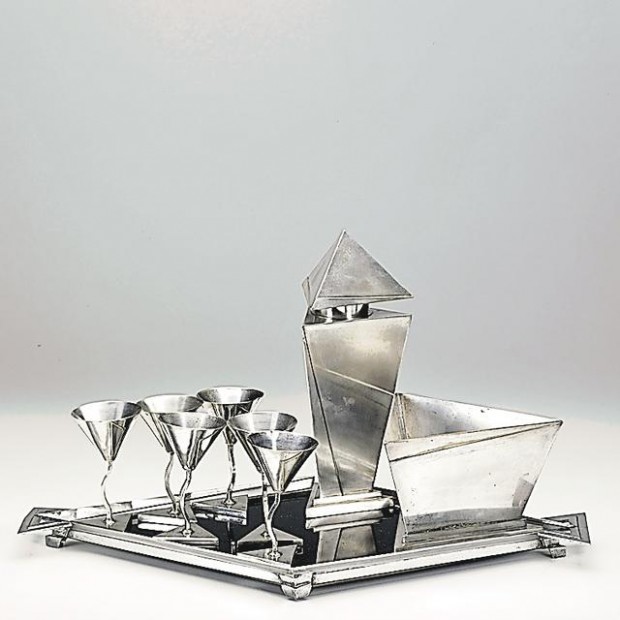
An Art Deco cocktail set designed by Elsa Tennhardt for the E. and J. Bass Co. in New York sold for $31,720 in a recent Sollo Rago Modern sale in New Jersey. The nine-piece, silver-plated brass set included an ice bucket and tray, six glasses and a shaker. Made in 1928, the iconic design is fresh today. A similar example is in the collection of the Brooklyn Museum.