

Q: I have several original magazine covers and advertisements featuring art of J.C. Leyendecker. Most were created for Kuppenheimer and Arrow collar. Value?
A: The reader's originals are period magazine covers and ads. The answer involves several lessons for smart collectors. Read on.
The writer adds, "I know the original paintings of these ads sell for thousands."
That's true: Heritage Auction Galleries in Dallas, www.ha.com, has probably sold the most J.C. Leyendecker (1874-1951) original cover art brought to auction recently. Last October, an oil-on-canvas cover for a December 1948 "American Weekly" cover brought $131,450. According to database www.artfact.com, the same sale saw results of $8,500 and $35,000 for more Leyendecker originals.
Stepping back, it's important to note that the artist fits into the genre of illustration art. Notable illustrators, to name just a few, include Maxfield Parrish; Haddon Sundblom, the creator of Coke's iconic red-cheeked Santa; and N.C. Wyeth, considered America's greatest illustrator.
People are also reading…
Here's a perfect example of how tastes and buying preferences change: As prices for fine art rose, collectors were able to better afford original illustration art. And so, within recent decades, demand and prices have soared. Today, in many cases, certain original illustration art outperforms fine art.
Note how many times the word "original" appeared here. That's because when it comes to serious money in art, only the original counts. That goes double in a recently emerged market such as illustration art.
Prints people, kindly park your soapboxes. This isn't about multiples in prints. It's about the mechanical mass reproduction of original art.
A director for Illustrator Art at Heritage Galleries, Todd Hignite, told us the house does not handle much printed material. Just original artwork. A smart collector can figure out why.
The word from Hignite is, "There is no correlation in value between the two." Lesson 1: In collecting, serious money goes to the real thing. Period.
That said, there are Leyendecker collectors who do look for clipped examples of his work.
Lesson 2: People who buy clipped covers and/or ads collect by category. Some go for memorabilia from old oil companies; others hunt ladies' fashions or old town scenes, perhaps views from certain scenic spots. Still others fancy specific hobbies, vocations or you name it.
Hignite suggests selling the clips on eBay. When we looked, 640 pieces were listed. Completed sales ranged from under $5 to $49.99 for an unused early Amoco calendar. A Saturday Evening Post cover featuring a rower brought $43.89.
See how this fits with Lesson 2? Collectors for those buys were looking for specifics. For sure, there will be fans of Leyendecker's ads featuring The Arrow Collar Man and Kuppenheimer men's clothing. Be sure to stress the niche when you post those clips.
Q: Attached are images of a gold and glass scale. Crystals are heavy, but do not have a ring to them. We're curious on value.
A: Popular decades ago, decorative metal and glass "scales of justice" are now standard at flea markets and resale shops. They're still made, but new versions are imports from the Far East.
Early versions were more ornate and better cast than the new. The reader's scale seems to be vintage, and that's stretching the term. The metal is not gold but brass or alloy plated.
Not all glass rings. The old saw about rating crystal by its ping when tapped is just that. The sound is vibration, and not all glass vibrates. Ping depends on material, size, wall thickness and other variables. Cheap glass can vibrate as well as the expensive stuff.
Similar scales have sold on eBay for $33 and $55. This better example could well bring more.
AUCTION ACTION
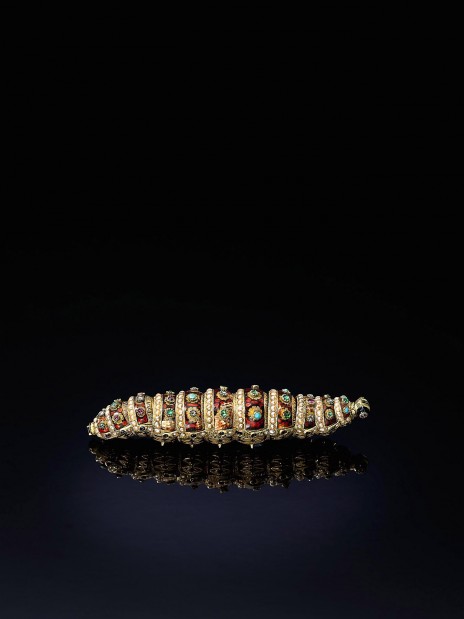
In the world of clocks and watches, automatons, a mechanical way of animating a wide range of objects, are a special subset. In the 19th century, automata including articulated moveable mechanical animals were a rage in the Chinese and Turkish courts. To feed this taste, Swiss watchmakers created astounding moveable novelties.
One, known as "The Ethiopian Caterpillar," sold for $415,215 recently at Sotheby's Geneva. One of only two known to exist, the piece made around 1820 is gold and enamel set with diamonds, pearls, rubies, emeralds and turquoise. Made with 11 jointed ring sections, the caterpillar undulates as he moves. Sold with original red leather fitted box, the piece was probably made for the Chinese market.
COLLECTOR QUIZ
Q: Avon's 1876 Cape Cod ruby-red glass dinnerware is highly collected. When was it made? Bonus points if you can ID the piece currently priced highest.
a: 1978-95
b: 1975-93
c. 1967-83
A: Correct production run is b. Both the 13-inch serving platter (1986) with original box and the two-tier server (1987) with box have book value of $46. Source: "Avon's 1876 Cape Cod Collection Glass Dinnerware: 2nd Ed." by Debbie and Randy Coe (Schiffer, $19.99). Includes dates and item price when issued.
Danielle Arnet welcomes questions from readers. She cannot respond to each one individually, but will answer those of general interest in her column. Send e-mail to smartcollector@comcast.net or write Danielle Arnet, c/o Tribune Media Services, 435 N. Michigan Ave., Suite 1400, Chicago, IL 60611. Please include an address in your query. Photos cannot be returned.