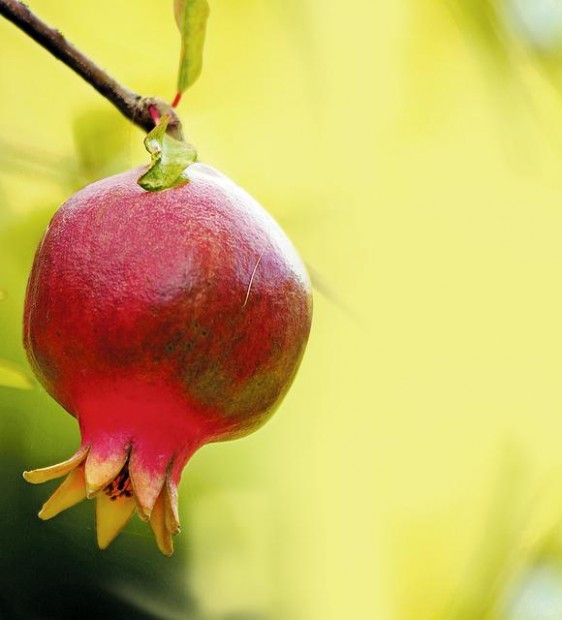
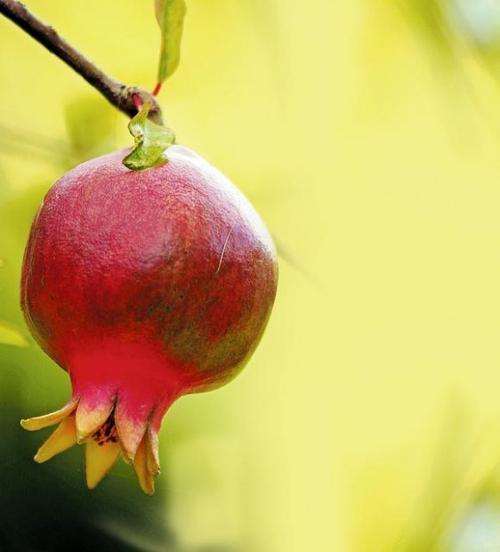
Let's hear it for the pomegranate — a fruit that's high in vitamin C and anti-oxidants.
In fact, it's said that the juice may help prevent heart disease and other chronic disorders.
But for desert gardeners, pomegranates probably are valued even more for their beautiful dark green leaves, showy orange-red flowers and lush deep-red fruit.
Pomegranates (Punica granatum) are well-suited to desert cultivation. Native to southeastern Europe and Asia, pomegranates were grown in ancient Egypt, Babylon, India and Persia (now called Iran).
They were cultivated extensively in Spain, and in the 16th century they were brought by the Spanish missionaries into Mexico, California and Arizona.
The name "pomegranate" comes from the French word "pomme," meaning apple — appropriate because the fruit is deep red and resembles a medium-size apple. The outer skin is hard, but inside the fruit is made up of numerous seeds surrounded by a pink to purplish-red juicy pulp — the edible portion.
People are also reading…
Although the pulp can be eaten fresh, it's somewhat tart to the taste. Not surprisingly, the pomegranate is most popular for its juice.
Pomegranates ripen in the fall.
Normally a dense, bushy, deciduous shrub 6 to 12 feet tall, the plant has slender, somewhat thorny branches. It may be trained as a small tree — it will grow to about 15 feet in height — but it's also attractive espaliered against a wall.
Pomegranates grow well in our alkaline desert soils, and they can withstand scorching heat and temperatures as low as 10 degrees.
Regular watering is important for good fruit development. Water requirements are about the same as for citrus. Water the plants weekly in the summer and every other week in the cooler months.
When trained as a tree, pomegranates have a lot of suckers that grow from the root and crown area. Cut them off, allowing only one trunk to develop, and remove additional suckers from around the main trunk. The goal is to produce a stocky, compact framework.
Light annual pruning of established trees encourages production of good-quality fruit. Dead or damaged wood should be removed in late winter. Suckering growth should be removed as it appears.
Don't fertilize pomegranates when they're first planted. Young trees should receive about 2 pounds of an 8-8-8 or similar analysis fertilizer in November and March.
(An 8-8-8 fertilizer contains 8 percent total nitrogen, 8 percent phosphoric acid and 8 percent water-soluble potash. The nutrients are always listed in this order on the label attached to the fertilizer.)
Mature trees require 5 pounds of a similar analysis fertilizer at the same intervals. Excessive or late applications tend to delay fruit maturity and reduce color and quality.
Pomegranate trees are self-fruitful, meaning they don't require cross-pollination from another pomegranate tree to produce fruit.
Severe fruit drop during the plant's juvenile period (three to five years) is not uncommon. Fruit drop is aggravated by over-fertilization and excess watering — practices favoring leafy growth.
Avoid putting young plants in stressful conditions. Mature trees seem to set and hold fruit better than younger trees, so have patience.
There is a dwarf variety of pomegranate (Punica granatum "Nana") that makes an ideal potted plant. It's available in single or double flowering forms and has dark green, nearly evergreen foliage.
The dwarf produces small pomegranate fruits, but those fruits have thick skin and lack edible pulp.
Gardening
Advice by John P. Begeman
» classes
"November Yard and Garden Activities" will be the topic of this week's garden demonstrations. They will be presented at 1 p.m. Wednesday at the Wilmot Library, 530 N. Wilmot Road, and at 1 p.m. Friday at the Oro Valley Public Library, 1305 W. Naranja Drive.