

Leaves and flowers make a tree beautiful, but while you're admiring them, don't ignore the tree's bark.
Take a look at eucalyptus, crape myrtle, our native Sonoran palo brea and Arizona sycamore. They all have beautiful bark colors and textures that give them unique, year-round interest and appeal.
Eucalyptus trees come in many shapes and sizes.
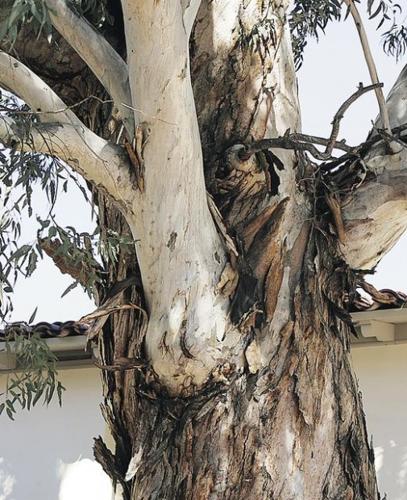
There are huge-growing park-tree varieties such as the red gum tree (E. camaldulensis) and sugar gum (E. cladocalyx) and smaller, more "yard-friendly" varieties such as the narrow-leafed gimlet (E. spathulata), the lemon-flowered gum (E. woodwardii) and the coolibah (E. microtheca).
All eucalyptus have attractive bark— most have a smooth white skin base with a scattered covering of strips of beige and brown peeling bark, while others have shiny smooth salmon-to-cinnamon brown bark.
People are also reading…
Not all varieties of eucalyptus are available at local garden centers. Those that usually are include the coolibah, silver dollar gum and white ironbark (E. leucoxylon).
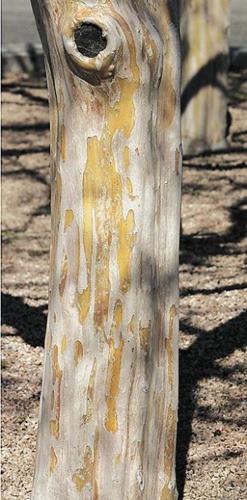
Crape myrtle (Lagerstromia indica), one of my favorites, has one of the most beautiful bark colors and patterns of all ornamental trees. The glossy smooth trunk is patterned in colors of cream, beige and light brown.
It's the bark that provides year-round interest, but crape myrtle stands out most in the winter when the tree is leafless. In late spring, the tree produces large crepe paper-like flower clusters in vivid red, hot pink, pink, lavender, yellow and white — depending on the variety. Heavy flowering continues through the summer, and in the fall leaves turn a bright coppery-red.
Crape myrtle trees grow in a spreading, vase-shape from 12 to 25 feet tall with equal spread. They are well-adapted to heat and full sun. They also enjoy low humidity and dry air and are not subject to powdery mildew here as they are in the Southeast.
In our alkaline soils, crape myrtle can develop yellowing foliage from a lack of iron, but that can be corrected easily with an application or two of chelated iron in the spring. Weekly deep watering in hot weather is required.
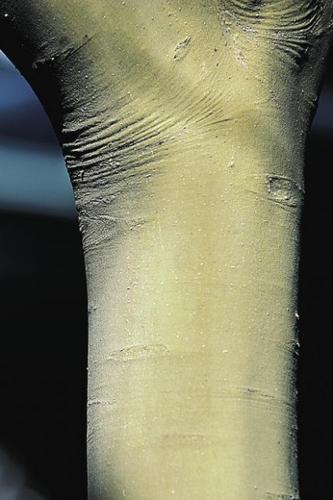
Sonoran palo brea (Cercidium praecox), a close relative of the blue palo verde, has unusual bright lime-green bark with a texture once described to me as "skinlike." I would have to agree with that; it has unblemished skin, to be sure, free of the brown and gray pock-marks typically found on trunks of blue and foothills palo verde. In other aspects, this tree is similar to the blue palo verde in size, form and growth habit. However, the flowers are more golden than yellow.
As with all trees of the genus Cercidium, once established, palo brea requires no supplemental irrigation, save for periods of extended drought. As a leguminous tree, it acquires nitrogen from root nodules in the soil and needs no fertilization. It is truly a trouble-free desert tree.
Although too large and water-needy for most home landscapes, I include Arizona sycamore in this grouping of trees because, in my estimation, it has the most handsome bark of all trees.
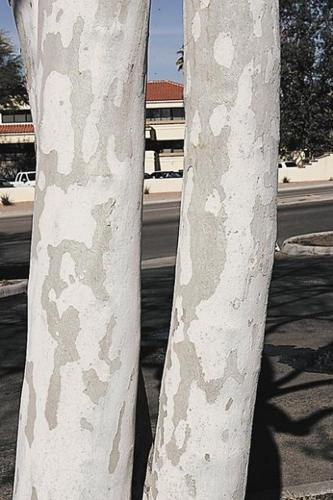
It's hard not to notice the glossy smooth, pure white bark of Arizona sycamore (Platanus wrightii). Some are dappled here and there with gray-white patches adding interest.
But it's the sheer size of its white trunk and structural branches that begs attention.
Enjoy our native sycamores along streams and canyons throughout Southern Arizona.
Photos by Benjie Sanders / Arizona Daily Star
» This week's demonstrations
"Improving Your Drip Irrigation System" will be the topic of this week's gardening demonstrations. Presentations are slated at 1 p.m. Wednesday at the Wilmot Library, 530 N. Wilmot Road, and at 1 p.m. Friday at the Oro Valley Public Library, 1305 W. Naranja Drive.