

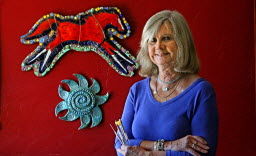
The artwork of Susan Stokes rises from the earth, horses in full gallop, their tails whipping the wind, and owls, wide-eyed and watchful.
The Tucson clay artist finds relaxation in working with this art form that feeds her spirit.
“Clay is of the earth,” Stokes said. “I like adding color and whimsy.”
For desert dwellers, clay art can be a powerful medium, bringing the outdoors in.
“Art should bring joy to your home,” Stokes said. She displays her art on colorful walls, exposing their color and spirit.
Stokes is one of about 15 members of the Southern Arizona Clay Artists who will take part in the nonprofit’s sale of clay art at the Tucson Museum of Art Holiday Artisans Market Friday through Sunday.
She said the artisan market provides an opportunity to purchase clay art — some functional, all fabulous — starting at $10. From pottery on shelves to plaques and wall hangings, pottery provides adornment to homes from subtle to dramatic.
People are also reading…
Stokes, who first worked with clay as a college student studying art education, has spent the last 15 years working on her art full time. She has a studio in the central home she has shared with her husband since they moved to Tucson in 1998. She also has a studio in their summer home in Vermont.
She works in her studio four days a week, and teaches two days a week, including at the Lew Sorensen Community Center on Tucson’s far northeast side.
Her favorite subjects are horses. In some of her personal pieces, she memorializes canine family members who have passed on — including black lab Molly and Dalmatian Hilda.
“Clay is a very relaxing medium,” Stokes said. “You can do so much with it. It’s so versatile.”
While she occasionally takes on clay sculptures, her favorite pieces are wall plaques. She starts with a piece of clay, rolled flat on her clay roller on her back patio. She carves it, adds texture with pieces of cholla, rocks, wooden stamps or other tools and then slumps it so it is no longer flat, adding dimension and interest.
“I can’t seem to leave a piece of clay carved but plain,” Stokes said. “I have to add texture.”
She creates mosaics, as well, with hand-carved tiles.
In her studio — an Arizona room that doubles as a dining area which looks out on the garden and the Santa Catalina Mountains — Stokes creates whimsical art from subjects in nature that she loves, including horses, birds, suns and leaves.
“It’s such a pleasant spot. It’s almost like working outdoors but you can’t work outdoors with clay. It dries too fast,” she said.
She glazes pieces in her studio and fires them in her electric kiln on the back porch, at temperatures of up to 2,200 degrees.
She uses empty oatmeal containers to form her owls and for a raven that sits perched atop a totem in her garden.
For much of her career, Stokes has been self-taught. She enjoys learning from other artists through Southern Arizona Clay Artists and she loves sharing her knowledge with others.
“I hope my art brings joy to people. It brings joy to me,” she said.
Stokes is one of about 200 members of Southern Arizona Clay Artists, or SACA, said Jada Crellin Ahern, a clay artist and president of the board of the organization, which has been a nonprofit since the 1980s.
“Our members range from hobbyists to clay teachers, professional artists to production potters,” Ahern said. “We come from all walks of life and all levels of expertise. Many are nurses, teachers, doctors, social workers, students and retirees.”
She said SACA includes “an amazing group of juried artists” who participate in three shows a year – two at TMA and one at Tohono Chul Park. The group recently concluded a month-long showing of emerging artists at the Pima County Public Library downtown.
SACA holds as many as eight workshops annually, some with nationally and internationally known clay artists that have included Christine Golden, Tip Toland and Bill van Gilder.
“We host them at local teaching studios to teach hands-on clay workshops in sculpture and throwing on the potter’s wheel,” Ahern said.
The organization started a scholarship fund this year, allowing students to participate in workshops. This year’s winners were Michelle Trinh from Amphitheater High School and Alexander Krabbendam from Ironwood Ridge High School.
“They both took the Christine Golden workshop last month and created beautiful and realistic sculptures of children,” Ahern said.
The group also takes part annually in Empty Bowls, creating up to 1,000 bowls sold at three events. Soup is served in the bowls by restaurants, benefiting local food banks, including the Community Food Bank in Tucson.
Ahern said SACA was formed to provide a greater understanding and appreciation of clay to the community and to provide a cooperative network for clay artists — both professionals and enthusiasts — through workshops, shows, lectures, slides and discussion groups.
She said shows like the upcoming TMA Artisans Market provide an opportunity for attendees to bring locally-crafted art into their homes.
“It’s really good to buy local, and you don’t have to be rich to buy clay art,” Ahern said.
What is it that clay artists love about the medium?
“Clay is very universal,” Ahern said. “We start when we are very young, making pinch pots and coil pots in grade school. Everyone has played in the dirt. We play in the dirt and make it permanent when we fire it.”