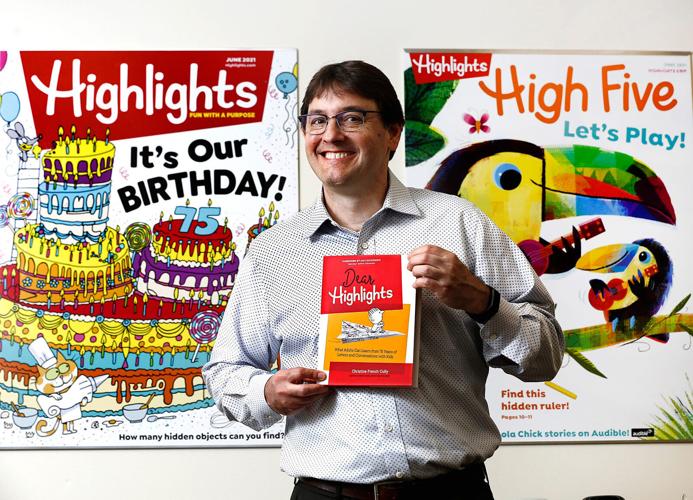
The CEO of Highlights for Children, Kent Johnson, has carried on the mission of his great-grandparents, who started the magazine. Highlights is celebrating its 75th anniversary. (Fred Squillante/Columbus Dispatch/TNS)
COLUMBUS, Ohio – When Cassandra Pritikin's daughters, Kimber and Taylor, were small enough to fit onto her lap, the three of them would read Highlights.
The three would sit under a tree — one child in Cassandra's lap, of course — and comb through the magazine, reading the sections and doing the search and finds. Sometimes, the girls would choose one of Highlight's craft ideas, and there went their afternoon.
These days, Kimber and Taylor are 13 and 17. They're too big to fit in their mother's lap, but never too big for Highlights.
Cassandra, 47, continues to have her father renew the family's subscription to Highlights magazine. And when they can find time, the three of them still sandwich together on the couch to do the famous search and finds.
Magazine remains a favorite of parents, children
People are also reading…
Highlights for Children, the Columbus-based magazine that began in 1946, is celebrating its 75th anniversary this year, and after all this time has managed to remain both relevant and beloved.
Garry Cleveland Myers and Caroline Clark Myers, late in their careers as educators at 59 and 61, wanted to create a magazine for both parents and children.
Kent Johnson, the current CEO of Highlights for Children and great-grandson of the founders, said the Myers had spent much of their careers focusing on what was then a new field of parenting and childhood development, and Highlights became a way for them to spread their knowledge.
Johnson, 52, said Highlights' first print run in 1946 made only 20,000 copies — all of which were sold and delivered door to door. Now, he says, "We don't count as much just magazines, but we count all the sort of interactions of children with Highlights-produced content around the world. Last year was about 10 million kids interacting with our content across 40 countries."
But 75 years ago, the world was much different. There were no tablets, smartphones, YouTube Channels, or even TV shows aimed at children. And yet Highlights has still remained a staple of many people's childhoods, much like Kimber and Taylor.
Johnson said the most important part of adapting has been keeping the goal of the magazine the same.
"I think the essence of Highlight's success has been a combination of holding the mission, and the values, and the insights, around children. Holding that constant, being dedicated to helping children become their best selves," he said. "But also being willing to change all the packaging, being willing to change the modes of marketing, and sales, and distribution to reach ... today's parents and today's kids."

Highlights for Children is celebrating its 75th anniversary. (Fred Squillante/Columbus Dispatch/TNS)
Highlights has magazines aimed at kids from birth to 12 years old. But the company has now expanded to having an interactive website with games, articles, and even jokes. There are also Highlights apps, a podcast and a YouTube Channel.
Dwight Smith, from Springfield, Ohio, who grew up reading Highlights magazine, is now 64 — and still loves it just as much as he did all those years ago. So much so, he was recently asked to be on the board of Highlights Foundation, a separate organization designed to support storytellers.
Smith thought back to a group of friends he had just spent time with: "We started talking about Highlights for Children, and one of the people piped up and said, 'Hidden pictures! Hidden pictures! You look at the magazine you gotta find the pictures!' And all of the sudden, four people in their 60s are having a child-like moment. You never outgrow being a child," he said.
Smith owns copies of old Highlights — one that was even personally gifted to him from Johnson from the month and year Smith was born (June 1958). He has nothing but good things to say about the way Highlights has been able to adapt.
"They've never lost the ability to connect in a deep and meaningful way with children," Smith said. "As children have remained the kind, young, loving souls that they are, the world has gotten very fast, very complex. And as the world has moved around, Highlights has managed to keep its arms around the children and say, 'We love you, let's have some fun.'"
Dealing with serious issues in a way children can understand
Pritikin, who also read Highlights as a child, said the magazine has helped her parent in many ways. "Highlights would call out special moments or a story of being kind or of social justice, but without it being a heavy subject. It would just gently lay the foundation."
She recalled a time when she was unexpectedly able to teach her daughters a lesson about bullying and how to get help, something she found hard to bring up organically.
"Highlights allowed you to be in a safe and comfortable environment to have that discussion because it kind of went along with the story you just read, so it doesn't feel forced," she said.
But there are things that Highlights has helped children deal with that are bigger than bullying: social justice, equity and inclusion.
And though Smith does not have children of his own, he is a big believer that children need a magazine like Highlights to help guide them.
"You think about the George Floyd murder, you think about social unrest, and Black Lives Matter," Smith said, "and I think that parents and people in general expect Highlights, that has such an influence on young people's lives, to speak up."
Smith is also a big supporter of Johnson's mission as CEO of Highlights. "Kent has done a really good job of saying, 'Let me share some wisdom, let me share some encouragement about topics that may not be easy to talk about, but in the best interest of our children, and of our society, I must speak up.' He talks about the importance of loving all children and creating a society that embraces differences and loves everyone," Smith said.

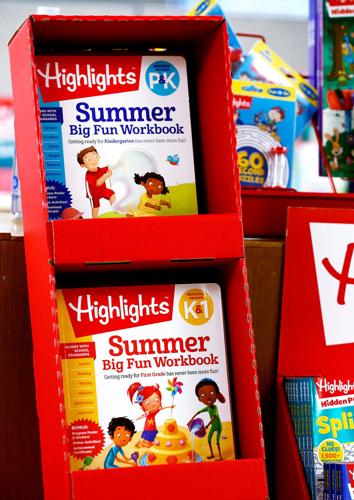
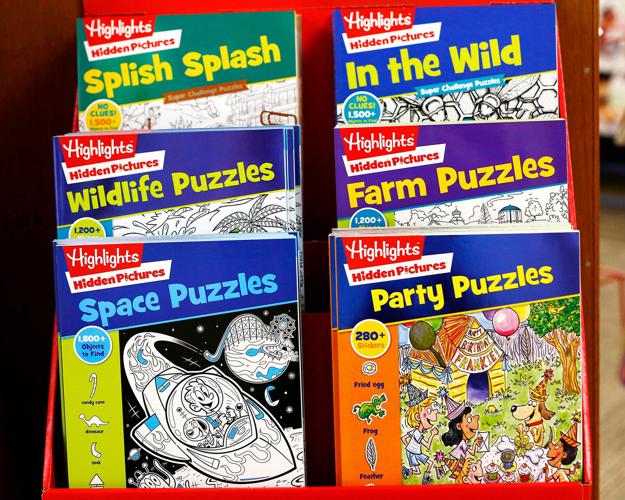
Highlights for Children is celebrating its 75th anniversary. Some of its current products are seen at Highlights headquarters. (Fred Squillante/Columbus Dispatch/TNS)
While the CEO does have a lot of influence, at Highlights, the children have just as much of a voice. Highlights has always given children a platform to ask important questions through the Dear Highlights column.
Dear Highlights is in every issue of the magazine. Children can write to Highlights with any question they might have, and editors will write them back. Highlights writes back to every single child who writes to them, and some letters may even be published in the magazine.
Johnson said the Dear Highlights column has always been an integral part of the magazine. "The reality is, a lot of kids are interested in their relationship with their families, trying to behave well, getting along with their siblings, getting along with their friends at school, those things that are so common across cultures and across children."
The questions can get deeper than friends at school, though. They also can be about tragedy, coronavirus, social and emotional health, mental health issues, and social justice. All things that are hard questions to ask about — and are equally as hard to answer.
According to Johnson, though, the editors at Highlights are experts in child development, and Johnson said if there's ever a question that Highlights can't answer on their own, they have multiple experts on call.
The Dear Highlights columns have been so crucial to the growth and mission of the magazine, that on Tuesday, Highlights will be publishing a book titled "Dear Highlights," that includes a collection of 300 pages of Dear Highlights letters as well as the answers that were sent back.
Johnson said the magazine wanted to do something special for the 75th anniversary, specifically geared towards grownups. This book culminates with examples of questions that children have asked Highlights for the past 75 years. Johnson called it "a cry out for a movement, to say, let's listen more carefully to our children."
Smith was able to get a copy of the book ahead of time. He said he found that a lot of the letters from long ago look very similar to the letters that children are writing today.
"So, I'm reading the book, cover to cover, right? And I would read a letter, and I would read Highlight's response, and I would tear up, and I'd go 'Oh man! That's my heart! It couldn't get any better than that!'" Smith exclaimed, "I'd turn the page, and I'd read the next letter, and the next letter, and what I found out from reading was that they give children an avenue and an opportunity to express themselves."
___
Evolution of play: How toys have changed over time
Evolution of play: How toys have changed over time

Kids love toys and always have. The earliest toys date back to 4000 B.C. and were made of natural materials like sticks, rocks, and stone. Some children even played with animal bones. Throughout the centuries and decades, children’s toys have evolved. Natural materials gave way to plastic. The invention of talking toys, video game consoles, and tablets brought technology to the forefront of the toy industry and forever changed the way children play.
By examining the history of childhood play and development, Lovevery compiled a list of 15 toys, games, and devices to show how children’s play has evolved.
The toys on this list include an iconic puzzle that every ’80s kid tried to solve, an accidental invention from a cleaning compound, and a toy that started out as art therapy and allowed kids to express themselves and get messy. They represent more than 200 years of play and joy. Each toy helps children build or reinforce a necessary childhood skill such as imagination, creativity, fine motor skills, and self-control. Many of these toys still exist today, though in an advanced, updated form.
Join Lovevery as it brings you the evolution of play with a thought-provoking review of toys throughout history.
1817: The kaleidoscope

Invented by Scottish scientist David Brewster, the first kaleidoscopes were made of metal and brass and were all the rage in London, not only with children, but with adults as well. The picture tubes fueled creativity and allowed people to see wondrous works of art by peering into the tube. Besides being mesmerizing, kaleidoscopes can be used to teach children about scientific principles such as the reflection of light.
1899: Martha Chase dolls

Being the wife of a physician and a seamstress helped Martha Jenks Chase in the pursuit of her doll-making venture. Put off by the hard and heavy European dolls, Chase’s dolls were soft and inspired children to truly treat their dolls like babies. She also disliked mechanical American dolls because she felt like the technology hampered children’s imaginations when it came to playing. A 2020 study conducted by Cardiff University neuroscientists and Barbie found evidence to support the fact that playing with dolls stimulates parts of the brain that have to do with feelings of empathy and social information processing.
1915: Raggedy Ann dolls

An artist and illustrator, Johnny Gruelle received a patent for the Raggedy Ann doll in 1915. Gruelle’s daughter Marcella, who may have played a role in the inspiration of the doll, died at 13. While Raggedy Ann was created as a doll, she was first brought to the public’s attention in 1918 in a series of stories written by Gruelle that taught children lessons about kindness.
1923: Radio Flyer wagon

This popular and beloved wagon conjures up images of parents carting their children around their neighborhoods. Many young children used the mobile wagon to help them with their paper routes, creating industrious entrepreneurs. The steel wagons were created by Italian immigrant Antonio Pasin.
1929: Pop-up books

While pop-up books have been around since the 14th century, S. Louis Giraud and Theodore Brown published the first in a series of pop-ups, the “Daily Express Children’s Annual No. 1” in 1929. The books breathed new life into reading by bringing three-dimensionality to young readers everywhere.
1936: Finger paint

Ruth Faison Shaw, an American teacher, developed finger painting as an art education form of child therapy. Her book “Finger Painting, a Perfect Medium for Self-Expression” focused on letting kids be kids even if it was messy. The theory caught on, and finger painting became and remained wildly popular, allowing kids everywhere to express themselves in a creative and fun way.
1949: Legos

First created as a set of red and white blocks that interlocked, Legos were the idea of Ole Kirk Christiansen, a Danish carpenter. Lego, which means “play well,” is taken from the Danish phrase “leg godt.” The plastic toys were not actually patented until 1958. Playing with Legos, or other types of blocks, can help children develop fine motor and spacial skills, and experts also believe block play may serve as a foundation for STEM learning.
1955: Fashion dolls

Modern fashion dolls got their start with the German fashion doll Bild Lilli, which was marketed toward adults. Toy company Mattel acquired rights for the doll, renamed her “Barbie” and began selling her in 1959. Controversy has followed Barbie throughout the years, but overall, the doll encourages imaginative play and is even considered to be a role model by many. In the past several years, the doll’s body dimensions and appearance have shifted to become more inclusive, and Barbies with more diverse backgrounds, interests, and accomplishments have been introduced.
1955: Play-doh

This modeling compound accidentally became a bestselling children’s toy that is still wildly popular. Not only does this soft, malleable clay foster creativity and imagination, but it also helps with fine motor skills and muscle development in the fingers and hands.
1964: Action figures

The G.I. Joe doll was considered the first action figure and marketed by Hasbro to young boys as their version of Barbie. The “real American hero” also inspired a television show, and boys could be found playing right along with their sisters. More action figures would pop up throughout the years and would often be tied to pop culture. G.I. Joe played a major role in eliminating, or at least lessening the stigma people have regarding boys playing with dolls.
1972: Video game console

Atari, a video game console created by Ted Dabney and Nolan Bushnell, and the Magnavox Odyssey, were both introduced in 1972. While video game systems remain popular, they often get a bad rap. Studies have shown, however, that video games actually improve hand-eye coordination and reaction time.
1974: Rubik’s Cube

Though invented by Ernö Rubik in the ’70s, this three-dimensional, color-coded puzzle became iconic in the 1980s. Worldwide cubing competitions still exist, and the puzzle isn’t just for entertainment. It helps develop spatial awareness, as well as with principles of math and science, and is generally a useful tool in STEM education.
1983: Tumbling tower

With the invention of Jenga, a game where players stack and pull blocks from a tower, kids and parents got to play a fun, though often stressful, game. Other building towers have popped up and even made their way into education. They are particularly useful as a sensory tool to improve fine-motor skills and manual dexterity, and can help teach kids about self-control and patience.
2000s: Electronic tablets

The first electronic tablet was actually invented in the 1960s, sort of. Alan Kay and his colleagues at the Xerox Palo Alto Research Centre came up with the idea for the Dynabook in 1968, and it was intended to function as a typewriter, an art tool, and a musical instrument. The Dynabook was never developed, though in the decades since many companies have created advanced versions of the electronic kid’s tablet including Amazon, Apple, and LeapFrog.
Mid-2000s and on: STEM coding toys

With the rise of electronics, especially as educational tools, emphasis has been placed on digital literacy. Children can now learn not only how to use electronic devices, but how to program them as well. These toys can be both basic and advanced, and they help kids focus on developing their science, technology, engineering and math skills.
However, while tablets and other electronic devices offer tools that could be beneficial from a learning standpoint, experts advocate limiting screen time for babies and for young children. The World Health Organization recommends that babies under 18 months are not exposed to screens at all and suggests children under 5 should not have more than an hour a day of screen time, but that less is even better. A 2019 study published in JAMA Pediatrics found that the brains of children who spent more time in front of screens had decreased levels of the white matter that aids in the development of cognitive, language, and literacy skills.
Montessori principles veer away from introducing screens to babies and elementary school-aged children altogether. In today's world, limiting technology altogether can be a challenge for parents, so setting specific restrictions around screen-based activities is recommended.
This story was produced and distributed in partnership with Stacker Studio.