

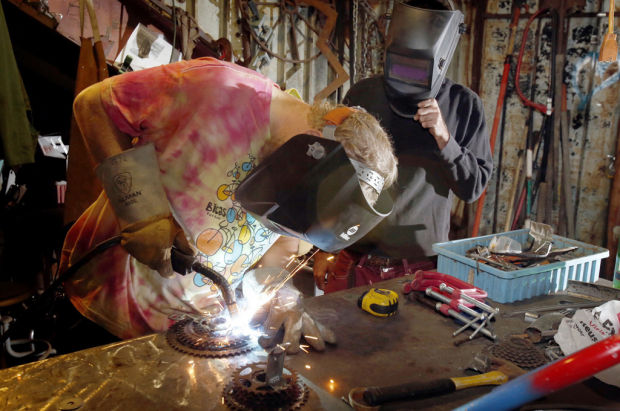
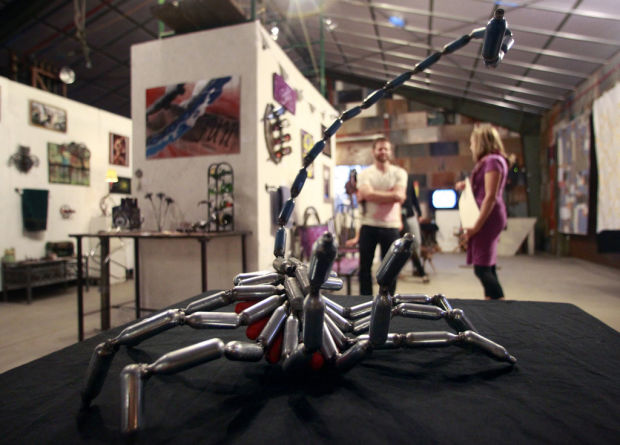
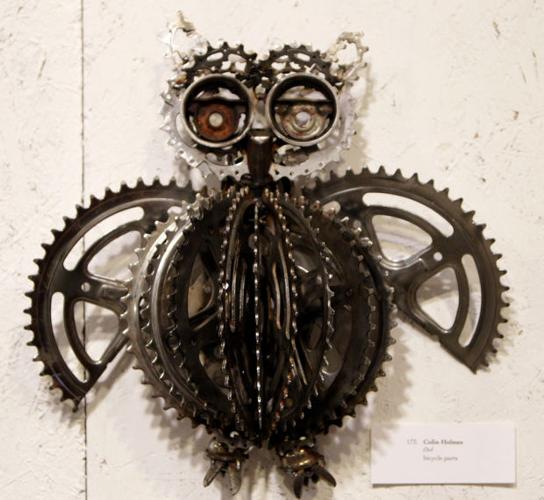
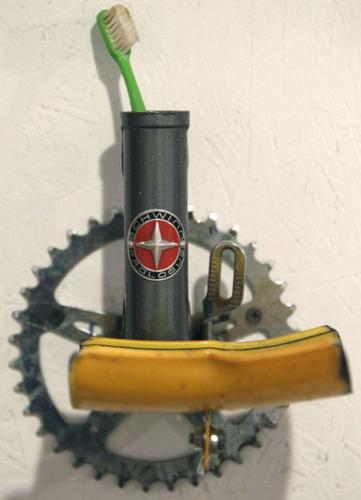
The art at BICAS, the downtown bicycle co-op, is definitely underground.
The nonprofit fills the basement of the old Citizens Transfer and Storage warehouse at 44 W. Sixth St. While most of the space is used to teach people to repair, maintain and even build their own bikes, an impressive amount is set aside for art - making it, showing it, and selling it.
And all of it, whether it's a towering saguaro sculpture made from bike rims or classes on crafting wallets from bike tubes, reflects the nonprofit's commitment to ecological consciousness and do-it-yourself ethics.
One of the country's oldest bicycle co-ops, Bicycle Inter-Community Art and Salvage, more commonly known as BICAS, produces some of Tucson's most creative, socially driven art.
"The organic and personal nature of what they do is really Tucson - that's what Tucson's about," said Michael Keith, CEO of the Downtown Tucson Partnership, who also praised the nonprofit's community involvement.
People are also reading…
"They are one of the most socially motivated organizations in downtown," he said. "Their mission is of the highest order - this whole idea of using their passion for alternative transportation and recycling to engage the community, to teach young kids and to do artwork. What an inspiration they've been."
They also make it fun. For example, BICAS has been the finale of the Downtown Parade of lights for the last few years.
"They end our parade with a wonderful parade of eccentric bikes that are all lit up. They're the ones who bring Santa," Keith said. "That just represents the whole heart and soul of what they do - they are so community oriented."
•••
Originally called Bootstraps to Share when it was founded in 1989 to assist and empower Tucson's homeless population, BICAS by the early '90s had focused on sustainable transportation as a key way for people to be self sufficient.
The nonprofit moved to its current home in the historic warehouse arts district in 1997.
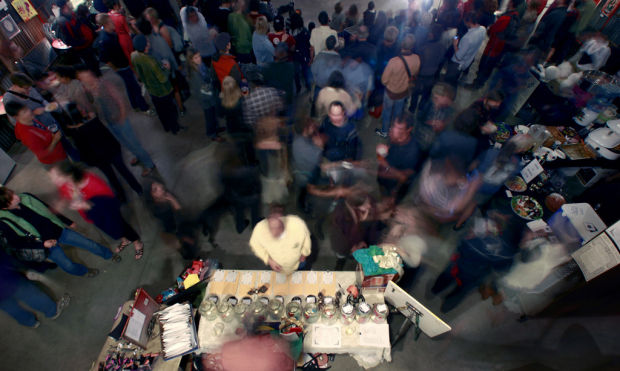
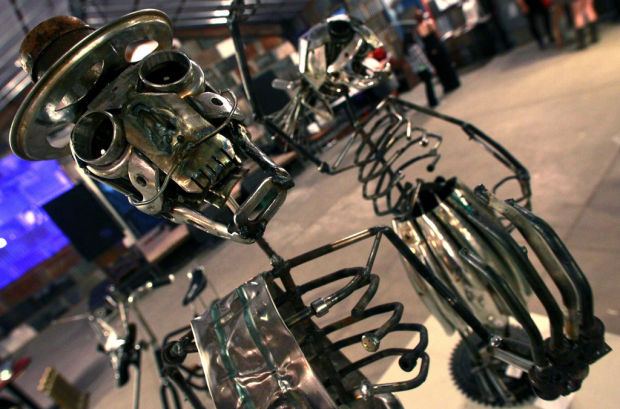
Its art auction, featuring works made from bike parts or inspired by bikes, has grown every year since it launched 17 years ago. The artists use bike parts too damaged to safely use for transportation.
Last month, the auction raised $21,000, nearly double the previous year, and drew 1,000 people to the Whistle Stop Depot over two days - a preview on a Saturday and the silent auction the next evening. There was music and family-friendly entertainment on both nights.
"I'm always incredibly impressed by the quality of the art," said DJ Carl Hanni, who has DJ'd the last three auctions.
And, he added, "everyone is just in such incredibly good spirits. To me, it's one of the most fun annual events in Tucson."
BICAS board member Erik Ryberg said every art auction has been better than the previous one.
"People are also realizing there is something for everyone," he said. "There are plenty of smaller items and jewelry that everyone can afford."
While BICAS has two galleries, the auction is where to see the most art - including a lot of works donated by other local artists.
Artist Erik Bang now lives in Ohio, but made 20 pieces for last month's auction. Bang first came to BICAS in 2009 from Milwaukee, where he'd been active in a similar bike organization.
But before walking into BICAS, he said, he'd never really thought about using bike parts as art. He made a couple of lamps for that year's impending auction, and enjoyed the camaraderie of everyone working to make it a success. "That added deadline kind of pressure really pushes you," he said.
A few years ago gallery owner Eric Firestone turned some heads when he attended, and bought work by BICAS shop coordinator Troy Neiman.
"Every year we see more and more new faces," said Kylie Walzak, BICAS' education and outreach coordinator. "It's become an event."
Neiman used hundreds of wheel spokes for the bristles on his "Javelina," which fetched $1,950 last month.
Despite its popularity, the auction has never been a moneymaker for BICAS, said Ryberg, the board member.
"Really, the big program that keeps BICAS alive is the shop," he said, where people learn to fix bikes, or buy or rent them.
Ryberg said he hopes that some day BICAS art will be appreciated enough to attract projects large enough for the program to become self supporting.
But, he stressed, "we're always going to be doing art whether it makes us money or not."
Neiman and Zach Lihatsh are two BICAS artists who are active in the community. In addition to private commissions for works such as custom-made bike racks, they work as independent artists on public projects.
One is a roundabout at University Drive and Second Avenue, near the Dunbar/Spring community garden.
Another is an installation of bike racks along what will be the bike boulevard on Copper-Flower streets, which is an effort to funnel cyclists off busier routes such as Grant Road.
Lihatsh, 33, who has a sustainable development and design degree from Prescott College, arrived at BICAS about six years ago.
He's also a blacksmith and has his own shop where he makes cleavers and other items from recycled and re-purposed materials. He sells some at MAST, at 299 S. Park Ave. in the Lost Barrio, and his work has also been highlighted in Martha Stewart Living magazine.
•••
For the past three years BICAS arts programs have been organized by Casey Wollschlaeger. The 33-year-old oversees everything from requests to commission artists to applying for arts grants. Community outreach projects include bringing art projects into schools. She also runs the nonprofit's two galleries and is developing an art workshop area that already holds thousands of pieces of scrap metal, fabric and other recycled items along with sewing machines and tools for projects.
Underground art is more than a play on words at the basement-dwelling nonprofit.
Much like the bike co-ops that emerged as a counterculture way to address social issues like homelessness, underground artists breach the boundaries of traditional fine art, she said.
There is a palpable feeling of creative energy and dedication to self sufficiency, sustainability and empowerment at BICAS, where artists form close bonds.
"Having those things in common makes it a little easier to be on the same page," she said.
"It's also our social circle. When I moved here these folks were my first friend base," said Wollschlaeger, who had already earned a bachelor of fine arts degree in photography at Minnesota State University Moorehead and started a bicycle collective with some friends in Fargo N.D., before she moved to Tucson to work as a bike mechanic.
Artist Angie Terry, 34, now lives in Portland, Ore., but remains committed to the success of BICAS. "We are all very closely connected," she said.
•••
BICAS takes part in the Tucson Artists' Open Studios tour each fall and spring.
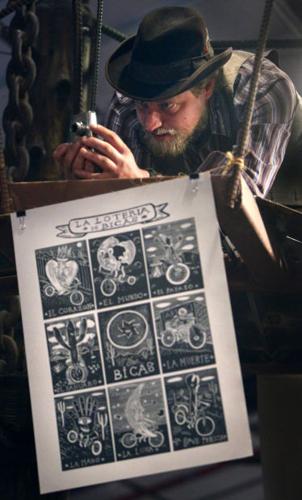
Its Community Art Studio is open daily during bike shop hours and always includes a wide selection of items - from bottle openers to limited-edition prints, clocks, jewelry and more. Everything makes a great gift for bicycle enthusiasts, she said. It's also art to feel good about because it helps a nonprofit and supports recycling. "You're covering multiple bases," she said.
BICAS opened its Art Annex Studio and Gallery on the ground level in 2011, which has put Wollschlaeger in more contact with the Citizens Artist Collective, made up of other artists that share the Citizens Warehouse.
Between BICAS' two galleries, works range from a few dollars up to several hundred.
BICAS also takes part in the annual holiday markets at the Mercado San Agustín off west Congress Street.
BICAS' Tuesday evening art workshops continue to build a following with a range of projects that don't always involve bike parts.
Knitterific , for example, on Jan. 8, was for people of all levels of knitting ability - including absolute beginners. Last Tuesday, 10 people showed up to sew fanny packs and handlebar bags.
The next workshop will be making wallets from bike tubes. On tap for Jan. 29 is a much-requested workshop to make alcohol stoves - which are great for boiling water while on a bike tour.
BICAS asks that participants donate what they can afford for most workshops. Last month's clock-making session cost about $30 because of specialty parts.
BICAS brings its arts education to schools, libraries and nonprofits. Wollschlaeger has done workshops with the Children's Museum Tucson as well as a community arts education and culture class at the University of Arizona.
In 2011, BICAS secured grant funding through the Tucson Pima Arts Council, supported by the Kresge Foundation, for a project called "Bridging Generations" that brought together students and seniors in the Armory Park Neighborhood through storytelling, photography and street art.
"We're always looking for more ways to reach out into the community," she said.
BICAS staff also works with other bike cooperatives on ways to to incorporate art into programs.
For example, Wollschlaeger traveled to Oaxaca, Mexico for an urban cycling congress where she talked about using discarded materials for art to make money for support programming.
"That's what makes BICAS so unique, our art program has been pretty well established," she said.
Last summer she traveled to Vancouver, British Columbia to lead a workshop on making bike journals out of bike tubes .
"BICAS is such a success story for Tucson," said Leia Maahs, a longtime arts advocate who lives in the Dunbar Spring neighborhood. "It's a very authentic program and their mission really puts their community and their participants first in all of their programming."
She also sees the nonprofit as a cultural anchor to the neighborhood.
Its location in the historical warehouse district puts it near a lot of development, not the least of which is the next phase of Downtown Links, connecting the Barraza-Aviation Parkway to Interstate 10 as a downtown bypass route.
The impact on the Citizens Warehouse remains unclear.
"We're very anxious about what the future holds for us," said Ryberg. The warehouse had been ideal because it affords BICAS a lot of space, and is easily accessible to the people it serves.
"They are as much identified with downtown as any organization in the urban center," said Keith of the Downtown Tucson Partnership.
"It would be a great loss if they weren't part of he day-to-day activities down here."
If you go
BICAS (Bicycle Inter-Community Art and Salvage)
44 W. Sixth St. (turn north at Ash Avenue), 628-7950, www.bicas.org www.facebook.com/ undergroundart , art@bicas.org
• Shop hours: 11 a.m.-6 p.m. Tuesday through Sunday. Also, 4-8 p.m. Monday for women and transgender people.
Community Art Studio: 11 a.m.- 6 p.m. Tuesday through Sunday.
Located within BICAS, the studio is free and open to the public during bike shop hours. People can use the space, along with donated art supplies, tools, sewing machines and recycles bike parts for personal projects as well as craft nights, meetings or other events.
Crafter Hours Art Workshops: 5-8 p.m. Tuesdays
BICAS hosts weekly recycled art workshops that encourage imagination, inventiveness, sustainability and creative problem solving using salvaged and re-purposed materials. Ongoing art projects include handmade books, jewelry, paper crafts, multi-media art, printmaking and metal sculpture. The workshops are updated monthly on BICAS' online calendar.
Next up on Tuesday: Vegan wallets, made of bike tubes, for people "who have too many flat tires and not enough places to keep all of your money" - stylish and environmentally friendly.
Art Annex Studio and Gallery: Noon-5 p.m. Saturday
Established in 2011 and located on the first floor of the Citizens Warehouse, the annex is a working studio and exhibition space that showcases BICAS' long tradition of bicycle related art. The annex increases exposure of local artists and artists of the collective by showing and selling donated and commissioned works of art. Works on display are made from recycled bike materials or with themes involving cycling culture.
Re-cycling and Donation Center: Same as shop hours.
The arts program gives new life to salvaged and donated bicycle parts that can no longer be used for riding by making them available for community arts projects. BICAS strives to facilitate recycling and re-purposing by participating in a local system of material reuse and redistribution within the community. BICAS accepts, shares and repurposes donations of bicycle parts, art supplies, tools, books and materials .
BICAS by the numbers
15
the number of collective members who work part time, with four others on call.
1,000+
number of work-trade volunteers, including more than 200 youth, last year.
5,730
number of customers BICAS welcomed in 2011.
Volunteer
There are many ways to contribute at BICAS, from sorting parts and organizing to helping with building repairs, maintaining the courtyard and working in the office. Volunteer orientations held the last Wednesday of the month.
Wish list
BICAS is a 501 (c)(3) nonprofit organization, which means donations of property, such as bikes, are tax deductible.
Always needed: Tools, bike parts, office supplies, cleaning supplies, shelving organizers.
Art needs: Tools such as dremmel and soldering kits, welding supplies, button maker, laminating machine, paintbrushes, scissors, rulers and straight edges. Supplies including paints and brushes, markers, all types of paper and cardstock, fabric, adhesives, stamp kits and ink, jewelry making supplies, thread, needles, hanging wire, glass, cameras and related equipment including old pinholes, and postage stamps. The art library also needs sewing, embroidery, cross stitch patterns and books, patterns for cycling caps, panniers and messenger bags, children's activity and coloring books, fine art, craft, and cottage industry books, old issues of magazines with do-it-yourself projects and cycling books (especially vintage) and encyclopedias.
And artists who can teach workshops.
Source: BICAS