

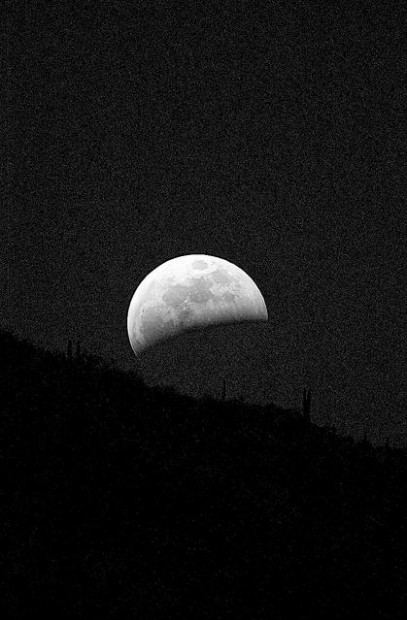
Mark your calendars for about 6 p.m. next Wednesday to catch the last total eclipse of the moon until Dec. 20, 2010.
It's also the most convenient one until 2015 — the others take place after midnight.
Here's the play by play:
6:05 p.m. — In Southern Arizona, the eclipse is under way as the moon starts to rise. The total lunar eclipses always occur at full moon when the moon is behind the Earth from the sun, and the Earth's long shadow is cast upon the moon. During the penumbral phase of a lunar eclipse, the moon enters a region of partial shadowing and is somewhat darkened. The moon rises while it is in the penumbral phase.
6:43 p.m. — The moon enters the Earth's umbra (the darkest part of the Earth's shadow). From this point on, the moon get progressively darker as it moves deeper into the umbra.
People are also reading…
8 p.m. — The moon becomes fully eclipsed.
8:25 p.m. — Mid-eclipse. Theoretically, the moon should disappear from sight during totality, because it is completely buried in the Earth's shadow — but that rarely happens. Instead, the moon becomes a gorgeous copper color due to sunlight being scattered by the Earth's atmosphere and somewhat focused on the moon. Blue light is scattered more than red light, giving us a red or copper-red moon.
8:50 p.m. — The moon starts to leave totality.
10:07 p.m. — It leaves the umbral shadow.
11:13 p.m. — The moon fully leaves the Earth's penumbral shadow.
Tim Hunter has been an amateur astronomer since grade school. Contact him at skyspy@azstarnet.com.
Flandrau Science Center and the Tucson Amateur Astronomy Association offer a special talk on the eclipse along with free public viewing of the eclipsed moon, Saturn and other celestial objects on the University of Arizona mall. Tom Fleming, a UA Steward Observatory astronomer and senior lecturer, will talk about eclipses.
• When: 6 p.m. Wednesday.
• Where: On the UA campus on the northeast corner of Cherry Avenue and University Boulevard.
• Cost: $5.
• More info: www.gotUAscience center.org or 621-STAR (7827).