

School's out and, of course, that means the science fair is over. Does that mean you can't dabble with fun science projects? Now is the perfect time to do a bit of tinkering, try a few experiments and find out what you are really interested in.
There are a lot of great summer programs you might participate in to learn more about science. Spaces may still be available, and there are scholarships you can apply for, too. The Flandrau Science Center offers SummerFUSION science camps for students ages 4 to 15 and family programs, also. The Arizona Youth University offers great hands-on middle and high school programs, including robotics, optics, astronomy, forensics and computer science.
Other ideas for cool summer projects you can do yourself might be found at the library. There are lots of books with ideas for you to try, no matter whether you are in the first or 10th grade. A great resource is always the Internet, especially the regional science fair Web site, www.sarsef.org. You will find links to interesting sites just to browse through, or experiments to try out yourself.
People are also reading…
You also might want to try your hand at a bit of exploration by taking apart a broken radio, TV, computer or other machine. If you don't find something broken around your house, you can probably find a tinkering project at a neighborhood yard sale for a few dollars.
You might even find that your parent or neighbor would like to work with you on this. Working with a mentor usually means you'll learn more than you would working alone. Many engineers and scientists have found their love for technology by taking apart broken machines and seeing if they can figure out how to put them back together.
Kits like David Eckold's "The Ultimate Robot Kit" (DK Children, $29.99) are great for trying something new. Projects like these help you follow the scientific method when you're doing them. That's always a good tool to practice. Once you've tried the experiment the way it was intended, change one of the variables and repeat the test to see how it comes out your way. Keep notes and draw sketches in a journal as you do the experiments to see what you've learned.
Trying your hand at different science topics during the summer will give you the opportunity to find out what you are most interested in. Next school year, Arizona schools will be focusing on new science standards. There will be new tests for science. Science fair projects will be a great way to apply the science, math and English standards. But you will need to choose what to do your project on. Summertime fun projects will help you find the project question that is right for you.
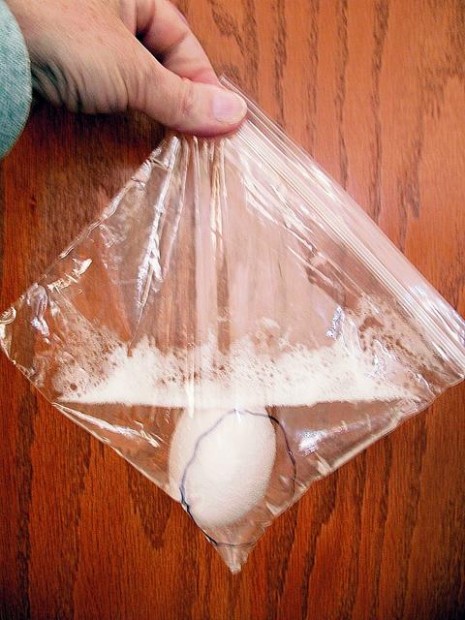
The "eggsperiment"
Question: Can you remove the shell from an egg without breaking it?
Hypothesis: Of course, you can.
Purpose: To see what might be inside the shell other than the yolk and white of the egg and to test what you can do with it.
Begin by putting an egg in a zip-type sandwich bag with enough vinegar to cover the egg. Zip the bag closed. Set it in a cup for 2 days.
Rinse off the egg over a bowl of cool water. Put the egg in another zip-type bag with enough clear corn syrup to cover the egg. Zip the bag closed. Draw around the egg with a permanent marker. Set in a cup for 1 day.
Look at the egg and the circle you drew. Are they different? Why?
Rinse the egg in a bowl of cool water, again. Put it in another zip-type sandwich bag covering the egg with your favorite beverage. Anything, except milk or water, works well. Zip the bag closed. Draw around the egg with a marker. Set in a cup for up to a day.
Look at the egg and the circle you drew. Are they different? Why?
Pour out any unabsorbed liquid. Zip the bag closed. Gently squeeze the egg until it pops. Observe the liquid, the egg yolk and the color of the egg membrane on the inside and outside.
Was the "eggsperiment" fun? Did you have to use more than one egg? Did you see the eggshell dissolve? Did your egg shrink with the syrup and swell in your favorite drink? How did you measure it? Did the membrane have a different color on the inside after you popped it? Why?
All these and many more questions can come up when doing this experiment. Keep a journal, follow the scientific method and you'll be able to pursue answers to your questions.
The experiment is an extension on an idea in the book "Science in a Bag," by Sandra Markle (Scholastic, $1.99).